My son removed me from the family group chat because,
My son removed me from the family group chat because, as he put it,
“Mom, it was for working adults.” I said nothing. I
went back to feeding the chickens, checking the fence line, and writing in the little farm notebook they all loved to mock.
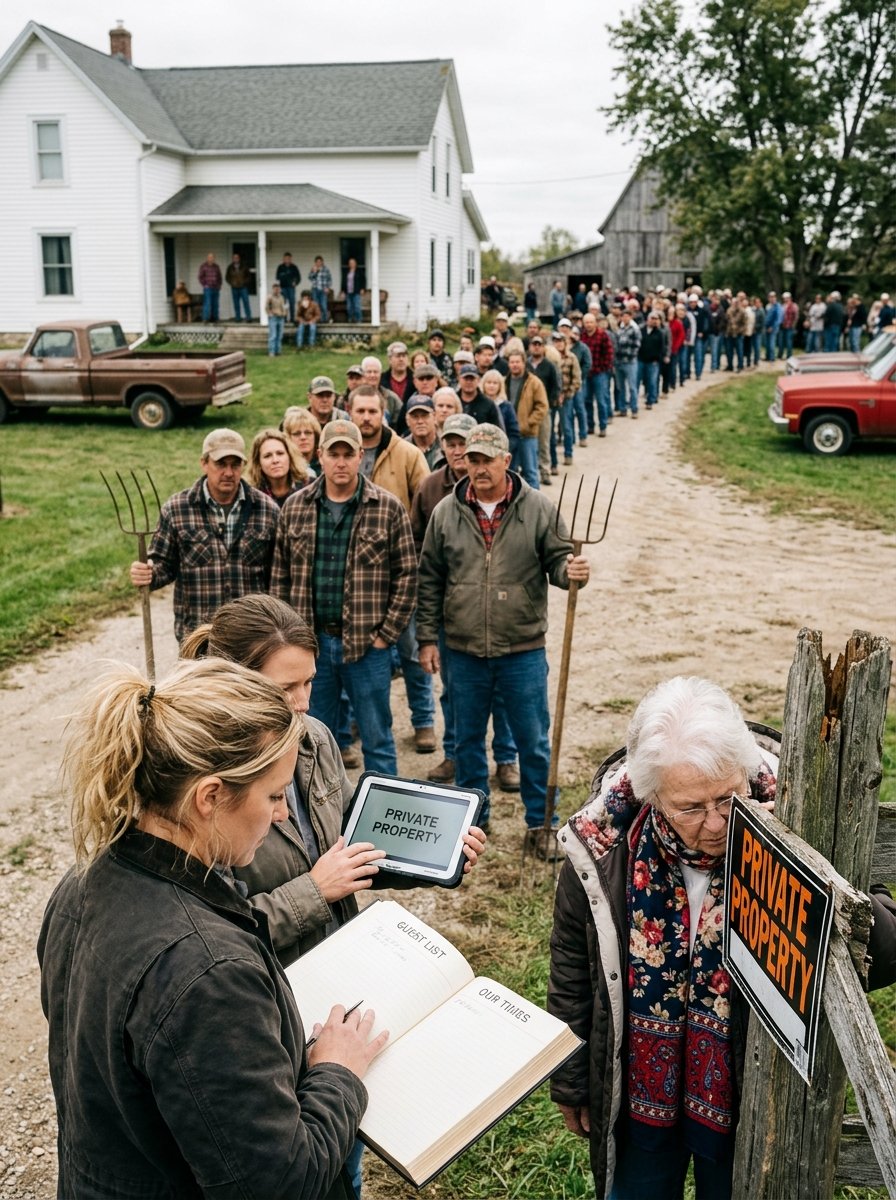
One week later, twelve of them arrived with suitcases, meat, coolers, and weekend plans, certain I would leave the key under the flowerpot again. But this time, the gate was locked.
My name is Ruth, and for most of my adult life, my family treated my farm like a place that opened whenever they needed it.
Not a home.
Not my work.
Just the family farm.
To me, it was the place my late husband and I had built one difficult season at a time.
A white porch swing.
A gravel driveway.
A red barn.
A kitchen window overlooking the pasture.
It was peaceful.
It was hard work.
And it was mine.
But every summer, holiday, or long weekend, my phone would start buzzing.
“Mom, can we come out?”
“Do you still have the big cooler?”
“Can you make potato salad?”
“Leave the key under the flowerpot.”
And for years, I did exactly that.
I washed sheets.
Filled the refrigerator.
Cooked breakfast.
Mopped muddy floors.
Picked up garbage after everyone drove away.
They called the farm “our little escape.”
I was the one left cleaning up after their escape was over.
Then my son Daniel removed me from the family group chat.
I only found out because my niece casually mentioned their Labor Day plans, and I realized I hadn’t heard a single thing about them.
I checked my phone.
The chat was gone.
So I called Daniel.
“Did you remove me?”
He paused.
“Mom, it was for working adults. You don’t understand what we talk about.”
I stood silently in my kitchen.
Working adults.
I thought about the tractor payment.
The leaking roof.
Feed bills.
County paperwork.
The decades I had spent keeping that farm alive while raising the son who apparently thought I no longer understood work.
“I see,” I said.
“Don’t make it dramatic, Mom. It’s just easier this way.”
Easier.
That had always been their favorite word.
Easier when I hosted.
Easier when I cooked.
Easier when I stayed quiet.
Easier when I left the key outside.
Easier when I never complained.
So this time, I did something different.
I didn’t argue.
I opened the kitchen drawer and pulled out my old black notebook.
They loved making fun of that notebook.
“Mom and her little farm diary.”
“Writing down chicken gossip again?”
“Careful, she’s probably documenting the potato salad.”
I always let them laugh.
Because I wrote everything down.
Who borrowed tools and never returned them.
Who promised to help with repairs and forgot.
Who left garbage behind.
Who invited extra guests without asking.
Who used my freezer, propane, pantry, bedrooms, equipment, and time.
Dates.
Names.
Promises.
Not because I wanted to embarrass anyone.
But because when people depend on your kindness long enough, they eventually start confusing kindness with permission.
The following Friday evening, headlights appeared at the end of the gravel driveway.
One truck.
Then another.
Two SUVs.
Twelve people climbed out carrying suitcases, coolers, groceries, folding chairs, and enough food for an entire weekend.
Daniel walked straight toward the flowerpot.
He lifted it.
Nothing.
He frowned.
Then he noticed the chain stretched across the gate.
Locked.
His wife looked confused.
The kids started asking why they couldn’t go inside.
Someone laughed.
“Maybe she moved the key.”
Daniel pulled out his phone and called me.
I answered from the porch.
“Mom, the gate’s locked.”
“I know.”
“We’re here.”
“I can see that.”
There was a pause.
“Can you open it?”
I looked at twelve people standing outside my property with everything they needed for a weekend they had planned without asking me.
“No.”
Behind him, my sister whispered:
“Is she serious?”
Daniel’s voice tightened.
“Mom, don’t do this in front of everybody.”
For half a second, I almost softened.
Then I remembered the group chat.
The way he had said “working adults.”
The confidence that I would still be useful even after they decided I wasn’t important enough to include.
“There’s a sign,” I said.
They all turned toward the fence.
A white board had been mounted beside the gate.
It read:
Welcome to Ruth’s Farm.
Private property.
No entry without invitation.
No overnight stays without written agreement.
No shared meals, equipment, rooms, or storage unless arranged in advance.
For questions, see the notebook.
Below the sign sat my old black notebook inside a clear plastic box.
Nobody laughed this time.
Daniel stared at it.
“Mom, what is this?”
I stood on the porch with one hand resting on the railing my husband had built thirty years earlier.
“It’s for working adults,” I said.
Daniel’s face changed.
Then someone behind him opened the notebook.
A few pages turned.
Then another.
And suddenly the entire driveway went silent.
Because for the first time, my family could see exactly how much their “little escape” had actually cost me over the years.
A page lifted in the evening breeze and slapped softly against the plastic cover.
My sister, Ellen, held the notebook with both hands.
She had stopped halfway down one page.
Her mouth was slightly open.
Daniel stepped toward her.
“Give me that.”
Ellen didn’t.
She read aloud instead.
“Memorial Day, three years ago. Fourteen guests. Two extra families not mentioned. Propane tank nearly emptied. Screen door torn. Daniel said he would replace it Saturday.”
She looked up.
The old screen door was still hanging crooked on the side entrance.
Nobody moved.
Ellen turned another page.
“July Fourth. Upstairs toilet blocked with wipes. Plumber, two hundred eighty dollars. Ruth paid. Daniel said he’d split the bill.”
My daughter-in-law, Melissa, slowly lowered the grocery bag in her hand.
Daniel’s jaw tightened.
“Okay. We get it.”
Ellen kept reading.
“Labor Day. Deep freezer left open overnight. Two hundred and fourteen dollars in meat spoiled.”
“That was an accident,” Daniel snapped.
I could hear him from the porch without the phone now.
The evening had gone still enough to carry every word.
Beyond the barn, one of the cows rubbed its neck against a fence post.
A cicada buzzed from the maple tree.
Ellen turned another page.
“Christmas weekend. Ruth cooked breakfast for eleven. Lunch for fourteen. Dinner for thirteen. Daniel told everyone she liked having something to do.”
That one landed differently.
Melissa looked at my son.
Daniel looked at the gravel.
I remembered that morning.
I had been standing at the sink at six-thirty, hands aching from peeling potatoes the night before, while everyone else slept.
Daniel had wandered in wearing pajama pants and poured himself coffee.
“You don’t mind, right, Mom?” he had said.
I had smiled.
“Of course not.”
The lie had come automatically.
That was the part nobody understood.
They thought silence meant I was happy.
They never considered that silence might simply mean I had gotten very good at swallowing words.
Daniel raised his voice.
“This is ridiculous. You’ve been keeping some kind of scorecard against your own family?”
“No,” I said.
He looked toward me.
“I’ve been keeping records about my farm.”
“That’s the same thing.”
“No, Daniel.”
I came down the porch steps.
Slowly.
My knees weren’t what they used to be, and the gravel shifted beneath my boots, but I didn’t rush.
There was no reason to.
For once, everyone else was waiting on me.
I stopped about twenty feet inside the locked gate.
“That’s exactly the problem,” I said. “You think you and this farm are the same thing.”
His face flushed.
“I never said that.”
“You never had to.”
Behind him, one of the children tugged Melissa’s sleeve.
“Mom, are we going home?”
Melissa bent down and whispered something I couldn’t hear.
The boy nodded, disappointed but calm.
That tiny reaction hurt me more than Daniel’s anger.
The children had done nothing wrong.
They had been taught the same thing the adults believed.
Grandma’s farm was always open.
Grandma always had food.
Grandma always said yes.
Daniel spread his hands.
“Look, can we stop performing for five minutes? Open the gate. We’ll talk inside.”
“No.”
His eyes narrowed.
“Mom.”
“No.”
“You’re really making twelve people turn around because your feelings got hurt over a group chat?”
Ellen shut the notebook.
The sound was soft.
But everyone heard it.
“Daniel,” she said.
He swung toward her.
“Don’t.”
She stared at him.
“What?”
“Don’t start taking sides.”
Ellen’s eyebrows lifted.
“Taking sides?”
“Yes.”
“I’m reading her handwriting.”
Daniel rubbed a hand across his mouth.
“This whole thing is manipulative.”
That was when my niece, Hannah, who had been standing beside the second SUV with her arms folded, said something that changed the entire evening.
“Is this really about the chat?”
Daniel froze.
I looked at her.
Hannah was twenty-six, quiet, thoughtful, the sort of girl who watched rooms more carefully than people realized.
She met my eyes.
Then she looked at Daniel.
He said her name once.
A warning.
“Hannah.”
She took her phone from her pocket.
My stomach tightened.
“Because if we’re finally telling Aunt Ruth the truth,” she said, “we should tell all of it.”
Nobody breathed for a second.
Daniel walked toward her.
“Put your phone away.”
Hannah stepped backward.
“No.”
“Hannah.”
“I said no.”
Melissa straightened.
“What truth?”
Daniel looked at his wife.
“Nothing.”
Hannah gave a strange little laugh.
Not amused.
Nervous.
Almost disbelieving.
“You told us she knew.”
Melissa’s face changed.
“Knew what?”
Daniel’s shoulders went rigid.
I could feel something moving through the group then.
Not yet understanding.
Just recognition that there was another floor beneath the one we were standing on.
Hannah unlocked her phone.
“The group chat wasn’t just for working adults.”
I looked at Daniel.
He wouldn’t look back.
Hannah swallowed.
“It was called Farm Future.”
I heard Ellen inhale.
The wind moved through the cornfield beyond the pasture.
Dry leaves whispered against one another.
Hannah continued.
“Daniel made it in June.”
I felt my fingers curl around the gate chain.
“For what?”
Daniel spoke before she could answer.
“Mom, don’t listen to half a conversation.”
Hannah raised the phone.
“He wanted everyone to talk about what would happen to the farm when you couldn’t manage it anymore.”
There are sentences that hurt because they are cruel.
There are others that hurt because they expose something you already suspected.
That one did both.
I looked at my son.
“When I couldn’t manage it anymore.”
He exhaled sharply.
“You’re seventy-one, Mom.”
“Yes.”
“You do everything alone.”
“Yes.”
“That’s exactly my point.”
I waited.
Daniel glanced at everyone behind him, perhaps expecting support.
None came.
He tried again.
“We have to be realistic.”
“About what?”
“The future.”
“Mine?”
“The farm’s.”
I almost smiled.
He still couldn’t hear himself.
Hannah’s thumb moved across the phone.
“There’s more.”
Daniel lunged.
Not violently.
But fast enough that Hannah jerked the phone against her chest.
Melissa stepped between them.
“Daniel.”
He stopped.
Her voice had changed.
I had heard Melissa irritated before.
I had heard her tired, impatient, laughing, embarrassed.
I had never heard her sound afraid of what her husband might say next.
“What is on that phone?”
Daniel looked at her for several seconds.
Then he said, “We were discussing options.”
Hannah answered.
“He contacted a land appraiser.”
The driveway became completely silent.
Even the children stopped whispering.
My hand slipped from the chain.
I heard the metal clink against the gate.
“What?”
Hannah looked at me.
“He said this weekend was partly about getting everyone together so you wouldn’t feel cornered.”
My throat went dry.
“Cornered into what?”
Daniel shouted then.
“She’s making it sound worse than it is.”
“Then you explain it,” Ellen said.
He turned on her.
“Fine.”
He looked at me.
His chest rose and fell.
“We were going to talk about putting the property into a family LLC.”
I stared at him.
He rushed on.
“You’d still live here.”
Still live here.
On my farm.
As if that was generosity.
“You’d have full use of the house,” he said. “Nothing would change day to day.”
“Except ownership.”
“It would protect everybody.”
“From what?”
“Future problems.”
“What problems?”
“Taxes. Probate. Maintenance. You getting older.”
Each phrase came faster.
More defensive.
More desperate.
“You shouldn’t have to carry all this alone.”
I looked at him for a long moment.
Then I asked the only question that mattered.
“Did you arrange for somebody to come here tomorrow?”
His silence answered first.
Melissa turned toward him.
“You did?”
Daniel rubbed both palms down his jeans.
“An appraiser was going to stop by.”
“Stop by,” I repeated.
“Just to give us numbers.”
“Us?”
He closed his eyes briefly.
“Mom.”
“No. Say it properly.”
His mouth tightened.
I stepped closer to the gate.
“My land. My house. My barn. My pastures. My mortgage payments. My taxes. My work. And you invited a stranger onto it to tell you what it was worth.”
“I was trying to plan ahead.”
“You were planning around me.”
His face hardened.
And there it was.
The expression I had seen when he was sixteen and caught lying about taking his father’s truck.
The expression that came when apology started feeling too expensive.
So he chose anger instead.
“You want the truth?” he said. “Fine. This place is too much for you.”
Melissa whispered, “Daniel.”
He ignored her.
“You refuse help.”
I laughed once.
A dry, stunned sound.
“Help?”
“Yes, help.”
“From whom?”
“From us.”
I pointed toward the notebook in Ellen’s hands.
“Read it again.”
His nostrils flared.
“That’s ancient history.”
“No. That is your help.”
He shook his head.
“You’re being petty.”
Something inside me went quiet.
Not broken.
Finished.
For years, I had imagined that setting a boundary would involve shouting.
Maybe tears.
Maybe some grand speech where everyone suddenly understood every sacrifice I had ever made.
Instead, I felt calm.
Painfully calm.
I looked at my son and realized I no longer needed him to agree with my version of my own life.
That was freedom I had not known I was missing.
“Hannah,” I said.
She looked at me.
“Would you send me screenshots of that chat?”
Daniel spun around.
“No.”
Hannah held his stare.
“Yes.”
“Hannah, this is family business.”
She shook her head.
“No. It became Aunt Ruth’s business when you started making plans for her property.”
Her phone made a small series of sounds as she sent the messages.
Mine buzzed in my cardigan pocket.
Once.
Twice.
Again.
Again.
Daniel stared at me.
“You’re not seriously going to make this into some legal thing.”
“I haven’t decided what I’m going to make it into.”
“It was a conversation.”
“You called an appraiser.”
“I can cancel him.”
“You should never have called him.”
His mouth opened.
Nothing came out.
Melissa stepped away from him.
Not far.
Perhaps three feet.
But I noticed.
So did he.
She folded her arms tightly across herself.
“Did you tell me Ruth agreed to this?”
Daniel’s face lost color.
I looked at her.
“What did he tell you?”
Melissa did not answer immediately.
Her eyes filled.
She blinked hard.
“He said you were tired.”
I waited.
“He said you’d been talking about slowing down.”
I said nothing.
“He said the family structure would make things easier for you.”
There was that word again.
Easier.
Her voice cracked slightly.
“He told me you wanted the children to keep having access after you were gone.”
“I do.”
Daniel seized on it.
“See?”
I turned toward him.
“After I’m gone is not the same thing as before I’m asked.”
He stopped.
Melissa pressed her fingertips beneath one eye.
“Hannah.”
Hannah looked down at her phone.
“There’s one screenshot you should see.”
Daniel said, “Enough.”
But nobody listened.
She walked toward the gate and held the screen between the bars.
I stepped close enough to read.
It was Daniel’s message.
If Mom gets emotional, don’t argue about ownership. Keep it about “reducing her burden.” Once the LLC is signed we can sort out usage later.
I read it twice.
Then below it:
The north field could eventually be split into three lots. That would cover repairs and probably leave enough to renovate the main house.
I stopped breathing.
The north field.
My husband’s field.
The ground where he had taught Daniel to drive a tractor.
The field where we had scattered part of his ashes beneath the old oak because he once told me he wanted some piece of him to stay where the sun went down.
Daniel knew that.
He had stood beside me when I released the ashes.
A tiny gray cloud had settled over his work boots.
I lifted my eyes.
“You were going to divide the north field.”
Daniel’s face crumpled for half a second.
Then he rebuilt it.
“It was one idea.”
I could barely hear him over the blood beating in my ears.
“One idea.”
“Years from now.”
“You wrote it down.”
“That doesn’t mean—”
“You wrote it down.”
He stepped toward the gate.
“Mom, listen to me.”
I stepped backward.
“No.”
That stopped him.
It was the smallest movement of the evening.
One step.
But I saw the moment he understood what it meant.
I did not want him closer.
My own son.
The boy whose fever I had sat beside all night when he was six.
The teenager I taught to mend fence wire.
The young man his father had hugged so hard on his wedding day that both of them cried.
I did not want him closer.
His shoulders sank.
“Mom.”
My voice came out quieter than I expected.
“Your father is in that field.”
Daniel closed his eyes.
Melissa covered her mouth.
Ellen turned away.
Hannah lowered the phone.
Nobody had anything to say after that.
Because there are betrayals you can argue around.
That was not one of them.
Daniel’s voice broke.
“I know.”
I looked at him.
“Then why did you write it?”
He opened his eyes.
For the first time all evening, the anger was gone.
What remained was smaller.
Shame, maybe.
Fear.
Or simply the look of a man who had finally reached the end of his explanations.
“I thought…”
He stopped.
His hands hung uselessly at his sides.
“I thought eventually it would all be ours anyway.”
There it was.
The sentence underneath every visit.
Every assumption.
Every borrowed tool.
Every extra guest.
Every key beneath the flowerpot.
Eventually it would all be ours anyway.
Ellen whispered his name.
Daniel looked at me as if he wished he could drag the words back into his mouth.
But some sentences cannot be taken back.
They can only be survived.
I reached for the chain.
For one terrible second, everyone seemed to think I was unlocking the gate.
Daniel even stepped forward.
Instead, I checked the padlock.
Pulled once.
Firm.
Secure.
Then I looked at the twelve people outside.
“The children didn’t do anything wrong.”
Melissa nodded quickly, tears slipping down her face.
“I know.”
“There’s a motel twenty minutes east. I called before you arrived. They have rooms.”
Daniel stared at me.
“You knew we were coming?”
“I knew someone was coming.”
“How?”
I looked at Hannah.
She shook her head.
“Not me.”
I reached into my pocket and took out a folded piece of paper.
“The county zoning office called me Wednesday.”
Daniel went pale.
“They wanted to confirm whether I had authorized questions regarding a potential parcel division.”
Ellen slowly turned toward him.
I unfolded the paper.
“They wrote down your name.”
Daniel said nothing.
“I spent Thursday with an attorney.”
His head jerked up.
That was the first time fear truly reached his face.
“Mom, what did you do?”
I looked at the pasture behind me.
At the fence posts my husband had set with his own hands.
At the barn roof glowing red beneath the last orange strip of sunset.
Then I looked back.
“I made a difficult decision.”
Daniel gripped the gate.
“Whatever you signed, you can undo it.”
I almost pitied him.
Almost.
“You still think this is about punishing you.”
“What else is it?”
“It is about protecting me from the part of my family that had already begun dividing my life before I finished living it.”
He released the gate.
Nobody moved.
I continued.
“My attorney prepared an agricultural preservation trust.”
Daniel stared.
Ellen’s hand rose slowly to her chest.
“The house and working acreage will remain mine for the rest of my life. I control it. I farm it. I decide who comes through this gate.”
Daniel’s lips parted.
“And after?”
“The land cannot be subdivided for private development.”
His face emptied.
“The north field stays whole.”
A faint breeze passed through the pasture.
Somewhere behind me, the porch swing creaked once.
Daniel whispered, “You did that because of me.”
“No.”
I looked at him.
“I finally did it because of me.”
He stared at the ground.
The irreversible part was not losing money.
It was not losing land.
It was discovering that the future he had quietly claimed had never belonged to him.
I told them the farm would eventually pass through the trust to a local agricultural stewardship program with priority given to a working family willing to keep the land in production.
There would be provisions allowing my descendants to visit the memorial oak by arrangement.
They would not own the field.
They would not sell it.
They would not turn it into three lots.
They would not stand over a map after my funeral and decide which pieces were worth the most.
Daniel looked as if I had struck him.
“You’re leaving the farm to strangers?”
“I’m leaving the farm to people who will understand that land is work before it is wealth.”
His eyes filled.
“That’s my childhood.”
“Yes.”
“My father built that barn.”
“Yes.”
“I grew up here.”
“Yes.”
His voice rose.
“And none of that matters?”
My own throat tightened.
“It matters so much that I refuse to let you sell it.”
He turned away.
Walked three steps.
Stopped.
Melissa watched him.
Then she picked up their suitcase.
Not the cooler.
Not the groceries.
The suitcase.
Daniel saw her.
“What are you doing?”
“Taking the kids to the motel.”
“We’re leaving.”
“Yes.”
“No, I mean going home.”
She looked at him for a long time.
“You can go wherever you want.”
His face stiffened.
“Melissa.”
“You lied to me.”
“I didn’t lie.”
“You told me Ruth wanted this.”
“She needs it.”
Melissa’s expression changed.
A small, exhausted disbelief.
“She is standing on a working farm she has run longer than we’ve been married, and you are still telling everybody what she needs.”
Daniel looked toward me.
Then away.
Melissa loaded the suitcase back into the SUV.
The children climbed in quietly.
Before she shut the rear door, the younger boy looked through the gate at me.
“Grandma?”
I walked closer.
“Yes, sweetheart?”
“Are we not allowed to come anymore?”
My heart broke cleanly at that.
I crouched as much as my knees allowed.
“You are allowed to come when Grandma invites you.”
He thought about that.
“So we ask first?”
“Yes.”
He nodded.
“That’s what my teacher says about people’s houses.”
Nobody said anything.
He buckled himself in.
Sometimes a child can reduce an entire family argument to one sentence.
Ask first.
Melissa closed the door.
Ellen handed the notebook to Hannah.
Then she came toward the gate.
“Ruth.”
I looked at my sister.
She had tears in her eyes.
“I’m sorry.”
I waited.
She shook her head.
“No excuses. I’m just sorry.”
Her hands curled around the metal bars.
“I thought because you always said yes, you liked all of us coming.”
“I liked seeing you.”
She nodded.
“That isn’t the same thing.”
“No.”
Her lips trembled.
“I should have known.”
I looked at her hands.
They were older now too.
Age had found both of us while we were busy pretending there would always be another holiday.
“You should have asked.”
She nodded again.
“I will.”
Behind her, Hannah slipped the notebook back into its plastic box.
“I’ll send you the whole chat,” she said.
“Thank you.”
Daniel gave her a wounded look.
“You’re proud of yourself?”
Hannah met his eyes.
“No.”
That answer silenced him more effectively than anger would have.
“I actually feel awful,” she said. “But feeling awful isn’t a reason to help somebody do something wrong.”
Daniel’s mouth tightened.
She continued.
“You removed Aunt Ruth from a conversation about Aunt Ruth.”
Nobody could improve upon that.
Ellen left with Hannah.
The others followed.
One by one, coolers went back into trunks.
Folding chairs disappeared.
Bags of groceries were lifted into cargo spaces.
The little invasion reversed itself.
Engines started.
Headlights swept across my fence.
Daniel remained beside the gate.
His truck was the last vehicle there.
Melissa and the children had already left in the SUV.
For several minutes, neither of us spoke.
Darkness settled around the farm.
The porch light glowed behind me.
Moths had started circling it.
Daniel pushed his hands into his pockets.
“When did you stop trusting me?”
The question hurt because it sounded almost like the boy he had once been.
I answered carefully.
“I don’t know.”
He nodded.
Then I said, “But tonight wasn’t when it happened.”
His chin dropped.
I went on.
“Trust doesn’t usually disappear during one terrible conversation. It gets worn thin in little moments.”
The broken screen.
The unpaid plumber.
The freezer.
The promises.
The jokes.
The key.
The group chat.
The appraiser.
The north field.
Daniel stared through the gate toward the oak, though darkness had nearly swallowed it.
“I wasn’t going to sell Dad’s field tomorrow.”
“I know.”
“It was just planning.”
“I know.”
He looked at me.
That seemed to make it worse.
“I thought I was being practical.”
“You were.”
His forehead creased.
I stepped closer.
“Practical about a future where I had already disappeared.”
He inhaled sharply.
For a moment, he could not answer.
Then his shoulders began to shake.
He turned his face away.
My first instinct was immediate.
Open the gate.
Put my arms around my son.
Tell him we would fix it.
That instinct had raised him.
It had also helped create this moment.
So I stayed where I was.
Not cold.
Not cruel.
Just still.
Daniel wiped his face with both hands.
“I miss Dad.”
I closed my eyes.
“So do I.”
“He would hate this.”
“Yes.”
Daniel flinched.
I added quietly, “But not the gate.”
He looked at me.
“He would hate what brought us to it.”
A long silence passed.
Finally he nodded.
“I don’t know how to fix this.”
“You don’t fix it tonight.”
“What am I supposed to do?”
“Start by going home.”
He swallowed.
“And then?”
“Become someone I can invite back.”
He looked as if he wanted instructions.
A checklist.
Something measurable.
Maybe that was why he had liked plans and paperwork and ownership structures.
Human repair was harder.
There was no form to sign.
No box proving completion.
He stepped away from the gate.
“Will you answer if I call?”
“Not this weekend.”
His face tightened.
But he nodded.
“Okay.”
He walked toward his truck.
Before getting in, he looked back.
“Mom?”
“Yes?”
“I am sorry about the field.”
I held his gaze.
“I believe you’re sorry now.”
He understood the difference.
He climbed into the truck.
The engine started.
Then he drove away.
I stood there until the red taillights vanished beyond the curve.
Only then did I unlock the gate.
Not for anyone else.
For myself.
I carried the notebook back toward the house beneath one arm.
The gravel crunched under my boots.
The farm felt enormous in the dark.
Not lonely.
Enormous.
For the first time in years, no one was sleeping upstairs.
No coolers blocked the mudroom.
No television shouted through the living room.
Nobody called from the porch asking where I kept the bottle opener.
I went into the kitchen.
The refrigerator hummed.
The clock above the stove ticked.
I put water on for tea.
Then I sat at the table and opened the screenshots Hannah had sent.
There were ninety-three messages.
Some hurt.
Some embarrassed me.
Some were ordinary.
Who can bring buns?
I’ll get beer.
Mom probably has blankets.
There’s plenty of wood there.
She always overbuys eggs.
Then I reached the messages about the LLC.
Daniel had done most of the talking.
But not all.
Ellen had reacted with a thumbs-up to one early message.
My brother-in-law had asked what the acreage was worth.
Someone joked about claiming the room with the good view “before probate turns into Hunger Games.”
My hands began trembling.
I put the phone down.
The kettle whistled.
I didn’t move.
It screamed until the kitchen filled with steam.
Finally I turned off the burner.
I did not cry until I saw one message from Hannah, sent three days earlier.
Has anyone actually asked Aunt Ruth what she wants?
No one had answered it.
Not one person.
I covered my mouth.
The tears came then.
Quietly.
Not because they had wanted the farm.
Because one person had asked the question.
And everyone else had stepped over it.
I cried until my tea went cold.
Then I closed the phone.
The next morning, I woke before sunrise.
Habit.
Animals do not care whether your family has betrayed you.
Chickens still want feeding.
Water troughs still need checking.
Fences remain indifferent to emotional devastation.
There was comfort in that.
I pulled on my boots and walked outside.
Mist lay low over the pasture.
The grass soaked the hems of my jeans.
At the barn door, I found a grocery bag.
For one ridiculous second, my heart jumped.
Then I saw the note.
It was from Melissa.
I did not come through the gate. I left this outside before sunrise.
Inside were the work gloves I had lent Daniel two summers earlier.
My missing socket set.
The barn flashlight.
Two extension cords.
A thermos.
And an envelope containing three hundred dollars.
Below the first sentence, Melissa had written:
I know this doesn’t make things right. I’m starting with what we can return.
I stood there holding the note as dawn turned the sky pale gold.
At the bottom was one more line.
The kids asked if they can write Grandma letters until they’re invited back.
I smiled through tears.
“Yes,” I whispered to nobody.
They did.
The first letter arrived four days later.
A crayon drawing of the red barn.
The gate was included.
So was the sign.
Above it, in crooked letters:
GRANDMA’S FARM.
Not OUR FARM.
GRANDMA’S.
I put it on the refrigerator.
Daniel did not call that weekend.
He did not call Monday either.
Tuesday, I received an email.
Not a speech.
Not an excuse.
A list.
Screen door: replacement ordered.
Plumbing bill: repayment enclosed.
Freezer loss: repayment plan.
Borrowed post-hole driver: located in garage.
County appraiser: canceled in writing.
He had attached the cancellation.
At the bottom he wrote:
You told me to become someone you could invite back. I don’t know if this is the right way. I’m trying to stop telling you what you need and start dealing with what I did.
I read it twice.
Then I closed the laptop.
I did not answer immediately.
That was new too.
Three weeks passed.
Then one October afternoon, I invited Ellen for coffee.
Only Ellen.
She arrived carrying nothing.
No overnight bag.
No food to cook.
No expectation.
At the gate, she called.
“I’m here.”
“I can see you.”
She laughed softly.
“May I come in?”
The words warmed something in me.
“Yes.”
I opened the gate.
We sat on the porch beneath blankets while wind pushed yellow leaves across the yard.
For a while, we talked about nothing important.
Her knee.
My roof repair.
Hannah’s new job.
Then Ellen put her cup down.
“I need to tell you something.”
I waited.
She stared across the pasture.
“When your husband got sick, he called me.”
My breath caught.
“Tom?”
She nodded.
“He made me promise not to tell you while he was alive.”
The porch seemed to tilt slightly beneath me.
“What did he say?”
Ellen reached into her coat.
She took out a small envelope.
Old.
Creased.
My name was written across the front.
Tom’s handwriting.
I knew it before she handed it to me.
My fingers stopped working properly.
“Why do you have this?”
“He gave it to me about two months before he died.”
I stared at her.
“He said I would know when you needed it.”
A flash of anger went through me.
“You waited all these years?”
Tears immediately filled her eyes.
“I thought you were fine.”
I almost laughed.
The cruelty of that phrase.
She nodded as if she heard it too.
“I know.”
She wiped beneath one eye.
“I was wrong.”
I opened the envelope.
Inside was one sheet of paper.
And a small brass key.
The old spare key from before we replaced the front lock.
I unfolded the paper.
Ruth,
You will keep saying yes long after your body and heart want to say no.
I know you.
It is one of the reasons I love you.
It is also the thing I worry about leaving behind.
I had to stop reading.
My vision blurred.
Ellen stared toward the field.
I breathed until I could continue.
The farm does not need you to sacrifice yourself to prove you love anybody.
Daniel loves this place, but he may confuse loving it with owning part of it. Maybe they all will.
Do not be angry too quickly.
We taught them the gate was always open.
But if they ever start acting like the gate belongs to them, close it.
Let them knock.
The people who love you will learn how.
At the bottom, beneath his signature, he had written one more sentence.
And check the back cover of that ridiculous black notebook.
I made a sound somewhere between laughter and a sob.
Ellen started crying too.
We went inside.
The notebook was in the kitchen drawer.
I set it on the table.
For thirty years, I had thought it was mine.
Tom had bought the first one after we lost an entire row of fence to a spring storm.
I opened the back cover.
The lining had separated slightly from the cardboard.
My thumbnail slipped beneath it.
Something crackled.
A folded piece of paper slid onto the table.
An old photograph.
Tom and me.
Young.
Filthy.
Standing in front of the unfinished barn.
I was holding a hammer.
He was holding two mugs.
On the back, Tom had written:
First year.
Ruth worked 3,118 hours.
Tom worked 2,904.
Neither received vacation pay.
I laughed so hard I had to sit down.
Then another note fell out.
Shorter.
If anybody mocks the notebook, charge them for eggs.
I pressed the photograph against my chest.
And suddenly the notebook changed.
It was no longer a ledger of resentment.
It was proof.
Proof that my work had always been visible to the one person who mattered most.
Tom had seen it.
Before Daniel called me retired.
Before they called the farm an escape.
Before anyone made me feel foolish for writing things down.
My husband had known exactly what those pages meant.
They meant the farm did not maintain itself.
They meant care had weight.
They meant love could be generous without becoming free labor.
Ellen reached across the table and covered my hand.
“I miss him.”
I nodded.
“Me too.”
Winter came.
Daniel continued sending payments.
No dramatic appearances.
No surprise visits.
No pressure.
He returned every tool he could find.
For the ones he couldn’t, he replaced them.
He sent me a copy of every message he had written to the rest of the family retracting the LLC plan.
He told them clearly that the farm belonged to me and nobody was to contact appraisers, attorneys, contractors, or county offices regarding it.
Then, just before Christmas, I received a handwritten letter.
Not from the children.
From Daniel.
Mom,
I kept trying to figure out when I became the kind of person who could write “once the LLC is signed” about your home.
I wanted to blame stress.
Money.
Responsibility.
Planning.
But the truth is simpler.
You gave so much so quietly that I stopped seeing the giving.
I only saw what was available.
Dad taught me how to work land.
You taught me how to be cared for.
I respected his lesson and exploited yours.
I am ashamed of that.
I don’t expect Christmas.
I don’t expect the key.
I just needed you to know I finally understand why the gate was locked.
I sat at the kitchen table for a long time.
Snow tapped softly against the window.
I could see the refrigerator drawing from the children.
GRANDMA’S FARM.
I took out my phone.
I typed three words.
Christmas lunch. Noon.
Then I deleted them.
Too easy.
Old habit.
I tried again.
Would you and Melissa bring the kids for Christmas lunch at noon? Please bring one side dish. Come through the front gate. Call when you arrive.
I read it carefully.
An invitation.
A request.
A boundary.
All in one.
Then I sent it.
Daniel answered four minutes later.
Yes.
Thank you.
That was all.
Christmas morning came clear and cold.
Snow rested along the fence rails.
Smoke rose from the chimney.
At eleven fifty-eight, my phone rang.
Daniel.
“We’re at the gate.”
I looked through the window.
His truck sat outside.
No one had touched the flowerpot.
I smiled.
“I’m coming.”
I put on my coat.
Walked down the gravel driveway.
The children bounced excitedly in the back seat.
Melissa held a casserole dish.
Daniel stood beside the truck.
He did not reach for the chain.
He waited.
I unlocked the gate.
The children ran toward me once it swung open.
I hugged them hard.
Melissa kissed my cheek.
Then Daniel and I stood facing each other.
A few feet apart.
He looked older than he had in September.
Maybe I did too.
“Merry Christmas, Mom.”
“Merry Christmas.”
He glanced toward the north field.
The memorial oak stood bare against the winter sky.
“I brought something.”
From the truck bed, he lifted a young oak sapling in a burlap-wrapped root ball.
I stared at it.
“The nursery said it can go in after the thaw.”
He rubbed the back of his neck.
“I thought maybe we could plant it near Dad’s tree.”
My throat closed.
“Why?”
He looked toward his children.
“So when they’re older, I can tell them their grandfather planted things he never expected to own forever.”
I could not speak.
Daniel’s eyes filled.
“And maybe I can teach them that loving a place doesn’t mean you get to claim it.”
I stepped forward.
This time, when I put my arms around my son, I chose it.
He folded around me.
His face pressed against my shoulder.
For several seconds, neither of us moved.
Then I whispered into his coat.
“You don’t have the key back.”
A wet laugh escaped him.
“I know.”
“I mean it.”
“I know.”
“You call first.”
“Yes, ma’am.”
I pulled away.
He was smiling and crying at the same time.
“Good.”
We walked toward the house.
Lunch was imperfect.
Which made it better.
Melissa forgot the serving spoon.
Ellen arrived twenty minutes late and called from the gate exactly as instructed.
Hannah brought rolls and, as a joke, presented me with a tiny notebook wrapped in a bow.
On the first page she had written:
Things Aunt Ruth Does Not Owe Us.
Below it:
Breakfast.
Laundry.
Beds.
Unlimited propane.
Free babysitting.
A deed.
I laughed until my stomach hurt.
Daniel laughed too.
Then he went quiet.
But this time, instead of becoming defensive, he reached for a pen.
He added:
An apology accepted before she is ready.
I looked at him.
He put the pen down.
We said nothing.
Nothing needed saying.
That spring, we planted the young oak.
Daniel dug the hole.
Hannah carried water.
The children fought over who got to shovel dirt around the roots.
Ellen sat on an overturned bucket giving useless instructions.
Melissa took photographs.
I stood beneath Tom’s old oak with the black notebook tucked beneath my arm.
At one point, Daniel leaned on the shovel.
“Deep enough?”
I examined the hole.
“Another six inches.”
He groaned.
Hannah laughed.
“Working adult.”
Daniel pointed the shovel at her.
“Don’t start.”
Even I laughed at that.
The sound drifted across the field.
For a moment, I imagined Tom hearing it.
Not as a ghost.
Not as anything supernatural.
Just as part of the place.
In the railing he built.
The barn boards he nailed.
The oak roots beneath the soil.
The habit of writing things down.
Before everyone left that evening, the children ran ahead toward the gate.
The younger one stopped beside the sign.
“Grandma?”
“Yes?”
“Are you ever going to take that down?”
I looked at the white board.
Welcome to Ruth’s Farm.
Private property.
No entry without invitation.
I thought about it.
Then I shook my head.
“No.”
Daniel, walking behind us, nodded.
“Good.”
I glanced at him.
He shrugged.
“Some of us need reminders.”
At the gate, everybody hugged me.
Then they left.
No garbage.
No dirty sheets.
No empty propane tank.
No broken door.
Just tire tracks fading down the road.
I walked back alone as sunset poured gold across the pasture.
The new oak cast almost no shadow yet.
Someday it would.
I climbed the porch steps and sat on the swing Tom had built.
The black notebook rested beside me.
I opened to a fresh page.
For years, the entries had been bills.
Repairs.
Promises.
Things borrowed.
Things forgotten.
I held my pen above the paper.
Then I wrote:
April 18.
Family came by invitation.
Daniel repaired east fence without being asked.
Melissa brought lunch.
Children collected eggs.
Ellen washed dishes before leaving.
Hannah made everyone laugh.
Nothing broken.
Nothing missing.
No one assumed.
Good day.
I closed the notebook.
The porch swing moved gently beneath me.
Across the pasture, evening settled around the two oak trees.
One old.
One new.
The gate at the end of the driveway was closed.
Not locked.
Closed.
There is a difference.
A locked gate says no one gets in.
A closed gate simply says someone must stop, recognize the boundary, and ask before entering.
For most of my life, I thought love meant keeping the gate open.
Tom had understood something I had taken decades to learn.
The people who truly love you do not need permanent access.
They need a way to knock.
And when they finally learn how, opening the gate becomes a gift again.
Not an obligation.
Not an expectation.
A gift.
I leaned back against the porch swing and listened to the chickens settling in the coop, the distant lowing of cattle, and the spring wind moving through the grass my husband and I had once stood ankle-deep in, wondering whether we had been foolish to believe we could make a life there.
We had.
A good one.
A hard one.
Mine.
The kitchen window glowed behind me.
The new oak waited in the field.
And at the bottom of the hill, beside the little white sign and the flowerpot that no longer hid a key, the gate stood exactly where it belonged.s