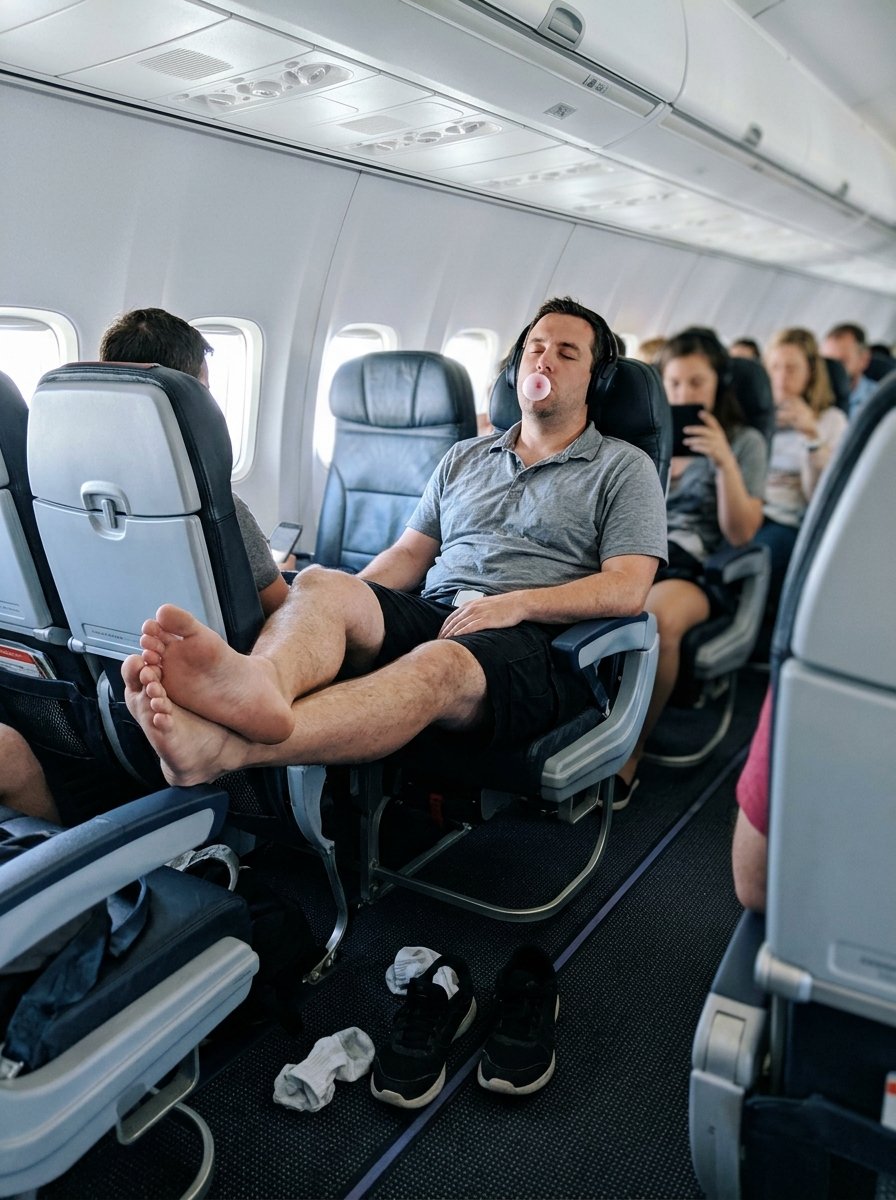
A man behind me put his smelly bare foot on my airplane armrest and refused to move them—I didn’t yell, yet my little lesson made him turn bright red.
I was 4 hours into a packed flight when something warm brushed my elbow.
I looked down.
5 bare toes were resting on my armrest.
For a second, I honestly thought I was imagining it.
Then the smell hit me.
I turned around. The man behind me looked about forty-five, wearing an expensive watch and headphones, with his shoes kicked under the seat.
“Excuse me. Could you move your foot?”
He pulled one headphone aside.
“It’s not touching you.”
“It’s on my armrest.”
“My feet need to breathe.”
“Then let them breathe in your own seat.”
He smirked. “It’s an airplane. We’re all sharing space.”
He glanced at my other arm.
“So use your other armrest and don’t bother me.”
I stared at him.
He smiled, put his headphones back on, and wiggled his toes.
I moved my elbow away.
Ten minutes later, his foot was still there.
When the plane hit turbulence, his toes actually brushed my sleeve.
I turned around again.
“Seriously. Move your foot.”
He sighed like I was exhausting him.
“Lady, it’s just a foot. You’re acting like I put it on your dinner plate.”
The woman beside me made a face.
“That’s disgusting.”
He laughed.
“You two need to relax.”
That was when I stopped arguing.
“Okay,” I said.
He smirked, clearly convinced he’d won.
Twenty minutes later, he fell asleep.
His bare foot was still inches from my elbow.
I stared at it for a moment.
Then an idea came to me.
I glanced at the woman beside me.
“Would you mind blocking his view if he wakes up?”
Her eyebrows rose.
“Why?”
I leaned closer and whispered my plan.
Her eyes widened. Then she covered her mouth to keep from laughing.
“Oh, you’re actually doing that? You’re my queen,” she whispered, winking at me.
I smiled.
For less than a minute, I quietly put everything in place while he slept.
Then I sat back and waited.
About forty minutes later, the man woke up, stretched, and stood to head toward the restroom.
He made it only a few steps.
A passenger across the aisle looked at him, did a double take, and burst out laughing.
Someone else turned around.
Then another.
Even the flight attendant stopped.
The man frowned.
“What?”
Nobody answered.
He looked down.
His face turned bright red.
Then he spun toward me.
“What the hell did you do?!”
I looked at the paper tent standing on the empty armrest.
Then I looked at the second card, which he had apparently carried into the aisle without noticing.
“I put up a notice.”
His fingers closed around the folded paper hooked over the loose hem of his trouser leg.
I had not touched his skin.
I had folded a narrow strip from a clean paper napkin into a hook, then slipped it over the fabric above his ankle.
When he lifted his foot, the little card traveled with him.
Across its front, in the thick blue ink of my crossword pen, I had written six words.
FREE FOOT PARKING. OWNER REFUSES COMPLAINTS.
Below that, in smaller letters, I had quoted him.
“We’re all sharing space.”
The card on my armrest said something different.
“Reserved for the passenger sitting here.”
It was a small, ridiculous protest.
At the time, that had seemed sufficient.
The man stared at the paper as though I had served him a subpoena.
“You attached something to me?”
“To your trouser cuff.”
“While I was asleep?”
“While your foot was on my seat.”
The flight attendant moved between us before either of us could say anything else.
Her name badge read MAYA.
“Sir, please keep your voice down.”
He held the card in front of her.
“Look what she did.”
Maya read it.
Her mouth twitched once before settling into a straight line.
“Did she injure you?”
“That isn’t the point.”
“Did she damage your clothing?”
“She humiliated me.”
A man across the aisle lowered his eyes.
The woman beside me stopped smiling.
That change should have warned me.
Laughter had been easy when the joke belonged to everyone.
Now it belonged to one furious person, and we were trapped in a metal tube with him.
Maya held out her hand.
“May I take the card?”
He gave it to her reluctantly.
“Your name,” he said.
“Maya.”
“Your full name.”
“My employee information can be included in a report. First, I need you to return to your seat.”
“I’m going to the restroom.”
“Then please do that calmly.”
He pointed at me.
“This is not over.”
Maya shifted half a step.
“Sir.”
For a moment, he seemed to consider arguing with her too.
Then he walked toward the rear lavatory, barefoot, the expensive watch flashing beneath the cabin lights.
The man across the aisle exhaled.
“Well,” he whispered, “parking enforcement is getting strict.”
I did not laugh.
Maya turned toward me.
“Please don’t attach anything else to another passenger.”
“I won’t.”
“If someone is bothering you, call us.”
“I should have.”
“Yes.”
There was no cruelty in the answer.
That made it harder to hide behind the fact that I had been right about the foot.
She collected the little tent from my armrest.
“I’ll clean this.”
“Thank you.”
Beside me, the woman folded both hands over a canvas tote.
Earlier, she had seemed delighted by the plan.
Now she watched the narrow opening between the seats.
“I didn’t think he would get that angry,” she said.
“Neither did I.”
“That was probably foolish of us.”
“Probably.”
She gave me a small, unhappy smile.
“I’m Leah.”
“Claire.”
We shook hands awkwardly, as though we had met at a neighborhood meeting instead of during an airborne rebellion.
Her palm was cool.
A faded hospital identification sticker clung to the inside of her tote strap.
She noticed me noticing and turned it inward.
I looked away.
My own canvas bag sat under the seat in front of me, packed carefully around a rigid blue folder.
The folder contained a printed schedule, a visitor badge, and an opening statement I had rewritten eleven times.
On its first page, I had underlined one sentence.
People need a way to say no before a small inconvenience becomes a public conflict.
I had spent most of the flight avoiding that folder.
Now the sentence seemed to glow through the bag.
Maya returned with a disinfectant wipe.
She cleaned the armrest, waited for it to dry, and indicated the call button.
“Use this if there’s another problem.”
“I will.”
“Do you want me to speak with him?”
“Yes, please.”
Leah glanced at me.
I could almost hear what she was thinking.
We could have done that an hour earlier.
When the man returned, Maya stopped him beside his row.
Their voices stayed low, but the seats were too close to hide much.
“Your feet need to remain within your own seating area.”
“I understand that.”
“Please put your shoes on when moving around the cabin.”
“I was asleep. I didn’t realize where my foot was.”
I turned before I could stop myself.
“You realized the first two times.”
Maya lifted one hand gently toward me.
“I’m handling it.”
I faced forward.
The man sat down with enough force to shake my seat.
A shoe scraped beneath me.
Then another.
For the first time since he had invaded my space, my armrest stayed empty.
That should have been the end.
It could have been an unpleasant flight story, shortened with every telling until it became a neat joke over dinner.
Instead, a phone appeared between the seats.
The man held it beside my shoulder.
“Look at this.”
On the screen, a paused video showed him standing in the aisle.
His face was visible.
So was the card dangling from his trouser leg.
Someone had filmed him.
I felt my stomach drop.
“I didn’t take that.”
“You arranged the whole thing.”
“No.”
He moved the phone closer.
The video had a caption across the top.
WHEN MR. BUSINESS CLASS DISCOVERS ECONOMY CONSEQUENCES.
We were all sitting in economy.
That detail somehow made it worse.
The clip had already been uploaded.
A small number beside a heart climbed while I watched.
“Get it taken down,” he said.
“I didn’t post it.”
“Your friend did.”
He pointed toward Leah.
She went pale.
“I didn’t.”
“Then whoever you were performing for.”
I pressed the call button.
He gave a short, bitter laugh.
“Now you want a flight attendant.”
“Yes,” I said. “Now I do.”
Maya returned.
He showed her the screen.
She looked toward the young man across the aisle, who had been holding his phone vertically during the confrontation.
His smile disappeared.
“Did you post a video of this passenger?”
The young man hesitated.
“It was funny.”
“That wasn’t my question.”
“Yeah. But everyone records things.”
Leah’s fingers tightened around her tote.
“Was I in it?”
He looked at her.
“Maybe a little.”
“Show me.”
He hesitated again.
Then he turned the screen.
I saw myself in profile.
I saw the angry man.
And behind my shoulder, reflected briefly in the dark window, I saw Leah with her hand over her mouth.
The young man had added music.
A bouncing arrow pointed toward the paper card.
It was crueler than anything that had happened in the cabin.
Not because the man’s behavior had become better.
Because a complaint about an armrest had become entertainment for strangers who would never have to share the consequences.
“Please delete it,” I said.
The young man frowned.
“He was being a jerk.”
“Yes. Delete it.”
Maya kept her voice even.
“We can’t guarantee what happens to something once it’s online. But you can remove your upload.”
He glanced around, looking for support.
Nobody offered any.
Finally, his thumb moved.
“Fine.”
“From your account,” Leah said.
“I just did.”
“And the original.”
He looked irritated.
“Why?”
“Because I’m asking you.”
Something in her voice changed the air around us.
It was not loud.
It was the kind of careful firmness people develop after discovering that panic makes others stop listening.
He deleted the original.
Then he opened another folder and deleted it there too.
He held the screen toward her.
“Happy?”
“No,” Leah said. “Thank you.”
The man behind me watched without speaking.
I thought he might sit down.
Instead, he pointed at the empty screen.
“Copies will already exist.”
The young man shrugged.
“I only posted it a few minutes ago.”
“That doesn’t mean anything.”
“I deleted it.”
Maya asked him to put the phone away.
Then she asked the man to return to his seat.
He leaned toward me before moving.
“You have no idea what you’ve done.”
I wanted to tell him that he had no idea what he had done either.
I wanted to remind him that this began with a simple request.
But Leah was staring at her hands, and Maya looked tired, and the whole cabin had become too interested.
So I said nothing.
The man sat.
For several minutes, the loudest sound near us was the steady ventilation overhead.
Then Leah whispered, “I’m sorry.”
“For what?”
“I laughed.”
“So did I.”
“I should have thought about the phones.”
“I should have thought about calling Maya.”
We sat with that.
A cart rattled somewhere behind us.
A child asked for juice.
The plane continued west, indifferent to the moral education occurring in row twenty-three.
I took out my water bottle.
My hand shook when I unscrewed the cap.
Leah noticed.
“Are you afraid of him?”
“I’m not sure.”
“That’s an honest answer.”
“I’m supposed to be good at difficult conversations.”
She looked at my blue folder, now visible beneath the seat.
“Work?”
“Something like that.”
“Then perhaps this is continuing education.”
I laughed once.
It escaped before I could decide whether I deserved it.
Leah smiled faintly, then looked toward the aisle again.
On the back of her left hand, a small square of adhesive had left a pale outline.
I wondered whether she had recently been a patient or had simply spent too long beside one.
She caught the direction of my glance.
“My daughter,” she said.
“You don’t have to explain.”
“I know.”
She rubbed the place once with her thumb.
Then she changed the subject.
“Is there any chance he’ll forget about it before we land?”
Behind us, a laptop opened with a sharp click.
“No,” I said.
The seatback screen in front of me showed our position above a broad stretch of cloud.
Just under two hours remained.
I had booked the flight reluctantly.
It was the least expensive nonstop that would get me there before the morning meeting.
For the past six years, I had worked at the public library in Dayton.
Most of my job involved computers, forms, and people embarrassed to need help.
I taught pensioners how to upload identification.
I helped parents apply for benefits while toddlers dismantled the children’s shelves.
I explained passwords to men who insisted their phones had personally betrayed them.
I had learned to make requests sound easy.
Would you mind lowering your voice?
Could we give her a little space?
Let’s try that again.
Sometimes people mistook that manner for weakness.
Usually, I let them.
But eight months earlier, my father had died after a winter of hospital admissions.
During his last trip, we had flown together to see my sister.
His portable oxygen equipment had fitted beneath the seat.
His pride had not.
He hated needing assistance.
He hated being discussed across counters.
Most of all, he hated the moment a stranger decided helping him meant taking control of every choice.
I had written about that trip afterward.
Not for publication.
For a customer feedback form with a strict character limit.
Someone had called.
Then someone else.
Eventually, a passenger advisory coordinator invited me to a small workshop in Seattle.
They were reviewing how passengers reported conflicts and requested accommodations.
My expenses were reimbursed after the event.
My contribution was supposed to be practical.
I had no authority, no professional title that impressed anyone, and no secret ownership of the airline.
I had one story about my father and some suggestions written in a blue folder.
Now I had another story.
This one made me considerably less comfortable with myself.
Behind us, the man began speaking into his phone.
There was no connection for a voice call, so he was apparently recording a message.
“Graham here. Something may circulate before tomorrow.”
Leah went still.
I felt her arm move away from mine.
He continued.
“Passenger harassment. A coordinated stunt. I’ve asked the crew to document it.”
A pause.
“No, I don’t want to make a larger issue of it unless necessary.”
He stopped recording.
For a moment, I heard only keyboard taps.
Then Leah leaned close.
“Did he say Graham?”
“I think so.”
She looked down at her tote.
“Do you know him?”
“No.”
The answer came too quickly.
I did not press.
A few seconds later, she added, “I might recognize his voice from somewhere.”
“Where?”
“A video.”
She turned toward the window.
It was not an invitation to continue.
Behind me, Graham’s fingers struck the keyboard harder.
I imagined a complaint being composed, polished, and sent.
I imagined the phrase coordinated stunt appearing in an official report.
Then I imagined my name on the visitor badge in my folder.
Claire Bennett.
Passenger contributor.
Tomorrow, I would tell people how to resolve conflicts fairly.
Tonight, someone would be able to show them a video of my solution involving paper signs and a sleeping man.
My face warmed.
Leah saw that too.
“What is it?”
“I might have made tomorrow difficult.”
“For him?”
“For me.”
She glanced at my folder again.
“Can you tell me?”
Before I could answer, Graham leaned forward.
“I need your name.”
Maya was still several rows away.
I kept my voice level.
“Why?”
“For the report.”
“The crew can record whatever information they need.”
“So you won’t identify yourself?”
“Not to you.”
He gave a cold smile.
“That tells me plenty.”
I pressed the call button again.
This time, I did not wait until my anger arrived.
Maya came over.
Graham straightened and addressed her with sudden composure.
“I’d like a formal incident report.”
“All right.”
“She attached an object to me while I slept.”
“I understand.”
“And organized filming.”
“I didn’t,” I said.
Maya looked at him.
“I have no evidence that she organized filming. The passenger who uploaded the video said he acted independently.”
“She encouraged the situation.”
“I’ll document what I observed and what each of you tells me.”
He hesitated.
“Will the report include the footage?”
“If you submit it through the appropriate channel.”
“And her identity?”
“We won’t exchange passenger information here.”
“I’m not asking you to announce it.”
“We still won’t exchange it.”
His jaw shifted.
For the first time, I watched him encounter a boundary that did not change because he disliked it.
Maya asked me whether I wanted to provide a statement.
“Yes.”
“Briefly, please.”
I described the foot, my two requests, his replies, the card, and the filming.
I did not make the paper hook sound nobler than it was.
“I should have called you before doing that.”
Maya wrote something on a small notepad.
Graham interrupted.
“She’s admitting it.”
“Yes,” Maya said. “She is.”
He blinked.
I suspected he had expected an admission to collapse the room around me.
Instead, it simply became part of the facts.
Leah asked to give a statement too.
Graham looked at her sharply.
“You were involved.”
“I can still say what happened.”
“You blocked my view.”
“Yes.”
She met Maya’s eyes.
“I thought it was harmless. I was wrong about how far it could go.”
“Thank you,” Maya said.
Leah continued.
“I also heard her ask him twice. He knew exactly where his foot was.”
Graham leaned back.
His laptop closed.
Maya finished writing.
“I’m going to see whether there’s another place available.”
The flight had been full at boarding.
I knew that because my own small suitcase had been taken at the gate.
Still, Maya walked toward the front.
Leah watched her go.
“I won’t move if it means leaving you beside him,” she said.
“You’re not beside him.”
“You know what I mean.”
I did.
That almost undid me more than the confrontation.
We had known each other for barely two hours.
Already, she was calculating whether my discomfort should cost her something.
I wondered what had taught her to do that.
Maya returned with another attendant.
There was no empty passenger seat.
A family near the front had offered to switch, but their arrangement would separate a young child from his mother.
“I declined,” Maya said.
“Good,” I said immediately.
She looked relieved.
“We can monitor this row. If either of you needs help, call.”
Graham spoke from behind us.
“I’m not a threat.”
Maya turned.
“Then we should have no further difficulty.”
The second attendant stayed near the rear galley.
The message was clear without becoming a performance.
Leah released a breath.
“Your hands have stopped shaking,” she whispered.
I looked down.
She was right.
Calling for help had not made me feel powerful.
It had made the situation smaller.
That was probably more useful.
I pulled out my folder.
Leah saw the visitor badge before I could turn it over.
Her eyes moved from the airline’s logo to my name.
Then she reached into her tote.
She took out a cream envelope, worn along the fold.
Inside was an identical badge.
Different name.
Same workshop.
Leah Morgan.
Passenger contributor.
We stared at each other.
“You’re going tomorrow,” I said.
“Yes.”
“Why didn’t you say anything?”
“Why didn’t you?”
I looked toward the seat behind us.
“Because I was embarrassed.”
She nodded slowly.
“Me too.”
For several seconds, neither of us spoke.
Then she tipped her badge over.
A handwritten number appeared on its back.
“I was planning to call them from the hotel.”
“To say what?”
“That I couldn’t come.”
“Why?”
Her fingers slid along the envelope’s edge.
“Because I thought I could tell my daughter’s story without becoming angry.”
She looked at the armrest.
“Apparently, I can’t even manage somebody’s foot.”
I wanted to tell her those things were unrelated.
They were not entirely unrelated.
Anger had a way of borrowing old furniture and making itself comfortable in a new room.
“What happened to your daughter?”
Leah looked toward the window.
For a while, I thought she would not answer.
Then she said, “She was seventeen when someone decided her worst day needed an audience.”
The plane gave a soft shudder.
Across the aisle, the young man who had posted the video adjusted his headphones without looking up.
Leah noticed.
She lowered her voice.
“Not him. Someone like him.”
Her daughter, Sophie, had a condition that sometimes caused her heart rate to race when she stood.
Most days, medication and careful planning helped.
Some days, neither was enough.
Last spring, during a crowded connection, Sophie had sat on the floor near a gate because she felt faint.
Her legs stretched into a narrow passage.
A man had demanded that she move.
A woman nearby had started filming.
By the time a gate employee arrived, Sophie was crying and struggling to explain.
The video showed the crying.
It did not show the warning signs, the medication, or the hospital visit afterward.
Online, people called her entitled.
They called her intoxicated.
They guessed things about her body.
They found her school.
Leah stopped speaking.
I looked at her tote again.
The hospital sticker made sense now.
“Is she all right?”
“She’s better.”
It was an answer with a door only partly open.
“Does she know you’re going to the workshop?”
“Yes.”
“Does she want you to?”
“She asked me not to bring photographs.”
Leah rubbed her thumb against the envelope.
“I packed them anyway.”
I said nothing.
“She said she didn’t want another room full of strangers looking at her face.”
“Then don’t show them.”
“That simple?”
“No. But that clear.”
Her eyes filled suddenly.
She turned toward the window before the tears fell.
Behind us, Graham’s laptop opened again.
I remembered the way Leah had reacted to his name.
“You recognize him from the workshop material,” I said.
She nodded.
“Not personally.”
“Who is he?”
She opened the envelope.
A folded agenda came out beneath the badge.
Near the top was a photograph of a man wearing a navy jacket.
The watch was visible.
Graham Whitmore.
Independent customer experience consultant.
He was scheduled to introduce the pilot program.
I read the title twice.
Giving Passengers the Tools to Resolve Minor Conflicts.
For a moment, the cabin seemed to tilt without the plane moving.
Leah watched my face.
“That’s why I asked about his name.”
I looked at the agenda again.
Graham’s proposal had a friendly subtitle about confidence and personal responsibility.
I had read the summary weeks earlier.
It suggested handling low-level disputes through polite conversation before requesting crew intervention.
That sounded reasonable on paper.
It sounded different with his toes still imprinted in my sleeve.
“He’s presenting this?” I whispered.
“He recorded the welcome video.”
“And he just recorded a message saying we coordinated harassment.”
Leah folded the agenda slowly.
“We should tell the coordinator before he does.”
My immediate reaction was relief.
We could explain first.
We could protect ourselves.
Then I looked at Graham’s photograph.
The temptation was sharp and ugly.
I could walk into tomorrow’s room carrying the video like a weapon.
I could make him feel the exact helplessness he had handed me.
Leah was watching me too closely.
“I’m not asking you to destroy him,” she said.
“I know.”
But I had been thinking about it.
That frightened me more than his anger.
I took out my phone and opened the email from the coordinator, Dana Ruiz.
The message welcomed us as people whose experiences could improve an imperfect system.
It asked us to speak honestly.
I began typing.
Then I stopped.
“What?” Leah asked.
“If I write this while I’m furious, I’ll make it about winning.”
“What would make it about something else?”
I looked at Maya, helping an older passenger fasten a stubborn seatbelt.
“The whole story.”
I wrote that an incident had occurred.
I included my own action.
I included the crew response.
I said another contributor had witnessed it.
I asked Dana to preserve any incident information through proper channels before discussing it at the workshop.
Then I showed Leah.
She read every line.
“You haven’t identified him.”
“No.”
“Why?”
“I want to send him the same account before he discovers it in a room.”
She looked toward the seat behind us.
“He didn’t give you that courtesy.”
“I know.”
I did not owe him kindness without limits.
But I owed myself a version of this story I could repeat without editing my behavior.
The seatbelt light came on.
Maya began walking through the cabin.
Graham shut his laptop and slid it into his bag.
I turned around.
“Mr. Whitmore.”
His eyes narrowed.
“So you did look me up.”
“Your photograph is on tomorrow’s agenda.”
Something moved across his expression.
It was not embarrassment this time.
It was recognition of a problem larger than a joke.
I held up my badge.
Leah lifted hers.
For several seconds, he did not move.
Then he looked from one name to the other.
“You’re the contributors.”
“Yes.”
He stared at me.
“Both of you?”
“Yes.”
Maya paused beside our row.
“Everything all right?”
“We’re speaking,” I said.
She waited.
Graham noticed and lowered his voice.
“What do you want?”
“I’m sending Dana an account of what happened. You should know before she receives it.”
“You’re threatening me.”
“No. I’m telling you.”
He looked at my phone.
“Let me read it.”
I hesitated, then turned the screen.
His eyes moved quickly.
At the sentence about the paper card, they slowed.
At the sentence admitting I should have called the crew, they stopped.
“You put that in?”
“It happened.”
He handed the phone back.
His watch slid toward his cuff.
For the first time, I noticed a narrow woven bracelet beside it.
A child had probably made it.
Several strands had frayed.
He pulled the cuff down before I could see the colors clearly.
“You don’t understand the position you’re putting me in,” he said.
“What position?”
He glanced toward Maya.
Then toward the phone across the aisle.
Then back at the two badges.
His voice became quieter.
“The proposal goes to a vote tomorrow.”
Leah sat straighter.
“A vote?”
“An internal decision. It isn’t relevant.”
“It’s relevant if you’re presenting us as evidence.”
“I didn’t say that.”
“You called this coordinated harassment.”
His mouth tightened.
I held the phone without sending.
“What does the proposal change, Graham?”
He did not answer.
Maya touched the top of an empty seatback.
“We’re preparing to land. This conversation needs to remain calm.”
“It will,” I said.
Graham looked past me at the blue folder.
Then he said something that made the little paper sign feel suddenly very far away.
“If tomorrow goes badly, they’ll say the pas
“What point?” Leah asked.
Graham rubbed his forehead.
“People escalate disputes instead of resolving them.”
“You refused to move your foot,” she said.
“And she attached a sign to me.”
“Yes,” I said. “Those are both facts.”
He looked irritated by the agreement.
I understood why.
It prevented him from assigning us the simple roles he needed.
In his version, he was a sleeping passenger ambushed by strangers.
In the version I had wanted ten minutes earlier, he was a bully receiving a perfect lesson.
Neither version included all of us.
Maya asked him to sit back while she checked the row.
He complied.
I faced forward and sent the email.
Leah did not ask whether I had included his name.
I had.
I had also included mine, hers with permission, the flight number, and the approximate time.
Under the account, I added one request.
Please do not use the online video in any presentation without speaking to the people shown.
Then I switched my phone to airplane mode.
For the first time since seeing the upload, I wanted silence more than information.
Beside me, Leah returned the photographs to her envelope.
“Will you still go?” I asked.
She pressed the flap flat.
“I don’t know.”
“You don’t have to tell Sophie’s story.”
“That’s why they invited me.”
“They invited you.”
She looked at me.
“There’s a difference.”
“I hope so.”
We descended through thin cloud.
Sunlight washed across the window.
Rows of houses emerged below us, each one small enough to make human problems look manageable.
Graham said nothing.
When we landed, applause broke out from a few rows near the rear.
Someone laughed.
Suitcases shifted overhead before the seatbelt light went off.
The ordinary impatience of arrival returned around us.
It felt almost indecent.
I had expected the whole aircraft to remain inside our conflict.
Instead, people checked connections, complained about legroom, and looked for chargers.
Most had barely noticed.
That realization loosened something in my chest.
Public humiliation felt permanent while it was happening.
Often, the public was already thinking about lunch.
When our row stood, Graham remained seated.
He let us enter the aisle first.
I could not decide whether that was courtesy or strategy.
Then he spoke.
“Claire.”
I stopped.
“Don’t forward the video.”
“I wasn’t going to.”
“Please.”
That word sounded uncomfortable in his mouth.
Leah waited ahead of me.
I looked back.
“I can’t promise nobody else will.”
“I know.”
“I can promise I won’t.”
He nodded once.
At the aircraft door, Maya stood beside another attendant.
I thanked her.
Then I said the thing I should have said before.
“I put you in a difficult position.”
“You had a legitimate complaint.”
“I still made it harder.”
She studied me for a moment.
“Yes,” she said. “You did.”
I appreciated that she did not rescue me from the answer.
“Will you include everything?” I asked.
“Everything I observed.”
“Good.”
She smiled faintly.
“Enjoy having your own armrest on the ground.”
I laughed.
This time, it felt clean.
In the terminal, Leah and I walked together toward baggage claim.
Neither of us moved quickly.
She checked her phone once, then put it away without answering.
“Your daughter?” I asked.
“Yes.”
“Does she know you landed?”
“She knows the flight landed.”
“That isn’t the same thing.”
Leah stopped beside a row of windows.
Below us, ground crews moved carts beneath the aircraft.
A worker guided a belt loader into place with two precise gestures.
Leah opened her messages.
She typed, erased, and typed again.
Then she handed me the phone.
I read the draft.
Landed safely. Something happened on the plane. I’m fine. I might need to change what I planned to say tomorrow.
“Too much?” she asked.
“It sounds true.”
She sent it.
The reply arrived before we reached the escalator.
You don’t have to make them understand everything. Just tell them what would have helped.
Leah read it twice.
Then she sat on a bench.
I sat beside her.
“She’s eighteen now,” she said.
“I wondered.”
“Everyone thinks I’m trying to tell the story for her.”
“Are you?”
The question cost me something.
She looked down at her phone.
“Some days.”
It was the first completely unguarded thing she had said.
“I couldn’t stop the video,” she continued. “I couldn’t stop the messages. I kept thinking there had to be a room where somebody would listen.”
“And Sophie didn’t want to be taken into it.”
“No.”
“She can still be the reason you’re there without being the exhibit.”
Leah wiped her eyes with the side of one finger.
“You should put that in your folder.”
“I’m trying to learn it myself.”
My phone vibrated.
Dana had replied.
Her message was short.
Thank you for telling me directly. I’ve asked the flight operations contact to preserve the crew report. Please don’t circulate the recording. We should speak before tomorrow.
There was no accusation.
There was no promise that everything would be fine.
I preferred it that way.
A second message followed.
I also need to clarify something about tomorrow’s proposed pilot. The passenger summary did not include all operational changes under consideration.
I showed Leah.
She read the last sentence aloud.
Then she looked at me.
“What operational changes?”
We did not have to wait long to find out.
Dana called while we stood beside the baggage carousel.
I put her on speaker after asking Leah’s permission.
Dana’s voice sounded brisk and tired.
“First, are you both safe?”
“Yes.”
“Do either of you need a different hotel arrangement?”
We were booked separately.
Neither booking had been shared with Graham.
“No,” I said.
Leah agreed.
“Good. Second, tomorrow isn’t a tribunal. I don’t want this becoming one.”
“Neither do we,” I said.
I meant it more honestly than I would have an hour earlier.
Dana continued.
“The workshop informs a decision about a limited passenger support trial.”
“We read the summary,” Leah said.
“The summary emphasized earlier passenger communication. One version also changes how certain minor complaints are routed.”
“To whom?” I asked.
“To a digital form first, unless a safety or accessibility concern is identified.”
I watched an empty luggage cart pass behind Leah.
“Before someone can speak to the crew?”
“Crew remain available. But the proposal’s language could discourage direct contact for matters labeled minor.”
“Who labels them?”
A pause.
“That’s one of the unresolved questions.”
Leah closed her eyes.
There it was.
A system that sounded tidy until someone had to prove their discomfort deserved a person.
Dana spoke again.
“Graham’s company developed the framework. He doesn’t make the final decision.”
“Does he know what happened will be discussed?” I asked.
“Yes. He emailed me separately.”
“What did he say?”
“I’m not sharing his correspondence without permission.”
Fair.
I had asked for fairness.
I could not resent it only when it protected him.
Dana offered to meet us in the hotel lobby at seven.
We agreed.
After the call, Leah folded the handle of her tote over her wrist.
“If I had used a form at that gate, Sophie might have fainted before anyone read it.”
“Then that’s what you can tell them.”
“And your father?”
“He would have said he was fine.”
“Was he?”
“Almost never when he said it.”
She nodded.
We understood each other in a way I wished had cost less.
My suitcase arrived with a bright orange gate-check tag.
Leah’s came several minutes later.
As she lifted it, her phone rang.
She looked at the screen.
“Sophie.”
“Take it.”
Leah walked a few steps away.
I checked the transportation signs.
Then someone said my name.
Graham stood near a pillar, holding a small black suitcase.
His shoes were firmly on.
I had no interest in finding that funny anymore.
“Could we talk?” he asked.
“Here.”
He looked around.
“Somewhere less public.”
“No.”
He accepted that after a moment.
“Dana called me.”
“She called us too.”
“I know how this looks.”
“Do you?”
He glanced toward Leah.
Then he lowered his voice.
“I need you to understand that the video could affect people who weren’t on that aircraft.”
“Everyone’s behavior can do that.”
“My daughter works for the company.”
I looked at him.
He touched the woven bracelet beneath his watch.
“She joined this summer. Entry-level research.”
That explained one thing.
It did not explain his foot.
He seemed to recognize the distinction in my silence.
“I’m not asking you to lie.”
“What are you asking?”
“Don’t make this into a public campaign.”
“I haven’t.”
“You could.”
“So could you.”
He looked away.
A family passed between us, following a boy dragging a dinosaur suitcase.
Graham stepped aside.
When they were gone, he said, “I told my daughter I handled difficult passengers for a living.”
The admission was smaller than I expected.
And sadder.
“Then handle one,” I said.
His eyes returned to mine.
“Start with yourself.”
For a moment, I thought I had gone too far.
Then he nodded.
It was barely visible.
Leah returned before he could answer.
Her gaze moved between us.
Graham spoke first.
“I asked Claire not to circulate the video.”
“We already agreed on that,” she said.
“Thank you.”
She waited.
He looked down at his suitcase handle.
“I also owe you an apology.”
“For what?” Leah asked.
He inhaled.
“For being rude.”
“That’s a category.”
His face reddened again.
I almost intervened.
Then I remembered how often women softened a difficult conversation for the person who had caused it.
Graham tried again.
“For putting my foot in her space. For refusing when she asked. For saying you both needed to relax.”
Leah studied him.
“And?”
He glanced at me.
“For calling it coordinated harassment without knowing what happened.”
I nodded.
“Thank you.”
He seemed surprised.
I continued.
“I’m sorry I attached the card while you slept. I should have called the crew.”
“I appreciate that.”
“It doesn’t cancel what you did.”
“I know.”
“I’m saying it so we don’t have to keep trading excuses.”
He looked at the floor.
For several seconds, nobody moved.
Then Leah said, “Why were you so determined not to move your foot?”
He gave a tired, embarrassed laugh.
“There isn’t a good answer.”
“Try the real one.”
“I was uncomfortable. I thought she was exaggerating. Then she told me what to do, and I didn’t want to be told.”
There it was.
No secret injury.
No noble sacrifice.
No misunderstanding that made the smell less offensive.
Just a man who had preferred another person’s discomfort to the small humiliation of being corrected.
“Tomorrow,” I said, “that answer might be useful.”
His expression tightened.
“To whom?”
“To you, first.”
We left him beside the pillar.
At seven, Dana met us in a quiet corner of the hotel lobby.
She wore a plain sweater and carried a notebook with no corporate logo.
That helped.
So did the way she began.
“I’m not here to prepare you to say the right thing.”
“What are you here for?” Leah asked.
“To make sure the process hasn’t already decided whose experience counts.”
I opened my folder.
Leah kept her envelope closed.
Dana listened while we described the flight again.
This time, there was no audience, no rising voice, and no phone recording.
The story became less exciting.
It also became more accurate.
I admitted that I had enjoyed planning the joke.
Leah admitted she had wanted someone rude to be embarrassed because she was tired of watching polite people absorb everything.
Dana wrote neither admission immediately.
She let them sit first.
Then she asked, “What would have changed your choice?”
“If Maya had arrived sooner,” Leah said.
I shook my head.
“I didn’t call her.”
“That matters,” Dana said.
“I thought I should handle it.”
“Why?”
“Because it was just a foot.”
The phrase sounded ugly coming from me.
I heard Graham’s voice in it.
Dana waited.
I looked down.
“Because I didn’t want to be the woman making a fuss.”
Leah let out a slow breath.
Dana wrote that down.
Then she asked Leah the same question.
“What would have helped at the gate with your daughter?”
“A person who asked what she needed before deciding what she looked like.”
Dana nodded.
“Can you tell that without showing photographs?”
Leah’s eyes lifted sharply.
“I didn’t say I brought photographs.”
“You’re holding the envelope like it might explode.”
For the first time that evening, Leah laughed.
Then she took out the pictures.
She looked at the top one without showing us.
“I wanted proof.”
“Of what?” Dana asked.
“That she was really ill. That we weren’t lying.”
“Who asked you to prove that here?”
“Nobody.”
Leah gathered the photographs.
Very carefully, she put them back.
“Then I’m not going to make her earn compassion with her face.”
Dana closed her notebook for a moment.
I looked at Leah and felt the evening shift.
She had arrived planning to persuade strangers.
Now she was deciding what strangers did not get to own.
That was not the same kind of victory as a room falling silent.
It seemed stronger.
Before we left, Dana explained the morning structure.
Graham would introduce the proposal.
Passenger contributors would speak afterward.
Operational staff would discuss practical limits.
There would be no public audience and no livestream.
Notes would identify themes rather than personal medical details.
“Can the video be kept out?” I asked.
“Yes.”
“Even if Graham wants to show it?”
“He can describe his experience. He can’t turn other contributors into visual evidence without consent.”
I thanked her.
Then I asked whether Maya could be heard.
Dana tapped her notebook.
“The report is being obtained through the appropriate team. We won’t ask her to participate outside her work.”
Good.
I did not want another woman handed unpaid responsibility for cleaning up our conflict.
That night, in my hotel room, I rewrote my opening statement.
I crossed out the sentence about saying no.
It was true, but incomplete.
Under it, I wrote something else.
A complaint should not have to become a crisis before someone helps.
Then I called my sister.
I told her the entire story.
She laughed at the paper card.
Then she stopped laughing when I explained the video.
“Dad would have hated that part,” she said.
“I know.”
“He also would have asked why you didn’t press the button.”
“I know that too.”
There was a pause.
“Are you going tomorrow?”
“Yes.”
“To win?”
I looked at the blue folder.
“To explain what happened.”
“Then get some sleep.”
I did not sleep much.
At eight-thirty, Leah met me outside the conference room.
Her envelope was gone.
Instead, she carried one handwritten page.
“Did you leave the photographs?” I asked.
“In my suitcase.”
“How does that feel?”
“Like I’m underdressed.”
I understood.
Evidence could become armor.
Setting it aside left a person exposed to being believed.
Inside, a dozen people sat around an oval table.
There were name cards, water glasses, charging cables, and a plate of untouched pastries.
Nobody looked powerful enough to repair everything.
That was unexpectedly comforting.
Graham stood beside a screen.
He wore the navy jacket from his photograph.
His watch was visible.
So was the bracelet.
He looked at us as we entered.
Then he said, “Good morning.”
We answered.
Nothing in his tone suggested we were friends.
Nothing suggested he intended to ambush us either.
Dana began by establishing ground rules.
No recording.
No personal information shared outside the group.
No assumption that a contributor represented every passenger with a similar experience.
Then Graham opened his presentation.
The first slide displayed the title from the agenda.
The second showed a diagram.
Minor discomfort.
Passenger conversation.
Digital support request.
Crew escalation.
I stared at the neat arrows.
They traveled only one direction.
People did not.
Graham explained the aim.
Fewer avoidable confrontations.
Clearer expectations.
More crew time for urgent needs.
All reasonable goals.
Then he described the flight.
My shoulders tightened.
He did not show the video.
He did not say coordinated harassment.
He described his foot, my requests, his refusal, and the card.
The room stayed very quiet.
“I initially characterized the incident as a passenger escalation,” he said.
He looked at the screen.
“That was incomplete.”
Dana’s pen stopped.
Leah lowered her page.
Graham continued.
“I was asked clearly to stop. I understood the request. I refused because I disliked being corrected.”
Nobody rescued him.
I watched his fingers settle against the edge of the table.
“The model assumes a good-faith response to an initial conversation.”
He paused.
“Yesterday, I was not acting in good faith.”
An operations manager leaned forward.
“Are you recommending a change to the sequence?”
“Yes.”
“What change?”
Graham clicked to the next slide.
There was no diagram.
Only a sentence.
A passenger who has already received a refusal should have a direct route to a person.
I looked at Leah.
Her eyes were fixed on the screen.
For the first time, Graham’s embarrassment had produced something more useful than red cheeks.
Then a finance representative asked the question that made the entire table straighten.
“Does your company still intend to claim the pilot’s projected reduction in crew interventions?”
Graham looked at the untouched water beside him.
“That projection should be withdrawn.”
The representative frowned.
“Your payment schedule is tied to those targets.”
“I know.”
And suddenly I understood what his apology at baggage claim had not yet cost him.
The room did not applaud.
I was grateful.
Applause would have made Graham’s admission feel complete before anyone had examined what it meant.
The operations manager turned toward Dana.
“Then the pilot needs to be redesigned.”
“Yes,” Dana said.
The finance representative asked for revised terms before any approval.
Someone from cabin services wanted clearer language about repeated requests.
Another participant pointed out that disabilities were not always visible, and passengers should not have to disclose diagnoses to strangers.
The neat diagram became a working document.
Arrows moved.
Words disappeared.
I watched minor discomfort change to nonurgent concern.
Then Leah raised her hand.
“Could we avoid asking passengers to decide whether they’re urgent enough?”
The room went still.
She looked at her page, then turned it facedown.
“My daughter once needed help at a gate. People decided she was being difficult before anyone asked why she was on the floor.”
Her voice shook.
She kept going.
“I’m not going to show you what she looked like. She asked me not to.”
Dana nodded.
Leah held the edge of the table.
“What would have helped was simple. Someone could have asked what she needed, protected a little space, and discouraged people from filming.”
The cabin services representative wrote that down.
Leah looked at Graham.
“And someone could have believed that an inconvenience might be real even when they didn’t feel it themselves.”
He nodded.
“Yes.”
There was no argument hidden inside the word.
When my turn came, I left my polished statement in the folder.
“I work in a library,” I said.
A few people looked surprised.
I wondered what profession they had assigned me.
“I help people with problems they often consider too small or embarrassing to bring to a desk.”
I described the moment before pressing a call button.
The calculation.
The fear of being unreasonable.
The hope that one more polite request would spare everyone trouble.
Then I described the paper card.
“I made the problem visible by turning a person into a joke.”
Graham looked down.
“I was frustrated,” I continued. “He had behaved badly. I still don’t want that to be the tool people need.”
Dana asked what I would recommend.
“One clear request, if someone feels comfortable making it. Then access to help without having to prove they tried hard enough.”
The cabin services representative nodded slowly.
“That’s workable language.”
“Also,” I said, “tell people that calling us isn’t an accusation.”
I stopped.
I had said us.
For a second, I felt embarrassed.
Then the representative smiled.
“It shouldn’t be.”
Near the end, Dana summarized the crew report.
Maya had documented the repeated boundary issue, the paper card, the raised voice, and the independent recording.
She had also noted that both passengers later complied with instructions.
No dramatic verdict followed.
There was simply a record that refused to flatten the incident.
Graham asked for one correction to his initial complaint.
He wanted the allegation of coordinated filming removed.
Dana explained that the original submission would remain preserved, with an amended statement attached.
He accepted that.
Accountability, I realized, did not mean getting to replace the old version with a cleaner one.
It meant leaving both where they could be seen.
The original pilot was not approved that morning.
A smaller revision would be reviewed after cabin staff and accessibility contributors examined it.
Graham’s company would have to submit new terms.
No one promised him the contract.
No one promised us a perfect airline.
But nobody asked Leah to display her daughter.
Nobody described my first two requests as a failure to communicate.
That was enough progress to feel real.
Afterward, Graham found us near the coffee table.
He held two paper cups, then seemed to reconsider offering them.
“Would either of you like coffee?”
“No, thank you,” Leah said.
“I’m all right,” I said.
He set the cups down.
“I called my daughter this morning.”
We waited.
“I told her what actually happened.”
“How did she take it?” Leah asked.
“She said she was glad I told her before someone else did.”
His fingers touched the bracelet.
“She also said she hoped I wouldn’t make being embarrassed everybody else’s emergency.”
Leah smiled faintly.
“She sounds sensible.”
“She is.”
He looked at me.
“I wanted you quiet because I was afraid people would see me behave like someone I advise them not to become.”
There was no reason to soften that.
So I didn’t.
“They did.”
“Yes.”
“And you’ll have to do something with that.”
“I’m trying.”
Leah glanced toward the conference room.
“Keep trying when we aren’t watching.”
He nodded.
That was the closest any of us came to forgiveness.
It was enough for an airport friendship and a business acquaintance that had begun with bare toes.
Later, Dana sent us the amended principles for review.
Leah and I read them together in the lobby before leaving.
The language was plain.
Passengers could request help directly.
Crew retained discretion.
No digital form replaced an immediate human response.
Boundary complaints would be addressed without requiring passengers to disclose private medical information.
The final line concerned recording.
Staff would seek to reduce unwanted exposure during conflicts rather than encourage public spectacle.
It was a draft.
There would be revisions.
Still, I took a photograph of that page with Dana’s permission.
Not of anyone’s face.
Of the work.
Leah called Sophie before we left.
I stood far enough away to give her privacy.
When she returned, her eyes were wet, but she was smiling.
“She asked whether I used the photographs.”
“What did you say?”
“I told her no.”
“And?”
“She said, ‘Thanks for listening, Mom.’”
Leah swallowed.
“I went all that way hoping strangers would hear me.”
I touched her arm.
“She did.”
At the airport, we had different departure gates.
We exchanged numbers beside a bookstore.
Neither of us made promises about lifelong friendship.
We promised something smaller.
A message when we got home.
A copy of any revisions.
Permission to remind each other when righteous anger started looking too much like an audience.
Before leaving, Leah reached into her tote.
She handed me a blue pen.
Mine.
“I borrowed it during the meeting.”
I had not noticed.
“Keep it,” I said.
She shook her head.
“You might need it.”
“For signs?”
“For better things.”
We hugged.
Then she walked toward her gate, carrying her own story and leaving her daughter’s photographs safely zipped inside her suitcase.
On my flight home, I had an aisle seat.
A young man occupied the middle.
Before takeoff, he folded his arms tightly across his chest and tried to make himself smaller.
He could not have been more than twenty.
His knee bounced.
When the plane began moving, his hand hovered uncertainly above the shared armrest.
I recognized the calculation.
The wish not to inconvenience anyone.
The ridiculous amount of thought a person could spend deciding whether they deserved somewhere to rest.
I shifted my elbow toward the aisle.
“You can use that,” I said.
He looked at me.
“Are you sure?”
“Yes.”
He placed his hand down carefully, as though accepting something fragile.
Outside, the runway lights slipped past the window.
I opened my blue folder and turned to the page I had crossed out.
Beneath the old sentence, I added one final line.
Help should arrive before humiliation does.
Then I capped my pen.
Beside me, the young man’s fingers slowly relaxed.