I came home exhausted from my night shift
I came home exhausted from my night shift
and saw my father tagging me
in the family chat.
“We’re using your lake house this weekend—20 guests.”
Mom wrote, “Fill the fridge and behave.”
I answered, “No.”
She sent laughing emojis.
“You really think you can stop us?”
I did not reply.
Friday morning, Dad screamed into the phone,
“What did you do to the house?”
Twelve hours into a double shift
in the cardiac unit, my phone buzzed
under a stack of patient charts,
and the notification on the screen
had nothing to do with a dying patient.
It had everything to do
with a dying family illusion.
My father had tagged me
in the main family group chat
at 3:07 in the morning.
“We are using Arden’s lake house
this weekend. Twenty guests.
Friday through Tuesday. Everyone bring towels.
Arden, get the place ready.”
I stood at the nurses’ station
in Charlotte, North Carolina,
with the smell of antiseptic in my hair
and old coffee burning in the pot
behind me. The heart monitor
from Room 12 blinked green
against the glass wall.
Somewhere down the hall,
a ventilator sighed in a steady rhythm.
I read my father’s message once.
Then again.
Then a third time,
because exhaustion can make you misread things,
and after fourteen years
as a registered nurse,
I knew better than to trust
the first version of anything at 3:00 a.m.
But the words stayed the same.
My name is Arden Voss.
I was thirty-six years old, single,
tired in my bones,
and the sole owner
of a small lake house
on Lake Norman that I bought
after nine years of double shifts,
packed lunches, clearance-rack scrubs,
and driving a dented silver Honda Civic
everyone in my family loved to mock.
The house was mine.
Not emotionally mine. Not “family mine.”
Legally mine. Financially mine.
Every mortgage payment came
from my checking account.
Every repair bill, every property tax statement,
every bag of mulch,
every broken screen door latch,
every gallon of paint.
I had bought that house
because I needed one place
in the world where nobody could walk
in and tell me
who I was supposed to be.
Then my mother replied
under my father’s message.
“Fill the fridge, sweetheart.
Aunt Liora likes fresh flowers
in the main bedroom.
Do not make this awkward.”
Within two minutes,
thumbs-up reactions started appearing.
My cousin Hollis wrote,
“Finally. That place needs real family energy.”
My younger brother Keaton sent,
“About time you shared something.”
Someone asked if the Wi-Fi password
was still the same.
I stared at that one longest.
I had never given any
of them my Wi-Fi password.
The unit was quiet except
for the machines.
The kind of quiet
that does not feel peaceful, only waiting.
A patient in Room 9 coughed twice.
My charge nurse walked past
with a medication tray and said,
“You good, Arden?”
I said, “Yes.”
That was the first lie
of the morning.
I scrolled back through the chat,
slow and cold,
looking for what I had missed.
Nurses are trained to notice
what is not said.
The missing symptom. The skipped dose.
The bruise under the sleeve.
I found it buried
under a conversation
from Memorial Day weekend.
My mother had written,
“We are at Arden’s lake place.
She does not know,
so do not post yet.”
Forty-three people had seen it.
Not one person had told me.
My hand went completely still
on the phone.
I did not gasp.
I did not cry.
I did not throw anything.
I just stood there
in the dim blue light
of the nurses’ station
and understood that my family
had been using my home
while I was saving strangers’ lives.
My mother had taken a key
I never gave her.
My father had opened a door
I never unlocked for him.
My relatives had slept in beds
I had made for peace.
And now they were announcing
a five-day vacation
like I was a hotel manager
who happened to share their blood.
I typed one word.
“No.”
No apology. No explanation.
No little smiling emoji
to soften the edge.
Just no.
My mother answered
in less than thirty seconds.
“You really think you can stop us?
Arden, we are your parents.”
My father added,
“Do not start drama at your age..
I stared at those two periods.
Even his typo felt familiar.
Careless.
Confident.
Certain someone else would fix everything.
Room 12’s monitor chirped.
My patient’s rhythm shifted.
Training replaced anger instantly.
I locked my phone
and hurried through the glass doors.
For the next forty minutes,
there was no lake house.
There was only Mr. Alvarez,
his falling blood pressure,
his terrified wife,
and the cardiologist running toward us.
We stabilized him before sunrise.
When his wife gripped my hand,
her wedding ring trembled
against my knuckles.
“Thank you for staying,” she whispered.
The words entered somewhere unguarded.
I had always stayed.
At work.
At funerals.
At family dinners.
Inside relationships already empty.
I had mistaken endurance
for love nearly my entire life.
At seven fifteen,
my shift finally ended.
Outside, dawn colored Charlotte
a thin exhausted gray.
I sat inside my Civic,
doors locked, engine silent.
Then I called Naomi Bell.
Naomi lived beside my lake house.
She was seventy-two,
a retired magistrate
with silver braids
and absolutely no patience for nonsense.
She answered on the second ring.
“Arden?”
“Were people inside my house
over Memorial Day?”
Silence followed.
Not confusion.
Recognition.
“Oh, honey,” she said.
“How many?”
“More than twenty.”
My fingers tightened around the phone.
“Did they have a key?”
“Your mother did.”
Naomi paused.
“She told me you approved everything.”
“I didn’t.”
“I suspected that.”
“Why?”
“Because they broke your dock light.”
My eyes closed.
Naomi continued carefully.
“And because your brother
carried out two black trash bags
at four the next morning.”
“What was inside?”
“I couldn’t tell.”
Behind her voice,
I heard geese calling across water.
“Did anything else happen?”
“A man fell from your deck.”
I opened my eyes.
“What?”
“Your cousin Hollis.
He was drunk.
An ambulance came,
but he refused transport.”
Nobody had told me.
I remembered finding
a newly replaced deck board
after Memorial Day.
My father had claimed
a storm probably damaged it.
The storm had been them.
“Naomi, do you have cameras?”
“My driveway camera caught arrivals.”
“Please save everything.”
“Already doing it.”
Her answer came without hesitation.
That nearly broke me.
A neighbor had protected me
before my own family did.
I called the locksmith next.
Then an alarm company.
Then my homeowners insurance carrier.
By eight thirty,
the stolen key was useless.
By nine,
temporary cameras covered every entrance.
At nine twenty,
I stood inside a law office
still wearing navy scrubs.
The attorney’s name
was Priya Shah.
She listened without interrupting.
Then she reviewed my deed,
insurance documents,
property photographs,
and screenshots from the chat.
“Did anyone ever receive
written permission to enter?”
“No.”
“Did anyone contribute financially?”
“No.”
“Did your parents store property there?”
“Not with my permission.”
Priya folded her hands.
“Then this is straightforward trespass.”
Relief moved through me.
It lasted three seconds.
“But,” she continued,
“Memorial Day creates potential liability.”
“For Hollis falling?”
“Yes. Especially if your family claims
you permitted the gathering.”
“They might do that?”
Priya looked at the screenshots.
“They already are.”
The room became colder.
My parents had not merely borrowed peace.
They had placed my home,
savings,
and future at risk.
“What should I do?”
“Document everything.
Communicate only in writing.
Do not threaten them.
Do not enter a physical confrontation.”
She slid a notepad closer.
“And do not underestimate people
who believe your property
is already theirs.”
That sentence followed me outside.
I slept four hours
inside my apartment in Charlotte.
Then I drove north.
The lake house appeared
through trees near sunset.
Its pale siding glowed amber.
The dock stretched across darkening water.
For years,
seeing it had loosened something
inside my chest.
That evening,
it felt like returning
to a patient after hidden trauma.
Everything appeared intact.
That meant nothing.
The locksmith waited near the porch.
So did Naomi.
She hugged me before speaking.
“You look exhausted.”
“I am.”
“You also look finished.”
That word felt more accurate.
Finished.
We walked through every room.
The first violation appeared upstairs.
My bedroom dresser
held a circular water stain.
The closet smelled
of my mother’s perfume.
A gold earring lay
beneath the bedside table.
It belonged to Aunt Liora.
In the guest room,
one pillowcase carried mascara marks.
The bathroom cabinet contained
three unfamiliar toothbrushes.
Someone had returned before Memorial Day.
Perhaps several times.
The kitchen revealed more.
My expensive carving knife was missing.
Two wineglasses were chipped.
A cabinet hinge had cracked.
Inside the trash drawer,
beneath folded grocery bags,
I found a receipt.
It came from a marina.
The date was six weeks earlier.
The signature line carried
my father’s name.
Four kayaks.
Fuel.
A pontoon rental.
Thirty-two lunch packages.
The total exceeded nineteen hundred dollars.
Across the receipt,
someone had written:
ARden VOSS — OWNER APPROVAL.
The capitalization was wrong.
The approval was nonexistent.
Naomi leaned over my shoulder.
“That isn’t all.”
She handed me her tablet.
The first video showed
my parents arriving
with Keaton’s blue pickup.
My mother approached the door.
She removed a brass key
from her purse.
The next recording showed twelve cars.
The next showed Hollis staggering.
At 3:46 a.m.,
Keaton carried out
the two black bags.
One split near his truck.
Silver objects spilled across gravel.
I zoomed in.
My grandmother’s candlesticks.
They had been stored
inside a locked cedar cabinet.
“They stole from me,” I whispered.
Naomi’s jaw tightened.
“Looks that way.”
My phone rang then.
Dad.
I let it ring.
A voicemail arrived.
“Arden, stop behaving like a child.
We will arrive Friday morning.
There will be no discussion.”
My mother sent another message.
“Aunt Liora needs your room.
Wash the blue sheets.
Also remove those depressing work shoes.”
Something inside me became very calm.
I photographed every room.
Priya arranged
a formal no-trespass notice.
Copies went by email,
certified mail,
and message.
The family chat exploded.
My mother called it fake.
Dad posted laughing emojis.
Keaton wrote,
“You cannot trespass your own family.”
Priya advised one response.
I pasted it exactly.
“The property is privately owned.
Nobody has permission to enter.
Law enforcement has been notified.”
Hollis responded first.
“You’re insane.”
Then Aunt Liora added,
“After everything your parents sacrificed?”
I almost asked what sacrifices.
Instead, I muted the chat.
Thursday passed in preparation.
Naomi helped inventory the house.
The sheriff’s office took my report.
A deputy named Marcus Dean
reviewed the videos
and photographed the broken cabinet lock.
“You believe they’ll still come?”
“Yes.”
He studied my face.
“Then don’t be alone.”
Friday morning arrived bright and windless.
I had not slept.
Coffee cooled untouched
beside the kitchen sink.
At eight forty-three,
the first vehicle appeared.
My father’s black SUV
turned onto the gravel road.
Behind it came another.
Then another.
Within five minutes,
twelve vehicles crowded the entrance.
A rented passenger van followed.
My parents had brought everyone.
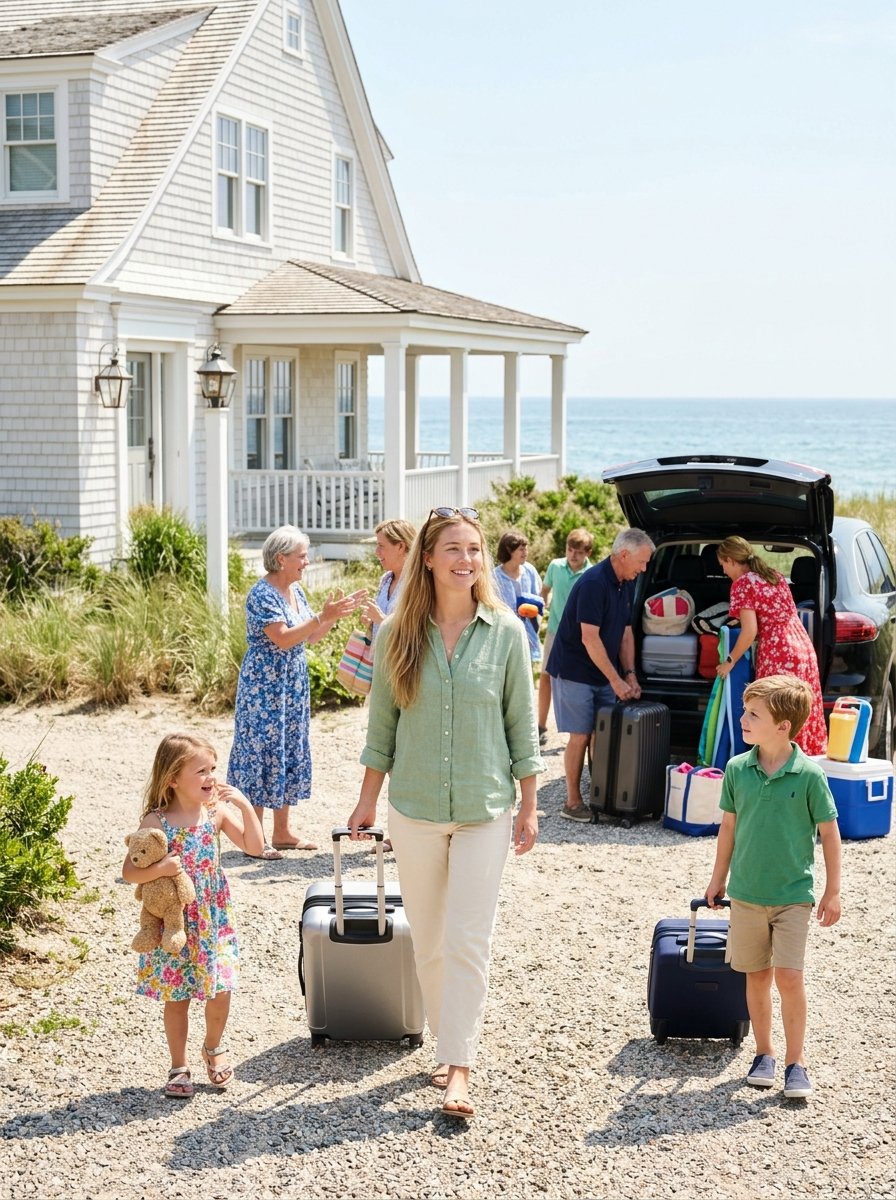
Children pressed against windows.
Beach bags filled back seats.
Coolers were strapped onto roofs.
My father climbed out first.
He wore khaki shorts,
a white polo,
and the expression
he used when challenging restaurant managers.
Mother emerged carrying flowers.
Not for me.
For my bedroom.
Keaton parked behind them.
Hollis lifted two beer cases.
Someone started filming.
Dad reached the porch.
He inserted the stolen key.
It did not turn.
He tried harder.
Then he struck the door.
“Arden!”
I watched from inside
through the new camera feed.
Mother attempted the side entrance.
The alarm sounded immediately.
Its shriek rolled across the water.
Children began crying.
Adults shouted over each other.
Dad called my phone.
I answered on speaker.
“What did you do to the house?”
His voice nearly distorted the microphone.
“I secured it.”
“You changed the locks?”
“Yes.”
“We have twenty people standing outside!”
“You were warned.”
“This is our family weekend!”
“No. It’s my private property.”
Mother appeared beside him.
“You open this door immediately.”
“No.”
“Your aunt drove four hours.”
“She should drive home.”
A shocked silence followed.
My mother lowered her voice.
That was always more dangerous.
“Arden, you are embarrassing us.”
“You brought an audience
to someone else’s house.”
“This house belongs to this family.”
“The deed says otherwise.”
Dad pounded the door again.
“Open it!”
“No.”
He stepped backward.
Then he pointed at Keaton.
My brother approached
carrying a red toolbox.
Naomi saw it too.
“He brought bolt cutters,” she said.
Deputy Dean’s patrol car
turned onto the driveway.
A second cruiser followed.
The crowd changed instantly.
Voices softened.
Beer cases disappeared into trunks.
Phones lowered.
My father straightened his polo.
Deputy Dean stepped out.
“Who owns this property?”
Dad answered before I could emerge.
“Our daughter does,
but this is a family misunderstanding.”
I opened the front door.
“This is not a misunderstanding.”
Mother stared at me.
I wore ordinary clothes.
Jeans.
A gray sweater.
No uniform.
No armor.
Yet her expression suggested
I had become unrecognizable.
Deputy Dean asked
whether anyone possessed permission.
“No,” I said.
Dad laughed sharply.
“She’s emotional.
She works nights.”
The deputy looked at me.
“Do you want them removed?”
My throat tightened.
Old instincts crowded forward.
Make peace.
Avoid spectacle.
Let them enter.
Clean everything afterward.
Then I saw the broken cabinet
inside my hallway.
I remembered silver candlesticks
spilling from Keaton’s bag.
“Yes,” I said.
“I want them removed.”
Mother’s face emptied.
“Arden.”
The single word carried
thirty-six years of commands.
I did not move.
Deputy Dean addressed the group.
“The owner has revoked permission.
Everyone must leave immediately.”
Aunt Liora pushed forward.
“I was promised the main bedroom.”
The deputy blinked once.
“That promise did not come
from the property owner.”
Hollis raised his phone again.
“This is discrimination.”
“Against whom?” Naomi asked.
Nobody answered.
Keaton remained near his truck.
The toolbox hung beside his leg.
Deputy Dean noticed it.
“What were those cutters for?”
“Nothing.”
“Set them down.”
Keaton obeyed.
My father’s anger sharpened.
“You called police on your parents.”
“I reported trespassers.”
“We raised you!”
“And I bought this house.”
“We fed you.”
“You were legally required to.”
Mother recoiled dramatically.
Several relatives murmured.
That trick once worked.
Her wounded silence
had governed whole rooms.
This time,
the lake remained louder.
Water tapped gently beneath the dock.
A breeze moved through pines.
Then Aunt Liora spoke.
“What about our deposits?”
Everyone turned.
My father’s face changed.
Mother whispered,
“Liora, stop.”
But Liora looked furious.
“I paid eight hundred dollars.
Hollis paid six.
The others paid too.”
I stared at her.
“Deposits for what?”
She glanced between my parents.
“For the weekend.”
No one moved.
Even the children quieted.
“How many people paid?”
I asked.
Mother stepped forward.
“Arden, let us discuss this privately.”
“How many?”
Liora opened her phone.
“Your mother charged
each household four hundred dollars.
Eight hundred for lake-facing rooms.”
The truth settled slowly.
They had not merely invaded.
They had rented my house.
My father grabbed Liora’s wrist.
“Put that away.”
Deputy Dean moved immediately.
“Sir, release her.”
Dad did.
Liora backed away.
Her anger had shifted targets.
“She said the money covered
maintenance and property taxes.”
My mother’s mouth opened.
No words came.
Keaton stared at the gravel.
“Hollis,” I said,
“did you pay them before Memorial Day?”
His bravado disappeared.
“Five hundred.”
“How many gatherings happened here?”
Nobody answered.
Naomi lifted her tablet.
“I have recordings
from at least four weekends.”
My knees nearly weakened.
Four.
Four separate invasions.
Four profitable deceptions.
Four times my family
had opened my home
and sold access to it.
Priya had warned me
not to underestimate them.
I finally understood why.
Deputy Dean requested payment records.
Several relatives cooperated immediately.
They were less loyal
once their money became evidence.
Screenshots surfaced.
Transfers.
Payment notes.
Bedroom assignments.
One message from Mother read:
ARDEN WORKS CONSTANTLY.
SHE NEVER USES THE PLACE.
Another promised
private dock access,
unlimited alcohol,
and no owner supervision.
My father had marketed my absence.
My exhaustion had become
their business advantage.
The deputy turned toward me.
“This is beyond simple trespassing.”
“What happens now?”
“We document everything.
Financial fraud may be involved.
Possibly theft.”
Keaton looked up quickly.
“I didn’t steal anything.”
Nobody had accused him yet.
Deputy Dean’s gaze narrowed.
“What did you take?”
“Nothing.”
I walked toward his pickup.
My brother blocked me.
“Don’t.”
That word confirmed everything.
“Move, Keaton.”
His face crumpled strangely.
Not remorse.
Fear.
Deputy Dean ordered him aside.
Inside the truck’s rear compartment,
beneath a stained tarp,
sat a cardboard box.
My grandmother’s candlesticks
rested inside.
So did my missing carving knife,
two crystal bowls,
an antique clock,
and a sealed envelope
from my cedar cabinet.
My name was written across it.
The handwriting belonged
to my late grandmother.
I stopped breathing.
I had never seen the envelope.
Keaton reached for it.
The deputy caught his wrist.
“Do not touch anything.”
Mother began crying.
Not softly.
Not sincerely.
She cried with theatrical gasps,
one hand pressed to her chest.
“This family is being destroyed!”
“No,” Naomi said.
“It is being revealed.”
Mother glared at her.
“You stay out of this.”
Naomi stepped beside me.
“I stayed out long enough.”
Dad pointed toward the road.
“All of you leave.”
Deputy Dean almost smiled.
“You don’t control this property, sir.”
For the first time,
my father looked small.
Not harmless.
Small.
There was a difference.
A second deputy photographed the box.
Keaton admitted taking the items.
He claimed Mother told him
they belonged to the family.
Mother denied it immediately.
“You chose those things yourself.”
Keaton stared at her.
“You gave me the key.”
“I did not.”
“You copied it
from Arden’s emergency ring.”
My stomach turned.
That ring had stayed
inside my Charlotte apartment.
Only three people
had entered recently.
My parents visited
after I caught influenza.
Mother had insisted
on tidying my bedroom.
She had not come to care for me.
She had searched for access.
My father’s voice broke through.
“You cannot prove anything.”
Naomi raised her tablet again.
“Maybe not from the first entry.”
She swiped to another recording.
“But I recorded Patricia
admitting everything yesterday.”
Patricia.
My mother’s first name.
Mother went perfectly still.
Naomi played the audio.
My mother’s voice emerged clearly.
“Arden will complain,
but she always gives in.
Once everyone arrives,
she won’t dare embarrass us.”
Then Dad’s voice followed.
“We earned that house.
She only has it
because we taught her discipline.”
Mother laughed.
“She can work another shift
if something gets broken.”
My chest became hollow.
Not because their contempt surprised me.
Because hearing it
removed my final hiding place.
For years,
I had translated cruelty
into misunderstanding.
I had called entitlement concern.
I had called mockery teasing.
I had called exploitation closeness.
The recording ended.
Nobody defended them.
Aunt Liora lowered her eyes.
Hollis stopped filming.
My father stared at Naomi
with pure hatred.
“You recorded a private conversation.”
“You held it
beside my property line,” she replied.
The deputies separated everyone.
Statements were taken.
Receipts were collected.
Vehicles began leaving individually.
The festive caravan dissolved
into embarrassed departures.
Some relatives avoided my eyes.
Others apologized quickly,
as though remorse
could prevent consequences.
Aunt Liora lingered.
“I thought you knew,” she said.
“You saw Mother’s Memorial Day message.”
Her face flushed.
“I thought she meant
you didn’t know we arrived early.”
“That is not what she wrote.”
“No.”
“Why didn’t you ask me?”
Liora looked toward the lake.
“Because the answer
might have inconvenienced me.”
It was the first honest thing
any relative said that morning.
She transferred every message
and receipt to Priya.
Then she left.
Hollis went next.
At his car,
he turned back.
“I’m sorry about the deck.”
“Did you threaten to sue me?”
His eyes widened.
“Who told you?”
“So you did.”
“I was angry.
Your father said insurance would pay.”
“You fell while trespassing.”
“I know that now.”
“You knew it then.”
Hollis had no response.
He drove away.
Eventually,
only my parents and Keaton remained.
Keaton’s truck was searched.
More belongings appeared.
Linens.
Kitchen tools.
A small Bluetooth speaker.
Three unopened bottles
from my wine rack.
Each discovery stripped another excuse away.
The deputies cited him
and arranged the property’s return.
Whether prosecutors pursued theft charges
would depend on the investigation.
Keaton stood before me afterward,
hands shaking.
“I needed money.”
“So you stole my belongings?”
“Mom said you wouldn’t notice.”
“And that made it acceptable?”
“No.”
His answer was barely audible.
“Why the candlesticks?”
“A collector offered twelve hundred.”
Grandmother had left them to me.
Not because they were valuable.
Because we polished them together
every December.
Keaton knew that.
“You were going to sell them?”
“I didn’t.”
“You hadn’t yet.”
His face twisted.
“I’m in debt.”
“How much?”
“Forty-three thousand.”
Dad swore under his breath.
Mother stared at Keaton.
“What did you do?”
He laughed bitterly.
“Now you care?”
The words opened another door.
Keaton had lost his job
eight months earlier.
My parents knew.
They had concealed it.
He had been gambling online,
borrowing from relatives,
and using rental money
to delay collection notices.
Dad had organized the gatherings
partly to finance him.
Mother had taken a share.
Their family weekends
were an illegal business
built inside my refuge.
“Why not ask me?” I said.
Keaton’s eyes filled.
“Because you would ask questions.”
“Yes.”
“You always make people
feel like patients.”
“No,” I said.
“I ask where the bleeding started.”
He looked away.
The deputies escorted him
to his vehicle.
He was not arrested that morning.
That surprised my parents,
who treated leniency
as proof nothing serious happened.
Priya later corrected them.
The investigation had only begun.
Dad approached me last.
His rage had cooled
into something calculated.
“Drop this,” he said.
“No.”
“You will ruin your brother.”
“Keaton made his choices.”
“He is sick.”
“Then he needs treatment,
not access to my property.”
Dad lowered his voice.
“You owe this family loyalty.”
“I gave you loyalty.”
“Then prove it.”
“I already did.
For thirty-six years.”
Mother stepped beside him.
Mascara streaked her cheeks.
She looked older.
For one dangerous moment,
I remembered childhood fevers,
her cool hand against my forehead,
and songs she once sang
while washing my hair.
Love had existed.
That was what made everything harder.
Harm does not erase
every good moment.
Good moments do not excuse harm.
“Arden,” she whispered,
“please do not do this.”
“I didn’t do this.”
“We made a mistake.”
“You made a business.”
“We needed money.”
“You could have asked.”
“You would have said no.”
There it was.
The whole truth.
Not buried.
Not complicated.
They deceived me
because consent might stop them.
My mother reached for my hand.
I stepped backward.
Her fingers closed on air.
“You are not entering this house again.”
She began crying anew.
“Ever?”
“I don’t know.”
That answer hurt us both.
“But not now.
Not while you still believe
consequences are cruelty.”
Dad took her arm.
“You’ll regret choosing strangers
over your blood.”
I looked toward Naomi.
Then Deputy Dean.
Then the house
I had purchased alone.
“I am choosing safety
over people who harmed me.”
Dad shook his head.
“You’ll die alone in there.”
The words struck precisely
where he intended.
He knew my deepest fear.
He had raised it.
I opened the front door.
“Then at least
I’ll die inside my own home.”
Deputy Dean escorted them away.
Their SUV disappeared among pines.
Silence returned slowly.
Not peaceful silence.
Aftershock silence.
The kind following a code blue,
when discarded wrappers cover the floor
and everyone’s hands begin trembling.
I entered the house.
Naomi followed.
The envelope from Grandmother
sat inside an evidence sleeve.
The deputy allowed me
to open it after photographing everything.
My fingers would not cooperate.
Naomi opened one corner carefully.
Inside rested three folded pages
and a small brass key.
The letter began:
My darling Arden,
if you are reading this,
someone finally opened
the compartment beneath my sewing table.
I looked at Naomi.
“What sewing table?”
She nodded toward the upstairs room.
The narrow mahogany table
had belonged to Grandmother.
I thought it contained
only thread and buttons.
We carried the brass key upstairs.
A hidden lock sat
beneath the lowest drawer.
Inside waited a leather ledger,
property records,
and another sealed packet.
Grandmother had documented decades
of loans to my parents.
Tuition payments.
Mortgage rescues.
Credit card settlements.
Business debts.
Beside nearly every entry,
she had written:
PROMISED REPAYMENT.
The repayment column remained empty.
The final packet contained
a notarized statement.
Grandmother had anticipated conflict.
She wrote that my parents
frequently treated relatives’ property
as communal resources
whenever they faced financial trouble.
She had left the candlesticks,
clock,
and sewing table specifically to me
because I alone
had never requested money.
Then came the final paragraph.
The lake house
had once belonged to her sister.
Not the same structure.
The original cabin
had burned decades earlier.
But the land beneath my home
carried a family history
my parents never mentioned.
Grandmother had sold the parcel
to fund my father’s failed business.
Years later,
without knowing that history,
I purchased part of the same shoreline.
My father recognized it immediately.
That was why he called it
family property.
Not because he owned it.
Because guilt had convinced him
he deserved to reclaim
what Grandmother sacrificed for him.
Naomi sat beside me.
“He knew.”
“Yes.”
“He let you buy it anyway.”
“Yes.”
“And then acted entitled
because his mother once owned the land.”
“Yes.”
Each answer sharpened reality.
My parents had watched me
work double shifts
to purchase property
their own decisions had lost.
They mocked my old car.
They laughed at my packed lunches.
They knew exactly
what the house represented.
Still,
they used it.
Still,
they charged admission.
Still,
they called me selfish.
I reached the letter’s closing.
Grandmother had written:
A home is not family
merely because relatives enter it.
A home becomes family
when the people inside
protect one another’s peace.
If anyone tells you
love requires surrendering your safety,
they are asking for obedience,
not love.
I read those lines twice.
Then a third time.
Exhaustion can make you misread things.
Grief can too.
But the words stayed the same.
That night,
I slept in my own bedroom.
At two in the morning,
a floorboard creaked.
I woke instantly.
My heart hammered.
The alarm panel glowed green.
Every door remained locked.
Nobody was inside.
Yet my body remembered invasion.
I checked each room.
Then checked again.
Finally,
I sat on the kitchen floor
with my back against a cabinet.
Naomi found me there at sunrise.
She had used
the emergency code I gave her.
Permission changed everything.
“I brought biscuits,” she said.
I started crying.
Not because of the biscuits.
Because she knocked first,
even with a code.
She sat on the floor beside me.
We ate without plates.
Butter melted through paper.
Morning spread across the lake.
“I thought boundaries
would make me feel powerful,” I said.
Naomi brushed crumbs
from her blue sweater.
“They make you feel responsible.”
“I feel terrible.”
“That doesn’t mean you were wrong.”
“They looked devastated.”
“Consequences often devastate people
who expected exemption.”
I laughed once through tears.
Then my phone buzzed.
Seventy-eight missed calls.
Hundreds of messages.
Some relatives called me cruel.
Others wanted refunds.
Several demanded
I forgive Keaton immediately.
One cousin asked
whether Thanksgiving was still happening.
I turned the phone off.
For three days,
the house remained quiet.
On Monday,
I returned to Charlotte.
My first shift back
began with a chest pain admission.
Work steadied me.
Bodies told truths
when people would not.
Blood pressure rose.
Oxygen fell.
Pain radiated.
Symptoms demanded attention.
Family wounds hid behind traditions,
jokes,
and obligations.
Priya called during lunch.
Bank records showed my parents
had collected almost eighteen thousand dollars
over fourteen months.
They rented the house
for birthday weekends,
a bachelor party,
two reunions,
and several smaller gatherings.
They had even promised it
for a September wedding.
I nearly dropped my coffee.
“Whose wedding?”
“Your cousin Maren’s.”
Maren was twenty-four.
Quiet.
Kind.
Newly pregnant.
I called her directly.
She answered cautiously.
“Arden?”
“Did my parents offer
my house for your wedding?”
A long pause.
“They said you donated it.”
“I didn’t know about it.”
Her breath caught.
“Oh my God.”
“How much did you pay them?”
“Three thousand.”
“For what?”
“The house, dock,
chairs, catering deposit,
and cleanup.”
My parents did not own chairs.
No caterer had contacted me.
“When is the wedding?”
“Six weeks.”
I closed my eyes.
Maren began crying.
“We already sent invitations.”
Anger surged first.
Then something more difficult.
Choice.
Maren had seen the Memorial Day message.
She had remained silent.
But she had also been deceived.
Boundaries were not punishment.
If I used them as revenge,
I would become another person
who treated access as control.
“The wedding cannot happen there,” I said.
“I understand.”
“I’m sorry.”
“You don’t owe me an apology.”
Her answer broke something open.
“My parents owe you money.”
“They said it was nonrefundable.”
“It wasn’t theirs to take.”
Priya helped Maren file a claim.
I contacted a legitimate venue coordinator.
An outdoor chapel nearby
had a cancellation that week.
I did not pay everything.
I did not rescue everyone.
But I introduced Maren
to someone honest.
She and her fiancé
booked a smaller ceremony
they could actually afford.
That mattered.
Help without surrender.
Compassion without self-erasure.
I was learning the difference.
The criminal investigation expanded.
My parents retained an attorney.
They stopped calling directly.
Their lawyer described everything
as an informal family arrangement.
Priya answered with deeds,
messages,
payment transfers,
camera recordings,
and Grandmother’s ledger.
The phrase informal arrangement
disappeared from later letters.
Keaton entered inpatient treatment
for gambling addiction.
The prosecutor delayed certain charges
while evaluating restitution
and treatment compliance.
I supported that decision.
Dad accused me
of controlling the process.
I was not.
That was another truth
he could not accept.
Not every outcome
revolved around my obedience.
Weeks passed.
Autumn touched the shoreline.
The damaged dock was repaired.
The broken cabinet lock was replaced.
I installed motion lights,
reinforced windows,
and added Naomi
as my only emergency contact.
Priya recommended
a property management audit.
The inspector found
more than broken objects.
Repeated overcrowding
had damaged the septic system.
A deck support had cracked
where Hollis fell.
One overloaded outlet
showed scorch marks.
They had nearly burned
the house down.
Repair costs exceeded twelve thousand dollars.
Insurance denied most of them
because the gatherings were unauthorized.
My parents were ordered
to preserve their financial records.
That was when
their story finally collapsed.
Dad had not used
the rental money solely for Keaton.
He had financed
a luxury fishing boat deposit.
Mother had paid
for a cruise with Aunt Liora.
Liora returned her portion immediately.
My parents had called it necessity.
Their bank statements called it indulgence.
The prosecutor offered resolutions.
Restitution.
Probation.
No contact with my property.
Community service.
Mandatory financial fraud counseling.
Keaton’s agreement included treatment,
repayment,
and a formal admission of theft.
My parents resisted.
Dad wanted trial.
Mother feared public testimony.
The family divided into camps.
I refused to join either one.
At Priya’s office,
I reviewed the proposed agreement.
“If they accept this,” I asked,
“does it erase what happened?”
“No.”
“Does it mean I forgive them?”
“No.”
“What does it mean?”
“It means the court
can enforce consequences
without asking you
to sacrifice more years.”
That mattered most.
Time had already been taken.
I would not donate more.
My parents accepted
the night before the hearing.
In court,
Dad stared straight ahead.
Mother twisted a tissue
between both hands.
Keaton sat separately
with his treatment counselor.
The judge reviewed every condition.
Then she addressed my parents.
“Your daughter’s success
did not create your entitlement.”
Dad’s jaw tightened.
The judge continued.
“Family relationships do not override consent.
Ownership is not disrespect.
Refusal is not abuse.
And access obtained through deception
is not hospitality.”
Mother lowered her head.
I felt no triumph.
Only a tired release.
The judge ordered full restitution.
Payments would continue for years.
All profits had to be returned.
Repair costs were included.
The no-contact order covered
my house, workplace,
and Charlotte apartment.
Personal communication remained prohibited
for twelve months,
unless initiated through counseling
and approved channels.
Outside the courtroom,
Keaton approached with his counselor.
He looked thinner.
Clearer.
Ashamed.
“I signed the admission,” he said.
“I know.”
“I wrote you a letter.”
“You can give it to Priya.”
He nodded.
“I’m not asking you
to read it now.”
That restraint was new.
I looked at him carefully.
“How long since you gambled?”
“Eighty-three days.”
“That is good.”
“It doesn’t fix anything.”
“No.”
“I used to think
being sorry meant feeling awful.”
His eyes remained on mine.
“My counselor says
it means changing what happens next.”
I thought about that.
“She sounds wise.”
“He.”
The correction surprised a smile from me.
Keaton almost smiled too.
Then his face grew serious.
“I told them everything.”
“What else was there?”
His hands tightened.
“Dad planned to refinance the property.”
My breath stopped.
“He couldn’t.”
“He knew that.
But he had copies
of your tax records,
signature samples,
and Social Security number.”
Cold spread through me.
“From where?”
“Your apartment.
Mom photographed your filing cabinet
when you had influenza.”
The hallway tilted slightly.
Priya stepped closer.
“What exactly were they planning?”
Keaton swallowed.
“A fraudulent family trust.
Dad knew someone
who could prepare documents.”
The fishing boat,
the rentals,
the missing valuables—
none represented the final danger.
My parents had intended
to create paperwork
suggesting the house belonged
inside a shared trust.
Perhaps the scheme would fail.
Perhaps not.
But they had moved beyond entitlement.
They had begun constructing ownership.
Keaton provided names,
messages,
and a thumb drive.
The second investigation
reached a document preparer
already suspected in other fraud cases.
My parents’ plea agreement
had to be reconsidered.
Dad blamed Keaton.
Mother blamed Dad.
Their alliance fractured
the moment loyalty demanded sacrifice
from either of them.
Additional charges followed.
Forgery conspiracy.
Identity theft preparation.
Attempted financial fraud.
Their attorney negotiated again.
This time,
the court imposed stricter probation,
electronic monitoring,
higher restitution,
and permanent restrictions
from handling my financial information.
The document preparer received
separate criminal charges.
My credit was frozen.
Every account was secured.
The deed was flagged
against unauthorized filings.
Priya helped create a trust
of my choosing,
managed by people
I actually trusted.
The irony was brutal.
My parents’ attempted theft
forced me to protect
the future they tried to seize.
Months later,
Keaton’s letter arrived
through Priya.
I waited two weeks.
Then I read it
beside the lake.
He did not ask forgiveness.
He described every stolen item,
every lie,
every gathering,
and every time
he watched our parents manipulate me.
He admitted resenting
my stability.
He thought I was lucky.
He never counted
the nights I worked,
the holidays I missed,
or meals I skipped.
He wrote:
You built a life
while I kept searching
for shortcuts into one.
Then we treated
what you built
as proof you owed us.
I am learning
that envy can disguise itself
as fairness.
At the end,
he promised repayment.
Not someday.
A schedule followed.
Small monthly amounts.
Almost embarrassingly small.
But the first payment
had already arrived.
Forty dollars.
I kept the receipt
inside Grandmother’s ledger.
Not because forty dollars
repaired the damage.
Because accountability begins
where excuses stop.
Maren’s wedding took place
on a cool October afternoon.
I almost declined the invitation.
Then she called.
“I want you there,” she said.
“Not because of the venue.
Because you helped me
without pretending nothing happened.”
So I went.
The chapel stood
beneath red maple trees.
There were thirty-two guests,
folding chairs,
white lanterns,
and no lake-facing bedroom assignments.
Maren wore her grandmother’s veil.
Her fiancé cried
before she reached the aisle.
Aunt Liora sat behind me.
After the ceremony,
she asked permission
to share my table.
That phrase mattered.
“May I?”
“Yes.”
She sat quietly.
Then she returned
a small velvet pouch.
Inside lay the missing gold earring.
“I found its pair
after the police visit,” she said.
“I should have spoken sooner.”
“Yes.”
“I enjoyed what silence gave me.”
I waited.
She did not dilute it.
“I am sorry.”
“Thank you for saying it plainly.”
“Will you ever forgive me?”
“I don’t know.”
Her eyes filled,
but she nodded.
“That is fair.”
We ate cake together.
We did not pretend closeness.
Yet we did not perform hatred either.
Sometimes healing begins
without reunion.
Sometimes it begins
with accurate distance.
Winter arrived early.
The lake house became
a quiet white shape
between bare trees.
I spent Christmas there
for the first time alone.
At least,
I expected to be alone.
At noon,
Naomi knocked.
She carried soup,
two wrapped books,
and a crooked wreath.
Behind her stood Maren
and her new husband.
Keaton was not there.
My parents were not there.
No one arrived uninvited.
No one brought luggage.
No one claimed a bedroom.
“Can we come inside?” Naomi asked.
I looked at the three faces.
Then at the clean hallway.
My pulse stayed steady.
“Yes.”
We ate beside the fireplace.
Maren helped polish
Grandmother’s candlesticks.
Her husband repaired
a loose kitchen drawer
only after asking.
Naomi beat us all
at three games of cards.
Before sunset,
they packed their things.
Nobody expected overnight access.
Nobody left me cleaning alone.
At the door,
Maren hugged me.
“This feels like a family house,” she said.
Fear flickered through me.
She noticed.
“I mean because you invited us.”
The fear softened.
“Then yes,” I said.
“It does.”
After they left,
snow began falling.
I carried Grandmother’s letter
to the window.
Lights from the repaired dock
shimmered beneath the flakes.
My phone remained quiet.
The court order helped.
Distance helped more.
That spring,
the no-contact period ended.
A counselor contacted me
on my mother’s behalf.
She requested one supervised session.
Dad refused counseling.
He still insisted
I had humiliated him publicly.
Mother’s request contained
no demand for forgiveness.
That difference mattered.
I agreed to one meeting.
The counselor’s room
held two gray chairs
and a box of tissues.
Mother entered slowly.
Her hair had grown longer.
She sat across from me.
For several minutes,
neither of us spoke.
Then she said,
“I knew the house was yours.”
No excuses followed.
“I knew every time.”
My chest tightened.
“Why did you do it?”
“Because your father believed
children’s success belonged
to their parents.”
“And you?”
She looked down.
“I believed keeping him pleased
was how families survived.”
“So you sacrificed me.”
“Yes.”
The word landed quietly.
Not softer.
Just cleanly.
She told me
the lake parcel history.
Grandmother’s sacrifice
had haunted Dad for years.
He felt cheated
by consequences he created himself.
When I purchased nearby land,
he interpreted coincidence
as restoration.
He spoke about the house
until Mother began believing
my ownership was technical,
while their claim was moral.
“But you saw my name
on every document,” I said.
“Yes.”
“You copied my key.”
“Yes.”
“You photographed my records.”
Her hands began trembling.
“Yes.”
“Did you plan
to take the house?”
She looked directly at me.
“I told myself
we were protecting it.”
“That was not my question.”
Her face collapsed.
“Yes.”
Silence filled the room.
I had imagined this confrontation
hundreds of times.
In those versions,
she begged.
I condemned her.
Justice felt hot.
Reality felt unbearably sad.
“You once cared for me,” I said.
“I still do.”
“No.
I mean when I was little.”
Tears gathered in her eyes.
“I remember.”
“What happened?”
She pressed her palms together.
“I made peace
with smaller wrongs.
Then larger ones felt normal.”
That answer frightened me
because I understood it.
I had done the same.
Each surrendered boundary
prepared the next surrender.
Each excuse softened another wound.
“Are you asking
to return to my life?”
“I am asking
whether I may earn
a different place in it.”
“What place?”
“Whatever you decide.”
For once,
she did not define my duty.
I gave her conditions.
No unscheduled calls.
No home visits.
No financial questions.
No messages through relatives.
Continued counseling.
Full compliance with restitution.
No blaming Keaton.
No minimizing Dad’s involvement.
“If you break one condition,” I said,
“I step away.”
Mother nodded.
“I understand.”
“I don’t trust you.”
“I understand that too.”
We did not hug.
We scheduled no holiday.
But three weeks later,
she mailed a card.
Nothing manipulative appeared inside.
Only two sentences:
I attended counseling today.
I hope your night shift was gentle.
It was not reconciliation.
It was a beginning
small enough to be honest.
Dad chose differently.
He sent messages through relatives,
calling me cold,
ungrateful,
and controlled by outsiders.
I returned each message
to his attorney.
Eventually,
people stopped carrying them.
Without messengers,
his anger had nowhere to travel.
A year passed.
Then another.
Keaton completed treatment.
He found steady work
repairing medical equipment.
The irony amused him.
“Machines make sense,” he told me.
“They show you
exactly where they’re broken.”
“People can too,” I said.
“We just hide the warning lights.”
We met for coffee
in a public place.
He brought no request.
No emergency.
No plan requiring money.
When the check arrived,
he paid for himself.
That tiny act
nearly made me cry.
He continued restitution.
Forty dollars became sixty.
Then one hundred.
He never missed a month.
I did not give him
a key to the lake house.
He never asked.
Mother remained imperfect.
Sometimes her old voice returned.
She once said,
“Your father is still hurting.”
I answered,
“That is not mine to fix.”
She went silent.
Then she said,
“You’re right.”
That correction cost her something.
I heard it.
Over time,
we met occasionally
with the counselor.
She apologized to Maren.
Then Naomi.
Then Aunt Liora.
She stopped asking
when everything would feel normal.
Normal had protected the wrong people.
We were building something else.
Dad violated probation
by contacting the document preparer.
The court extended monitoring.
After that,
Mother moved into a small apartment.
She did not ask me
to pay her deposit.
She found part-time work
at a garden center.
For her first birthday there,
I sent yellow tulips.
No invitation.
No promise.
Just flowers.
She thanked me once.
That was enough.
Three years after Friday’s confrontation,
I changed the lake house again.
Not the locks.
Those remained excellent.
I converted the smaller guest room
into a rest space
for nurses from my hospital.
One person at a time
could stay free
after particularly traumatic rotations.
They applied privately.
They received written permission,
clear dates,
and their own temporary code.
The first guest was Elena,
a young intensive-care nurse
who had lost two patients
during the same shift.
When she returned,
she left a note.
I slept twelve hours.
Then I remembered
silence can be kind.
I framed that sentence
near the kitchen.
Soon other nurses came.
They rested.
They walked beside the water.
They drank coffee on the dock.
Nobody called the house
a free vacation rental.
Nobody assumed access.
Every guest left it gentler
than they found it.
The place finally gained
what Hollis once mocked me for withholding.
Real family energy.
Only it did not come
from entitlement or blood.
It came from care.
On the fourth summer,
Keaton completed restitution.
His final payment arrived
with no dramatic message.
Just:
Paid in full.
Thank you for allowing accountability.
I invited him
to the lake house afterward.
Not overnight.
Lunch.
He parked beside Naomi’s fence
and waited outside.
When I opened the door,
he held a small wooden box.
“May I come in?”
“Yes.”
His eyes moved
through the restored hallway.
He looked older.
Healthier.
He placed the box
on the kitchen table.
Inside rested a carved stand
for Grandmother’s candlesticks.
He had made it himself.
Two intersecting pieces
held the silver safely upright.
“I remembered they always tipped,” he said.
“They did.”
“I’m sorry I treated memories
like inventory.”
I touched the smooth wood.
“Thank you.”
We carried lunch outside.
Halfway through,
he looked toward the dock.
“Dad still says
you stole everyone from him.”
“I know.”
“He does not understand
that people left
when he stopped controlling access.”
“No.”
Keaton rubbed one thumb
against his coffee cup.
“He may never understand.”
“I know that too.”
“Does that hurt?”
“Yes.”
The answer surprised him.
“Boundaries don’t stop grief,” I said.
“They stop repeated injury.”
He nodded slowly.
Then we watched a sailboat
cross the far water.
No grand forgiveness occurred.
No music swelled.
He washed his plate.
I dried it.
Sometimes peace arrives
through ordinary completed tasks.
Later that autumn,
Dad suffered a minor stroke.
Mother informed me
through the approved channel.
I was not his nurse.
I did not rush
into the role he expected.
But I called his hospital
after receiving permission.
His prognosis was good.
He entered rehabilitation.
Two weeks later,
a letter came.
His handwriting slanted unevenly.
Most of it defended him.
He wrote about sacrifice,
respect,
and family hierarchy.
Then near the end,
one line changed everything:
I knew you were working
while we used the house.
It was not apology.
It was confession.
He had known.
All along.
He had pictured me
walking hospital corridors at night
while strangers occupied my bed.
He understood the contrast.
He simply believed
his desire mattered more.
For years,
I needed him
to understand my pain.
His letter proved
understanding had never been missing.
Respect had.
That revelation freed me
from explaining further.
I answered with three sentences:
I received your letter.
I hope rehabilitation goes well.
My boundaries remain unchanged.
Then I released the rest.
Not forgiveness forced by illness.
Not reunion demanded by age.
Release.
The refusal
to keep holding arguments
inside an empty courtroom.
Five years after the first invasion,
I stood on the repaired dock
before another night shift.
Dawn spread coral light
across Lake Norman.
The water barely moved.
Behind me,
the house waited
with locked doors,
warm lamps,
and clean blue sheets.
Naomi approached carrying coffee.
She moved more slowly now,
but her silver braids
still swung behind her.
“Big day?” she asked.
“Fourteen years at the hospital.”
“You counting the double shifts?”
“Especially those.”
She handed me a cup.
My phone buzzed.
Once.
Not seventy-eight times.
Mother had written:
Thinking of you today.
No demand followed.
Keaton sent a photograph
of the final restitution receipt
framed above his workbench.
Maren shared a picture
of her daughter
wearing Grandmother’s old sunhat.
My life had not become empty.
It had become selective.
That was not the same thing.
Naomi looked toward the house.
“You ever regret it?”
“Which part?”
“Saying no.”
I considered the question.
The ruined gatherings.
The courtroom.
The sleepless nights.
The truth about my parents.
The years required
to feel safe again.
“No,” I said.
“I regret how long
I believed no required permission.”
Naomi smiled.
A heron lifted
from the shoreline.
Its wings crossed
the brightening reflection
without disturbing much water.
I finished my coffee.
Then I walked back
through the house.
In the kitchen,
Grandmother’s candlesticks stood
on Keaton’s carved base.
Her letter rested nearby.
The framed note from Elena
caught the morning light.
Different kinds of family.
Different forms of repair.
At the front door,
I entered the alarm code.
The locks engaged softly.
Not like a prison.
Like a promise.
Outside,
my old silver Civic waited.
I could afford another car now.
I kept this one
because nobody’s mockery
could change what it represented.
Every dent remembered survival.
Every mile had carried me
toward something truly mine.
I slid behind the wheel.
Before starting the engine,
I looked once more
at the lake house.
It was no longer
the place where family betrayed me.
It was where I learned
love must knock.
Love must ask.
Love must hear no
without becoming cruel.
And when the people outside
refuse those simple things,
closing the door
is not the death of family.
Sometimes,
it is the first moment
a real home begins.