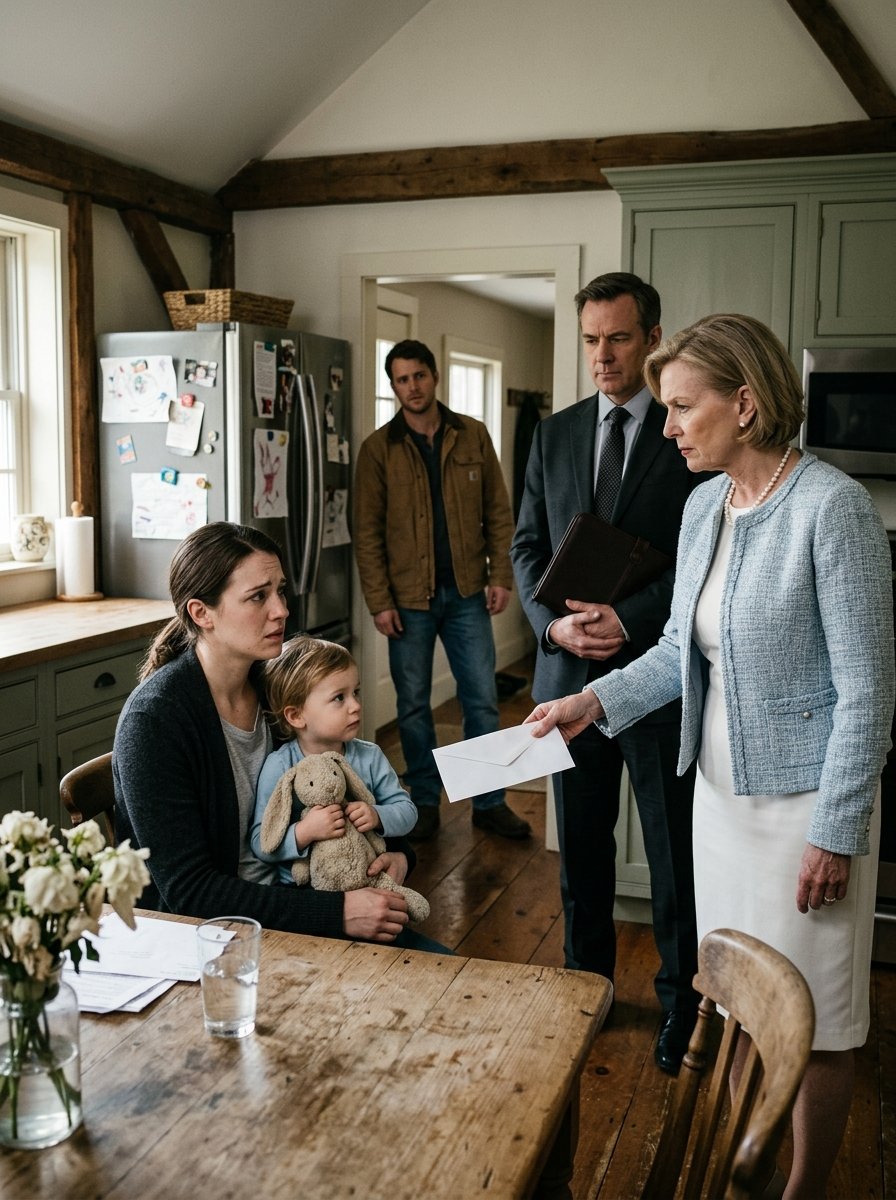
“Where’s my fifteen hundred dollars? It’s the tenth. Don’t tell me you’re going to leave your mother-in-law empty-handed because of your petty little moods.”
Beatrice’s voice pierced the living room before Valerie could even take off her heels. Outside, the sweltering July heat of Phoenix beat down like an oven; inside, the air conditioning ran at full blast—paid for, of course, on Valerie’s credit card.
Beatrice sat at the glass dining table wearing a brand-new silk blouse with freshly manicured nails. Everything about her looked expensive, paid for by someone else. And that someone was Valerie.
For nearly five years, Valerie had transferred $1,500 every single month to her mother-in-law for “personal spending.” That didn’t include groceries, electricity, water, high-speed internet, or prescription meds—Valerie paid for those directly. The $1,500 was strictly for salon visits, luxury brunches with friends, designer clothes, gifts for Beatrice’s daughter, and weekend trips that the older woman bragged about on social media as if she’d earned them herself.
Valerie worked as a senior project director for an international logistics firm. She made a great salary, but not because money fell from the sky. Her life was a constant blur of corporate meetings, airport terminals, 3:00 a.m. conference calls, and high-stakes deadlines. In the beginning, she had agreed to help her husband’s family because she believed it would maintain peace in her marriage.
She was dead wrong.
“I had a liquidity issue with my accounts this month,” Valerie said, setting her briefcase down on a chair. “I’m not transferring anything today. We’ll reassess next month.”
Beatrice’s eyes widened as if she’d just heard a blasphemous insult.
“Excuse me? You joined this family to respect your elders! I am Mason’s mother! If I have to beg you for pocket money like a charity case, what are my friends going to say?”
“That your personal lifestyle expenses aren’t my legal or moral responsibility.”
The silence lasted barely two seconds.
Beatrice launched into a barrage of insults. She mocked Valerie’s parents, claimed Valerie thought she was superior just because she made significantly more money than Mason, and even brought up how Mason was “generous enough” to marry a thirty-four-year-old career woman who worked too much.
Valerie didn’t raise her voice.
“That top you’re wearing cost four hundred dollars. The resort trip to Sedona last month was paid for by me. Your daughter’s spa membership comes off my card. I am not an endless piggy bank.”
Beatrice stepped forward, trembling with rage. “You ungrateful bitch.”
And she slapped her across the face.
The blow was so hard that Valerie felt a metallic taste in her mouth. Her lip split open. For years, she had swallowed microaggressions and insults to keep her marriage intact. But that physical strike shattered something permanent inside her.
Valerie raised her eyes, her gaze stone-cold.
Beatrice raised her hand again.
This time, Valerie caught her wrist in mid-air. In the ensuing struggle, she shoved Beatrice away to protect herself. Beatrice lost her balance and stumbled backward onto the area rug, knocking over a ceramic vase.
“She attacked me!” Beatrice instantly shrieked at the top of her lungs. “Mason is going to see what a monster you really are!”
The front door opened at that exact second.
Mason walked in, saw his mother sprawled on the floor, and spotted his wife’s bleeding lip.
He didn’t ask what happened.
He charged straight at Valerie.
And in that moment, Valerie understood that her mother-in-law’s slap was not the worst thing that was going to happen that day.
PART 2
“You laid a hand on my mother?!” Mason roared.
Valerie barely managed to say, “She hit me first—” before he grabbed her violently by the arm and shoved her against the hallway wall. Beatrice, already back on her feet, made no attempt to stop her son. In fact, she egged him on.
“Show her who runs this house!”
Mason completely lost control. He shouted profanities, grabbed her hair, and struck her repeatedly while Valerie covered her face and head with her arms. There were no cinematic heroics, no witty comebacks—just fear, sharp pain, and a chilling realization: the man she had been married to for five years was capable of physically brutalizing her to defend his mother’s fragile vanity.
When he finally pulled back, breathing heavily, Mason pointed aggressively at the front door.
“If you can’t live under our rules, get the hell out of my house!”
Valerie, her face swollen and bruised, stared back at him.
The phrase was almost comical. The house was titled solely in Mason’s name because he had purchased it shortly before they married, yes—but the mortgage payments, HOA fees, property taxes, home maintenance, his truck lease, utilities, and a massive chunk of Beatrice’s lifestyle came straight out of Valerie’s paycheck.
Without saying a single word, she walked into the master bedroom. She pulled out a medium suitcase, packed her essential documents, basic clothing, and opened the safe in the closet.
Inside was a sealed envelope that had been sitting there for six months: a draft of divorce papers prepared by her lawyer after a previous night of verbal abuse.
She walked back to the living room and dropped the paperwork on the glass table.
“Sign them whenever you’re ready. My attorney will handle the rest.”
Mason went pale.
Beatrice let out a sharp, nervous laugh. “You’ll be crawling back here in three days!”
Valerie walked out the door without looking back.
In the Uber heading toward her parents’ home in North Scottsdale, she opened her banking app on her phone. First, she canceled Mason’s authorized secondary credit card. Next, she removed her bank account from the automatic bill-pay for the house mortgage and utilities. Finally, she canceled the recurring $1,500 monthly transfer to Beatrice.
She didn’t touch a single dollar that wasn’t hers. She simply stopped funding the lives of grown adults who had spent years pretending they could afford a lifestyle she was bankrolling.
Then she remembered something.
A year prior, she had installed a discrete indoor nanny-cam in the living room after several valuable items disappeared during a family visit. The camera was still active and recording directly to her secure cloud account.
She opened the app and downloaded the footage.
Everything was there in crisp high-definition video and audio:
- The struggle.
- Beatrice demanding money.
- The initial slap.
- Mason walking in without asking questions.
- The physical assault, the verbal threats, and Beatrice cheering him on.When Valerie arrived at her parents’ house, her mother, Elena, dropped the garden hose she was holding in the yard. Her father, Richard—a retired senior detective with the Phoenix Police Department—didn’t scream. He simply walked over, gently lifted her chin, and examined her injuries.“Was it Mason?”Valerie nodded.That same afternoon, they went to an urgent care clinic. Doctors documented every contusion, bruise, and the laceration on her lip. Afterward, accompanied by a trusted family law attorney, Valerie went to the precinct, filed a formal police report for domestic battery, and handed over a flash drive containing the cloud footage.The investigating detective watched the video twice.“There’s no ‘he-said, she-said’ here,” the detective said flatly. “The video clearly establishes the primary aggressor, the incitement, and your self-defense.”Valerie took a slow, deep breath. For the first time in years, she felt no guilt for protecting herself.That night, Mason invited several of his buddies out for an expensive seafood dinner in Old Town Scottsdale. He wanted to prove to himself that nothing had changed. He ordered premium steaks and wine without checking prices, and at the end of the night, smugly slapped his black credit card onto the bill tray.A few minutes later, the waiter returned. “Sir, this card was declined.”His friends stopped laughing. Mason called the bank in a panic, only to hear the automated recording state that the primary account holder had removed his authorized user status.The next morning, Beatrice checked her bank account and realized her $1,500 transfer hadn’t arrived either.Before she could finish cursing Valerie’s name, there was a heavy knock at the front door.It wasn’t Valerie.It was two Maricopa County Sheriff’s deputies serving a formal criminal summons and an emergency Order of Protection that legally prohibited both Mason and Beatrice from contacting or coming within 500 feet of Valerie.Beatrice sneered at the deputies’ paperwork. “A restraining order? We’ll see if her wealthy family has the nerve to say that to my face.”And she convinced Mason to make the fatal mistake that would seal their ruin.PART 3At eleven o’clock that morning, a taxi pulled up outside Valerie’s parents’ gated driveway in Scottsdale.Beatrice, Mason, and Mason’s younger sister, Lauren, stepped out onto the sidewalk. They were furious, sweating in the Arizona heat, convinced that causing a public scene in an affluent neighborhood would force Valerie’s parents to surrender out of embarrassment.The Order of Protection was crystal clear: Mason was barred from any contact or proximity. But Beatrice insisted it was “just a piece of paper” and that if they made enough noise, Valerie would cave.Beatrice marched right up to the front gate.“Valerie! Get out here right now! After everything this family did for you!”Lauren began shouting at the top of her lungs that Valerie was an unfaithful wife, that she’d abandoned her husband, and that she was trying to leave a “poor elderly woman” destitute.Mason stood behind them, calling out, “Valerie, I’m willing to forgive you! Just come outside, reactivate the cards, and stop acting crazy!”
Inside the house, Valerie watched everything on the security monitors. The swelling on her face had gone down slightly, but the deep bruising was undeniable. Her mother stood by her side while her father, Richard, stood with his arms crossed, watching the screen. Their attorney, Veronica, was already on the phone with the local police precinct.
“He is voluntarily violating a served protection order on camera,” Veronica said. “Do not go outside.”
Richard informed dispatch that a suspect with an active Order of Protection was currently attempting to breach his property.
Outside, Beatrice kept screaming. “Fifteen hundred dollars is pocket change to you! Give me my money and this circus ends!”
Every word was picked up in crystal-clear audio by the driveway security cameras.
Valerie stared at the monitor. She didn’t feel the intense rage she thought she would. Instead, she felt a profound, heavy disappointment. After a physical beating, a police report, and a legal restraining order, neither Mason nor his mother cared about the violence they had committed.
They only cared about the money.
When two police cruisers pulled up with lights flashing, Mason tried to back away toward the taxi.
Officers verified the Order of Protection, spoke briefly with Veronica and Richard, and immediately placed Mason in handcuffs for felony violation of an order of protection and interference. Beatrice tried to throw herself between the officers and her son, but an officer firmly escorted her back to the sidewalk.
Then, something happened that Valerie could never have envisioned two days earlier.
Her mother-in-law began to beg.
Looking directly toward the house windows, Beatrice shrieked, “Valerie, honey, please tell them it’s a misunderstanding! Mason was just stressed! I was stressed! We’re family!”
Valerie walked out onto the front porch, but remained well behind the locked iron gate.
“When you slapped me across the face, you didn’t treat me like family,” Valerie said calmly. “When you told your son to hit me harder, you didn’t care about family.”
Beatrice went dead silent.
Mason yelled from the back of the police cruiser, “Valerie, don’t do this! You’re going to ruin my life!”
“No, Mason,” she replied, her voice unwavering. “You ruined your own life. I just stopped hiding what you did.”
The police cruiser pulled away. Lauren hailed another ride and abandoned her mother on the curb without saying goodbye. Beatrice was left standing alone on a scorching sidewalk, her pride in tatters, without a single person left to fund her life.
The true consequences, however, unfolded in the months that followed.
For years, Mason had projected the image of a wildly successful professional. He held a mid-level government administrative job with a modest salary, yet he drove a late-model luxury truck, paid for expensive dinners, and took trips—all bankrolled by Valerie’s high-limit credit cards and income.
When her money vanished, his artificial lifestyle vanished with it.
The mortgage on his house came due. Mason had to cover the $3,200 monthly payment solely on his own salary. He couldn’t.
Beatrice discovered that the electric bill, high-speed internet, landscaping, and her cell phone plan were no longer linked to Valerie’s accounts. Notices began piling up in the mailbox.
Beatrice called her daughter. “Lauren, I need you to send me some cash.”
“Mom, I don’t have money to give you.”
“But Valerie used to give you money!”
“Valerie gave me money. You don’t. Figure it out.” And she hung up.
The extended relatives who received lavish holiday gifts every year stopped calling. Beatrice’s country-club acquaintances evaporated when there were no more sponsored brunches or spa invites. The woman who had spent half a decade acting like a wealthy matriarch realized, far too late, that her status had been entirely financed by the daughter-in-law she treated like a servant.
Meanwhile, Valerie returned to work.
It wasn’t easy. There were mornings she sat in her car in the office parking garage for ten minutes, practicing deep breathing to stave off panic attacks. There were nights she woke up sweating, hearing the sound of the front door opening and Mason’s heavy footsteps in the hall. She started seeing a trauma therapist. She changed all her security codes, restructured her bank accounts, and stopped apologizing for establishing boundaries.
She also stopped repeating the phrase that had kept her trapped for years: “For the sake of the family.”
Because she finally understood that a family that demands your silence to protect an abuser isn’t a family—it’s a hostage situation.
Two months later, the preliminary court hearing took place.
Mason appeared with a public defender. He wasn’t wearing the custom suits Valerie used to buy him or the expensive watch he used to show off. He looked exhausted, visibly thinner, and thoroughly humbled.
Beatrice sat in the gallery behind him. When she saw Valerie walk in wearing a sharp white blazer alongside her attorney and parents, she sneered under her breath. “Look at her… playing the saint.”
Valerie heard her, but didn’t even turn her head.
In the courtroom, the nanny-cam video was played on the main display monitors.
There was no room for interpretation:
- Beatrice demanding cash.
- Beatrice striking first.
- Valerie attempting to push her away in self-defense.
- Mason barging in without asking questions.
- Mason shoving, grabbing, and striking his wife while his mother cheered him on.
For the first time in her life, Beatrice had to listen to her own cruel words echoed in a room where shouting couldn’t save her.
Mason kept his eyes glued to the floor.
Facing overwhelming physical evidence, Mason’s legal counsel negotiated a plea agreement that included a formal admission of guilt, mandatory domestic violence intervention programs, restitution, and a strict permanent order of protection. The prosecutor ensured that the domestic violence conviction remained on his permanent record.
The divorce proceedings moved forward separately.
Mason attempted to text her from burner numbers:
“I just want to talk like adults.”
“My mom is sick because of all this stress.”
“We can put this behind us.”
Valerie forwarded every message directly to her attorney and blocked the numbers.
During the financial settlement hearing, the judge reviewed the property. The house had been purchased by Mason prior to the marriage, so Valerie did not claim ownership of the real estate.
Beatrice smirked in the gallery, foolishly believing they had won.
Until Valerie’s attorney clarified that Valerie would also assume zero future financial liability for the mortgage, HOA fees, or home equity loans.
The remaining balance on the mortgage was astronomical.
Mason stared at his lawyer in terror. “But she always paid the mortgage!”
“Voluntarily paying your mortgage during the marriage does not create an ongoing legal obligation to pay it after you assault her,” Veronica stated flatly to the judge.
Beatrice leaned over the railing, whispering frantically, “Tell her she can’t leave us with the debt!”
Valerie looked back at her calmly. “The house is Mason’s. So is the debt.”
Beatrice’s smirk vanished forever.
Sometime later, Mason lost his job. It wasn’t because Valerie called his employer or because her father pulled strings; his department launched an internal review when his domestic violence conviction became public record and his unexcused absences accumulated. Having spent years relying on Valerie’s financial cushion, he couldn’t handle the pressure, began drinking heavily, and performed poorly at work.
Eventually, the bank initiated foreclosure proceedings on the house.
Beatrice was forced to sell her jewelry, then her designer furniture, just to afford a small rented apartment.
One afternoon, Beatrice showed up near Valerie’s corporate office building. Unable to approach due to the restraining order, she left an envelope with the front desk receptionist.
Valerie opened it in the presence of her attorney.
It wasn’t an apology. It was an itemized list of Beatrice’s living expenses: rent, prescription co-pays, grocery bills, and legal fees.
At the bottom, she had written:
“If you ever considered me a mother, send me at least a thousand a month.”
Valerie read the note twice, then handed it to Veronica to add to the court harassment file.
“Are you going to reply?” Veronica asked.
“No.”
And she never did.
That evening, Valerie bought three first-class tickets to take her parents on a weekend getaway to Sedona. It wasn’t a flex or a stunt; she simply wanted to sit on a quiet resort balcony with them, drink good wine, and enjoy the company of people whose love didn’t come with a price tag.
Nearly a year after the assault, Valerie sat on a balcony overlooking the ocean during a business conference in San Diego. Her logistics firm had just closed one of the largest corporate accounts of her career.
Her phone buzzed with an email from a former mutual acquaintance. Attached was a photo taken from afar showing Mason working as a ride-share driver in Phoenix. He looked aged, disheveled, and completely drained.
The caption read: “Look how far he’s fallen.”
Valerie looked at the picture for a few seconds, then deleted it permanently.
She didn’t need to see Mason hit rock bottom to know that she had won.
She had won the day she stopped financing her own abuse. She had won when she used evidence instead of emotion, when she asked for help without shame, and when she accepted that real love never demands that you accept violence, disrespect, or financial manipulation.
For years, she had believed that keeping the peace meant paying, staying quiet, and ceding her dignity.
Now she knew the truth.
Peace purchased through fear isn’t peace—it’s an unpayable debt.
And eventually, you just have to stop paying it.