At JFK Airport, I discovered my widowed daughter-in-law
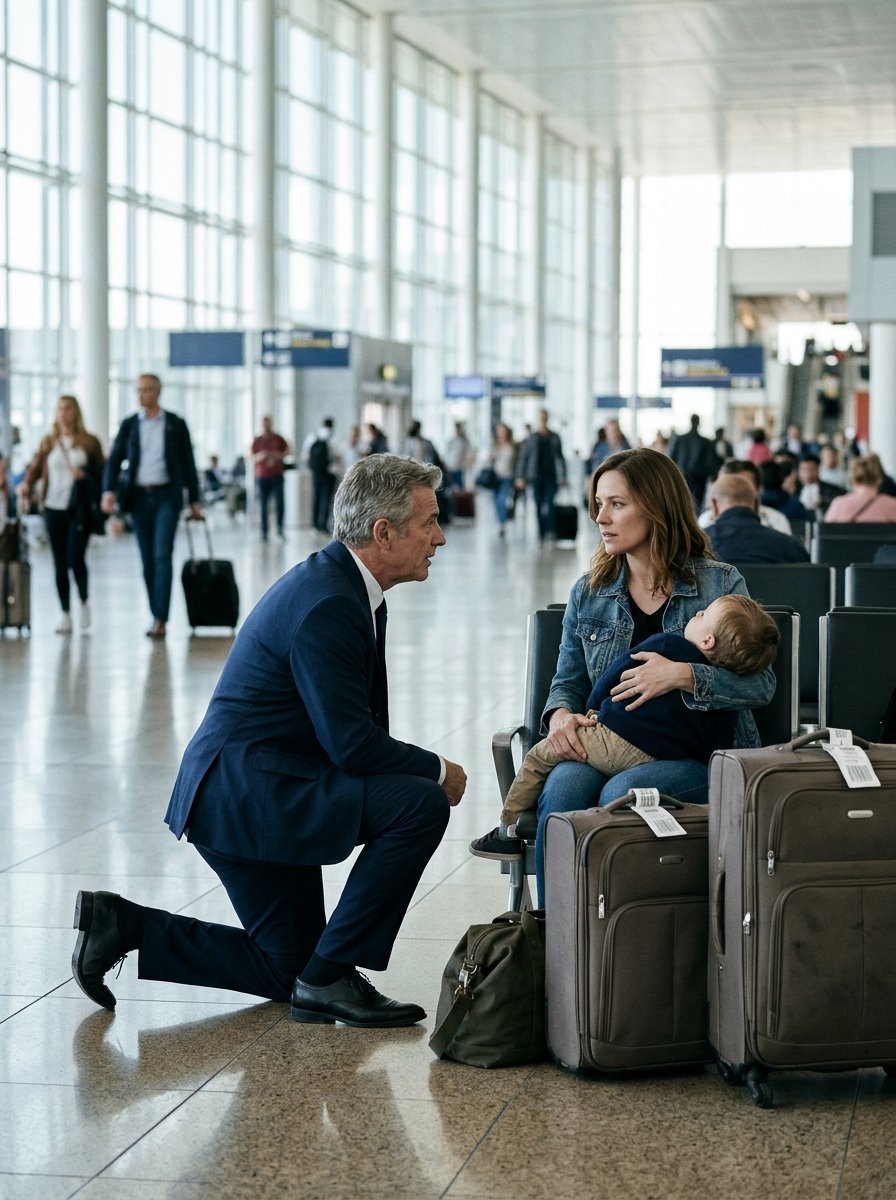
At JFK Airport, I discovered my widowed daughter-in-law
cradling my sleeping grandson, with three worn
suitcases beside her and a one-way ticket
someone else had arranged without her consent.
Through tears, Elena whispered, “Your sister said
that Liam is dead, so I’m no
longer part of this family.”
I did not argue or react in anger.
I simply took the one-way airline ticket
from her trembling hand, called my attorney,
and said, “Bring me Liam’s complete file—the
documents Beatrice was never supposed to see.”
By the time we arrived back
at the estate, my sister was already
waiting near the entrance, convinced every piece
of her plan had fallen perfectly into place.
Then she saw who stepped out
of my car.
I had not planned to return
to New York that afternoon.
My meetings in London had finished earlier
than expected, and after spending most
of the flight awake, all I wanted
was to leave JFK, drive back
to my home on Long Island,
and finally get some sleep.
Everything changed the moment I noticed
a faded denim jacket near
the baggage claim area.
It belonged to Elena.
She sat alone on a cold metal
bench with three worn suitcases lined
neatly beside her, as though they held
everything she still owned.
My four-year-old grandson, Leo, was asleep
against her shoulder, his face flushed
with exhaustion and marked by faint trails
of dried tears.
She should never have been there.
After my son Liam died
in a military training accident
the previous year, I had made
Elena one promise I never intended
to break.
She and Leo would always have
a home with us, and neither
of them would ever be abandoned
simply because Liam was gone.
“Elena?”
She flinched at the sound
of her name before slowly lifting
her head.
The moment she recognized me,
surprise washed across her tired face.
“You weren’t supposed to return until tomorrow.”
“The meetings ended early.”
I crouched beside her and glanced
at the suitcases lined up
at her feet.
“Why are you at the airport
with all your belongings?” I asked,
already fearing the answer before she spoke.
Her eyes dropped to the wrinkled envelope
she was clutching, and within seconds
her composure collapsed.
“Beatrice came to the guest house
this morning with two security guards,”
she said.
“They had already started packing our things
before I even understood what was happening.”
A heavy knot settled in my chest.
“What exactly did she say?”
“She gave me a one-way ticket to Ohio.
She said that since Liam is gone,
there is no longer any reason
for me to remain connected
to your family.”
For several long moments, the noise
of the airport seemed to disappear
around us.
Elena continued quietly, struggling to keep
her voice steady.
“She told me I didn’t belong
in your world.
She said my presence was embarrassing
the family and that Leo deserved
to be raised by people
who understood what his surname meant.”
I did not explode with anger.
Instead, something inside me became colder
and far more dangerous.
Beatrice had always measured people
by their wealth, their social standing,
and the names attached to their families,
but Elena was the woman
my son had chosen to spend
his life with.
Leo was Liam’s child and my grandson,
and what Beatrice had done
was not responsibility disguised as tough love.
It was calculated cruelty wrapped
in polite words.
“Did she tell you that I approved this?”
Elena nodded without looking at me.
“She said you already knew.
She said you would understand
when you came home.”
At that moment, I understood exactly
what my sister had done.
She had mistaken my absence for permission
and assumed I would quietly accept
the decision she had made
in my name.
I reached down and lifted
two of the suitcases.
“You’re coming with me.”
Elena remained seated, tightening her arms
around Leo.
“Raymond, I don’t want to start
a war between you and your sister.”
I looked at my grandson sleeping peacefully
against her shoulder before answering.
“You did not start anything.
You simply endured what she did.”
My driver saw us approaching
and immediately opened the rear door
without asking a single question.
Elena climbed into the car with Leo
while I loaded the luggage
into the trunk, and as soon
as we pulled away from the airport,
I called the estate manager.
“Change every gate code immediately,” I ordered.
“No one enters or removes anything
from the guest house without
my personal approval.”
The moment I ended that call,
I contacted my attorney.
“I need Liam’s full family file.”
He paused for a moment before asking,
“All of it?”
“Especially the documents Beatrice has never
been authorized to review.”
His voice immediately changed.
“So she finally tried something.”
I looked into the back seat,
where Elena held Leo so tightly
it seemed she still feared someone
might take him away.
“Yes,” I replied.
“She did.” ..
The estate gates opened slowly before us.
Evening light stretched across the long driveway.
Elena straightened when she saw Beatrice.
My sister stood beneath the entrance portico.
She wore a pearl-gray coat.
Her posture was immaculate.
Her expression was not.
Two security officers waited behind her.
Several cardboard boxes surrounded their feet.
One contained Leo’s picture books.
Another held Liam’s folded winter clothing.
His framed military portrait lay facedown.
Elena released a small, wounded breath.
“They brought everything outside.”
Her words barely carried.
Leo stirred against her shoulder.
His eyes opened slowly.
“Mommy?”
“I’m here,” Elena whispered.
He noticed the familiar stone walls.
Then he saw Beatrice.
His fingers tightened around Elena’s jacket.
“Are we allowed back?”
The question entered me like a blade.
Elena closed her eyes briefly.
I turned toward Leo.
“This is your home,” I said.
“You never needed permission.”
He studied my face carefully.
Children recognize uncertainty before adults do.
I gave him none.
The car stopped beneath the portico.
My driver opened Elena’s door first.
Beatrice took one step backward.
Her surprise vanished almost immediately.
Calculation replaced it.
“Raymond,” she said.
“You returned early.”
“So I have been told.”
Her gaze moved toward Elena.
Then it settled upon the suitcases.
“This is highly inappropriate.”
Elena’s body became rigid.
I stepped between them.
“What part concerns you?”
“You bringing her back like this.”
“Like what?”
Beatrice lowered her voice.
“We should discuss this privately.”
“No.”
Her eyebrows lifted.
“Excuse me?”
“Anything involving Elena and Leo
will be discussed before Elena.”
Beatrice glanced toward the officers.
Neither man met her eyes.
She tried another approach.
“You are exhausted from traveling.”
“I am alert enough.”
“You lack the necessary information.”
“I found them at an airport.”
My voice remained quiet.
“You supplied enough information.”
Beatrice drew a measured breath.
“I handled an unpleasant situation.”
“You manufactured one.”
“The arrangement was never permanent.”
Elena flinched beside me.
Beatrice noticed.
She continued anyway.
“The guest house belongs to this estate.
Liam is gone.
We cannot maintain indefinite obligations
to everyone he left behind.”
Elena’s face lost its remaining color.
Leo buried his face against her neck.
I looked at my sister.
“Everyone he left behind?”
“You know what I mean.”
“I want to hear you say it.”
A faint breeze crossed the portico.
It lifted one corner
of Liam’s exposed military portrait.
Beatrice’s eyes moved toward it.
Then they returned to mine.
“Elena was Liam’s wife,” she said.
“That connection ended with his death.”
“No,” I replied.
“His life ended.”
“Their marriage did not become meaningless.”
She looked irritated now.
“Sentiment cannot govern an estate.”
“Neither can cruelty.”
Beatrice’s jaw tightened.
“I secured appropriate transportation.”
“You sent them away.”
“I offered her a reasonable relocation.”
“With guards packing her belongings?”
“She refused every civilized discussion.”
Elena finally spoke.
“You never discussed anything with me.”
Beatrice ignored her.
I did not.
“What happened inside the house?”
I asked Elena.
She shifted Leo carefully.
“They arrived shortly after breakfast.”
“Beatrice said the decision was final.”
“I asked to call you.”
“She said you were unavailable.”
One officer looked down.
Elena saw him.
“She ordered them to take my phone.”
Beatrice turned sharply.
“That is not accurate.”
“You held it for forty minutes.”
Elena’s voice trembled.
“You said I could have it back
after I entered the car.”
“It was an emotional situation.”
“You created the emotion.”
I faced the officers.
“Who removed her phone?”
The older officer raised his hand slightly.
“I did, sir.”
“What is your name?”
“Owen Price.”
“Did you have a court order?”
“No, sir.”
“An eviction order?”
“No.”
“Any legal authority whatsoever?”
He swallowed.
“Mrs. Beatrice showed us
a directive bearing your signature.”
“I signed no directive.”
Owen’s face changed.
Beatrice stepped toward him.
“You were following estate instructions.”
He looked at her then.
“You told us Mr. Raymond signed it.”
“He delegated authority.”
“I delegated nothing,” I said.
Mrs. Alvarez appeared inside the doorway.
She had managed the estate
for nearly nineteen years.
I had never seen her visibly angry.
She was angry now.
“The guest house has been reopened,”
she told me.
“Fresh codes are active.”
“Thank you, Marisol.”
Beatrice stared at her.
“You changed them without consulting me?”
Mrs. Alvarez did not blink.
“Mr. Raymond owns the estate.”
“And Elena occupies the guest house,” I added.
“You no longer hold operational authority.”
Beatrice gave a disbelieving laugh.
“You cannot mean that.”
“I have never meant anything more.”
I pointed toward the boxes.
“Everything returns inside.”
Neither officer moved immediately.
Beatrice’s chin rose.
“Do not touch them.”
Owen looked between us.
Then he bent toward Liam’s portrait.
He lifted it carefully.
“I will return these personally.”
The younger officer followed.
Beatrice watched them carry the boxes away.
She seemed unable to understand
why obedience had abandoned her.
A dark sedan entered the driveway.
Arthur Bell stepped from the rear seat.
My attorney carried a navy document case.
He had removed his tie.
His expression revealed nothing.
Beatrice recognized him instantly.
For the first time,
real fear touched her face.
“Arthur,” she said.
“This hardly requires legal theater.”
Arthur approached without answering.
He shook Elena’s hand first.
“I am terribly sorry.”
Elena nodded, unable to speak.
He looked toward Leo.
“Hello, young man.”
Leo remained hidden against Elena.
Arthur did not press him.
Then he faced Beatrice.
“You should retain independent counsel.”
The color left her cheeks.
“For a family disagreement?”
“For several potential felonies.”
Silence settled beneath the portico.
Even the officers stopped moving.
Beatrice looked at me.
“You called the police?”
“I called my attorney.”
Arthur opened his document case.
“He called me.”
“I contacted the county authorities.”
Beatrice’s composure cracked.
“You had no right.”
Arthur regarded her calmly.
“I had an ethical obligation.”
“To whom?”
“To everyone your actions endangered.”
Leo began trembling.
Elena felt it immediately.
“This conversation needs to move inside.”
Her voice was soft.
It was also firm.
I nodded.
“Marisol, please prepare the small library.”
“And something warm for Leo.”
Leo lifted his head.
“Hot chocolate?”
Mrs. Alvarez’s expression softened.
“With extra marshmallows.”
He considered this.
Then he nodded solemnly.
Elena carried him inside.
I followed beside her.
Beatrice remained beneath the portico.
Nobody invited her.
She entered anyway.
The small library had once belonged
to my late wife, Margaret.
Its windows faced the western gardens.
She had preferred that room
because evening sunlight warmed the shelves.
Elena sat near the cold fireplace.
Leo stayed pressed beside her.
Mrs. Alvarez brought hot chocolate,
toast, fruit, and a blue blanket.
Leo accepted the blanket first.
He wrapped it around himself.
Arthur placed his case on the desk.
Owen waited near the doorway.
Beatrice chose the largest chair.
She did not ask permission.
“I will explain what happened,” she said.
“No,” Arthur replied.
“You will listen first.”
Her eyes hardened.
“You work for this family.”
“I represent Raymond and designated trusts.”
“You have never represented me.”
“That distinction is suddenly fortunate.”
I sat opposite Beatrice.
Arthur removed the airline envelope.
I had given it to him outside.
He examined the printed itinerary.
His attention stopped on the passenger field.
“Elena,” he said carefully,
“where was Leo’s boarding pass?”
She frowned.
“Beatrice said it awaited us there.”
“At the airline desk?”
“Yes.”
“They could not find his reservation.”
Her fingers tightened around the blanket.
“I called Beatrice twice.”
“What did she say?”
“She said her driver would collect Leo.”
The room became completely still.
Elena continued.
“She told me to board alone.”
“She said Leo would travel tomorrow.”
Leo looked up at his name.
Elena stroked his hair.
“I refused.”
Arthur turned the itinerary toward me.
Only Elena’s name appeared.
There was no linked reservation.
No second confirmation number existed.
I stared at Beatrice.
“You intended to separate them.”
“It was a booking error.”
Arthur shook his head.
“The reservation was made three days ago.”
“The passenger count was entered manually.”
“One adult.”
Beatrice crossed her legs.
“Then my assistant made a mistake.”
Arthur removed another document.
“Your assistant disagrees.”
A shadow crossed Beatrice’s face.
“What did Camille tell you?”
“Enough to preserve her records.”
Beatrice leaned forward.
“You contacted my private assistant?”
“She contacted me.”
That answer landed heavily.
Arthur placed several printed emails down.
Camille Ward had worked
for Beatrice nearly nine years.
The first message displayed instructions.
Reserve one passenger.
Destination Columbus.
No return segment.
A second instructed the driver
to remain outside Terminal Four.
He was to retrieve Leo
if Elena entered airport security alone.
A third message concerned court filings.
Arthur slid it toward Beatrice.
She did not touch it.
I read the title.
Emergency Guardianship Petition.
The proposed petitioner was Beatrice.
The child named was Leo.
The document claimed Elena intended
to abandon New York permanently.
It described her as emotionally unstable.
It alleged she had surrendered Leo voluntarily.
None of it was true.
The petition had been prepared yesterday.
“You planned this,” Elena whispered.
Beatrice looked toward her.
“I planned to protect Leo.”
“From his mother?”
“From chaos.”
Elena stared at her.
“You put him outside with suitcases.”
“I provided transportation.”
“You tried taking my child.”
Her voice did not rise.
That made it more devastating.
Leo looked between them.
“Mommy?”
Elena gathered him closer.
“No one is taking you.”
Beatrice exhaled impatiently.
“This is precisely the instability
I was attempting to avoid.”
Something struck the desk.
My hand had closed upon it.
I had not realized.
Arthur watched me carefully.
I released the wood.
Then I stood.
“Do not speak about her stability.”
My voice remained controlled.
“You invaded her home.”
“You confiscated her telephone.”
“You packed a grieving child’s belongings.”
“You purchased one airline ticket.”
“You prepared a lie for court.”
“And you used my name.”
Beatrice stood as well.
“Because you refused making difficult decisions.”
“You never asked me.”
“You would have said no.”
“Yes.”
The answer stopped her.
I stepped closer.
“That is not permission, Beatrice.”
“That is the absence of permission.”
She looked toward Arthur.
“You cannot prove I forged anything.”
Owen cleared his throat.
Everyone turned.
“I can provide the directive.”
He removed his work tablet.
“The document came through internal dispatch.”
“It carried Mr. Raymond’s digital signature.”
“I also saved the access log.”
Beatrice’s eyes narrowed.
“You violated company protocol.”
“No, ma’am.”
“I followed evidence-preservation protocol.”
His hand trembled slightly.
“I became concerned this morning.”
“Why?” Arthur asked.
“Mrs. Elena asked for an attorney.”
“Mrs. Beatrice told us she had none.”
Elena looked stunned.
“I never said that.”
Owen nodded miserably.
“I know that now.”
He continued.
“The younger officer began packing upstairs.”
“I remained near the entrance.”
“Mrs. Beatrice entered Mr. Liam’s study.”
“She removed a cedar field box.”
My stomach tightened.
“What box?”
Elena looked at me.
“Liam kept his service papers there.”
“Letters, medals, photographs.”
“He never let anyone move it.”
Arthur glanced toward Beatrice.
“Where is it?”
“I know nothing about a box.”
Owen tapped his screen.
“The corridor camera recorded you carrying it.”
Beatrice became very still.
Owen looked toward Elena.
“I should have stopped everything sooner.”
“I am sorry.”
Elena regarded him for several seconds.
“You should have.”
“I know.”
“Why didn’t you?”
He swallowed.
“I was afraid of losing my job.”
Elena looked down at Leo.
“So was I.”
Her words carried no cruelty.
That made Owen’s shame more visible.
Arthur took the tablet.
He copied its records securely.
Then he opened Liam’s file.
The first folder contained estate documents.
The second held trust amendments.
The third was marked confidential.
Beatrice recognized Liam’s handwriting.
She sat down again.
Arthur began with the recorded covenant.
“Eleven months before Liam’s death,”
he said, “he amended his family trust.”
“Elena was informed about the beneficiary provisions.”
“She was not shown confidential fiduciary schedules.”
Elena nodded slowly.
“I knew Leo had a trust.”
“I never asked its value.”
“The amount is not tonight’s central issue.”
Arthur looked toward Beatrice.
“The governing authority is.”
He removed a notarized amendment.
“An earlier draft named Beatrice
as a temporary successor fiduciary.”
“That draft predated Liam’s marriage.”
“It also predated Leo’s birth.”
Beatrice said nothing.
“The final amendment removed her entirely.”
Her head turned sharply.
“That is impossible.”
Arthur continued.
“Elena became Leo’s personal guardian
by natural and legal right.”
“An independent institution became property trustee.”
“Elena received voting direction over Liam’s shares.”
“Raymond became the secondary family adviser.”
“Beatrice was expressly prohibited
from exercising authority over any beneficiary.”
Beatrice stared at the document.
“Liam would have told me.”
“He intentionally did not.”
“Why?”
Arthur opened the confidential folder.
“Because he no longer trusted you.”
The sentence seemed to empty the room.
Beatrice gave a brittle laugh.
“That is absurd.”
Arthur placed a signed statement down.
Liam’s signature crossed the final page.
I recognized its strong upward stroke.
He had signed it eight months
before his fatal training accident.
The first paragraph documented
an argument inside the foundation offices.
The second described unauthorized transfers.
The third named Beatrice.
My eyes refused the words initially.
I forced myself to read again.
Harbor Light Foundation had been established
to support military families after emergencies.
Liam joined its board after enlisting.
Beatrice became treasurer years earlier.
Liam had discovered seventeen questionable payments.
They totaled nearly three million dollars.
Each had been labeled consulting expenses.
Each had gone toward shell companies.
Their beneficial owner was Beatrice.
I looked up.
She did not deny it immediately.
That silence answered first.
“You stole from military families.”
Her expression hardened.
“I was reimbursing legitimate services.”
“What services?”
“Strategic work.”
“Name one.”
She looked toward Arthur.
“This is privileged organizational material.”
“No,” Arthur said.
“It is evidence from an internal audit.”
Beatrice turned back toward me.
“You know what I contributed.”
“I ran that foundation for twelve years.”
“I rescued it from incompetence.”
“I cultivated every major donor.”
“I gave it credibility.”
“You gave yourself its money.”
“I took deferred compensation.”
“There was no approved compensation.”
“There should have been.”
Elena’s eyes remained fixed upon her.
“Liam discovered it.”
Beatrice’s mouth tightened.
“He misunderstood complicated accounts.”
Arthur removed another page.
“He asked three uncomplicated questions.”
“Why were invoices duplicated?”
“Why did vendors lack employees?”
“Why did their mailing address
match your private property manager?”
Beatrice glanced toward the windows.
The fading sun caught her profile.
For one fleeting moment,
she looked old.
Then anger restored her.
“Liam always believed morality was simple.”
“He had the luxury of innocence.”
Elena stood slowly.
She placed Leo beside me.
“Stay with Grandpa.”
Leo reached for her.
She squeezed his hand.
Then she approached Beatrice.
“My husband buried friends.”
Her voice remained steady.
“He sat with their families afterward.”
“He remembered every child’s birthday.”
“He believed that foundation kept promises.”
Beatrice looked away.
“You stole those promises.”
“You know nothing about governance.”
“I know what grief costs.”
Elena’s breath caught.
She continued anyway.
“I know what an empty chair costs.”
“I know what silence after bedtime costs.”
“And I know exactly what happens
when someone weaponizes a dead man’s absence.”
Beatrice stood abruptly.
“Do not lecture me.”
“I knew Liam before you did.”
“You knew him longer.”
Elena stepped closer.
“You did not know him better.”
Beatrice lifted one hand.
The gesture was small.
Owen moved forward instantly.
She noticed.
Her hand dropped.
Arthur removed a compact encrypted drive.
“Liam made a statement.”
Beatrice stared at it.
“You cannot play private recordings.”
“New York permits one-party consent.”
“He recorded his own meeting.”
Arthur connected the drive.
Liam’s voice filled the library.
For a moment,
none of us breathed.
He sounded tired.
He also sounded alive.
“If this statement becomes necessary,”
he began, “then our private resolution failed.”
“I confronted Beatrice about foundation payments.”
“She acknowledged controlling North Coast Strategic.”
“She called the transfers overdue compensation.”
“I told her repayment must begin immediately.”
“She threatened Elena’s standing within the family.”
“She said marriages could be temporary.”
“She said blood could not.”
Elena covered her mouth.
Leo stared toward the speaker.
“Daddy?”
The single word shattered us.
Arthur stopped the recording.
Elena returned immediately.
She knelt before Leo.
“Yes, sweetheart.”
“Was that Daddy?”
“Yes.”
“Is he coming home?”
Her eyes filled.
“No, my love.”
“That was his voice from before.”
Leo touched her cheek.
“Don’t cry.”
She kissed his fingers.
“I’m all right.”
But she was not.
Neither was I.
Arthur waited for Elena’s permission.
She nodded.
The recording resumed.
Liam’s voice seemed closer now.
“My concern is not only financial.”
“Beatrice sees family control as entitlement.”
“She believes Elena remains an outsider.”
“She has questioned whether Elena should influence Leo.”
“If anything happens to me,
protect them without imprisoning them.”
“Elena must retain every choice.”
“Leo must never become leverage.”
“Do not let our name become his cage.”
The recording paused.
Then Liam spoke directly to me.
“Dad, I know you avoid conflict.”
“You call it patience.”
“Sometimes it is fear.”
“Please do not make Elena pay
for the peace you preserve.”
I closed my eyes.
My dead son had known me.
He had seen the weakness
I disguised as restraint.
Arthur stopped the recording again.
No one asked him to continue.
Nothing else was needed.
Beatrice’s eyes glistened.
Her voice emerged thinly.
“He recorded me.”
“He protected his wife,” Elena said.
“From you.”
Beatrice looked at me.
“You believe him over your own sister?”
“I believe the records.”
“And the forged directive.”
“And the stolen money.”
“And the woman you stranded.”
“And the frightened child beside me.”
She shook her head.
“You always chose him.”
“This is not about choosing Liam.”
“It is about recognizing truth.”
“You gave him everything.”
“I gave you authority.”
“I trusted you with our company.”
“Our foundation.”
“Our home.”
Her laugh broke strangely.
“You gave me labor.”
“You gave Liam love.”
I had no immediate answer.
There was history inside that accusation.
Some of it was distorted.
Not all of it was invented.
After Margaret became ill,
Beatrice had carried difficult responsibilities.
I had thanked her with money.
I had rewarded her with titles.
I had mistaken compensation for attention.
She had mistaken access for ownership.
Both things could be true.
Neither excused what she had done.
“I may have failed you,” I said.
“But Elena did not.”
“Leo did not.”
“The widows you robbed did not.”
“You cannot collect payment from innocents.”
Beatrice’s face twisted.
“You think you are innocent?”
“No.”
The answer surprised her.
“I trusted convenience over scrutiny.”
“I let you govern through intimidation.”
“I dismissed concerns because confronting you
would have disrupted my life.”
“I will answer for that.”
“But I will not conceal yours.”
A knock sounded at the doorway.
Mrs. Alvarez entered.
“Two county detectives have arrived.”
Leo stiffened.
Elena gathered him immediately.
I looked toward Arthur.
“Can this happen elsewhere?”
“Yes.”
Arthur closed the file.
“The east sitting room.”
I faced Beatrice.
“You are free to leave this room.”
“You may not remove estate property.”
“Your company credentials are suspended.”
“Your foundation access is frozen.”
“A preservation order covers your devices.”
She stared at me.
“You cannot do this publicly.”
“I have not made anything public.”
“You called detectives.”
“You committed crimes privately.”
“That does not make accountability public cruelty.”
Her voice dropped.
“Raymond, think about our name.”
Leo’s face remained hidden.
I looked at the child
she had placed beside airport luggage.
“Our name survived Liam’s death.”
“It will survive your consequences.”
She came closer.
“You owe me.”
“I owe the truth more.”
“I am your sister.”
“Yes.”
My voice faltered once.
Then it steadied.
“And Elena is my daughter now.”
“Not because Liam died.”
“Because she is family.”
“I will not negotiate her belonging.”
Beatrice’s gaze moved toward Elena.
Something bitter passed through it.
Then another emotion appeared.
Loss.
Perhaps she finally understood
that her plan had not merely failed.
It had revealed her completely.
“You will regret humiliating me.”
Elena answered before I could.
“No one humiliated you.”
“You made choices in rooms
where you thought nobody mattered.”
“Now those choices have witnesses.”
The detectives waited outside.
Arthur accompanied Beatrice toward them.
At the doorway, she turned.
“What about the box?”
I asked.
She smiled without warmth.
“You should have valued it sooner.”
Then she left.
The front doors closed behind her.
Leo began crying soundlessly.
His small shoulders shook.
Elena held him against her chest.
I crouched beside them.
“No one is sending you anywhere.”
I spoke slowly.
“Not tonight.”
“Not tomorrow.”
“Not ever against your mother’s wishes.”
Leo looked at me through tears.
“Is Aunt Bea mad?”
“She made dangerous choices.”
“Are you mad?”
“Yes.”
His lower lip trembled.
“Will you send her away?”
The question silenced my anger.
Children turn every punishment inward.
I chose each word carefully.
“Adults decide where they live.”
“Police decide whether laws were broken.”
“But none of this happened because of you.”
“Not one part.”
He studied me.
“Because Daddy died?”
“No.”
Elena kissed his temple.
“Daddy dying did not cause this.”
“Aunt Beatrice chose it.”
Leo leaned toward me.
I opened my arms.
He entered them cautiously.
Then completely.
I held him until his breathing slowed.
Outside, tires moved across gravel.
Nobody watched through the windows.
Mrs. Alvarez closed the curtains.
That small kindness mattered.
Later, we crossed toward the guest house.
Night had settled over the gardens.
Owen and the younger officer
had returned every box inside.
Drawers remained open.
Cupboards stood bare.
Empty hangers swayed in the closets.
The rooms looked violated.
A pale rectangle marked the wall
where Liam’s portrait had hung.
Elena stopped inside the doorway.
She could not move farther.
“I thought I had lost everything.”
“You nearly did,” I said.
She turned toward me.
“No.”
Her voice was exhausted.
“I nearly believed her.”
That was worse.
Mrs. Alvarez carried Leo upstairs.
He had fallen asleep again.
Elena watched until they disappeared.
Then she entered the living room.
She touched the back of Liam’s chair.
Beatrice had wrapped it for storage.
One corner remained covered in plastic.
Elena pulled the plastic away.
The sound seemed unbearably loud.
“I should leave,” she said.
My heart dropped.
“You do not have to.”
“That is not what I said.”
She faced me.
“I need to know I can choose.”
“Liam said that too.”
“I heard him.”
“I also heard what he said
about protection becoming a cage.”
Her eyes held mine.
“If I stay because you rescue me,
then Beatrice remains partly right.”
“I become someone living through permission.”
“You have more than permission.”
Arthur had joined us quietly.
He carried one remaining folder.
“This recorded occupancy covenant
cannot be revoked by Raymond.”
Elena looked at him.
“What does that mean?”
“The guest house and surrounding parcel
were placed in Liam’s trust.”
“You retain exclusive residential control.”
“Raymond cannot remove you.”
“Neither can the company.”
“No family vote can alter it.”
She looked toward me.
“You knew?”
“I knew Liam created protections.”
“I did not know every provision.”
Arthur opened the folder.
“There is another option.”
“The trustees may transfer title
directly to Elena upon her request.”
“No gift conditions.”
“No residency requirements.”
“No family oversight.”
Elena stared around the room.
“This house could be mine?”
“It already functions that way.”
Arthur’s voice softened.
“The deed would make it unmistakable.”
She sank onto the sofa.
For several moments,
she simply breathed.
Then anger arrived.
“Why didn’t anyone tell me clearly?”
Arthur accepted the question.
“Liam requested privacy during review.”
“After his death, I explained the trust.”
“But I used legal language.”
“You were grieving.”
“I believed avoiding details was kindness.”
“It was not.”
He sat across from her.
“I am sorry.”
I lowered myself beside the fireplace.
“I am sorry too.”
Elena looked at me.
“For what Beatrice did?”
“For what I failed to prevent.”
“I gave her unrestricted access.”
“I allowed staff to fear her.”
“I left no obvious boundary
between assistance and authority.”
“I made you a promise.”
“Then I assumed words could enforce themselves.”
She wiped her face.
“I kept wondering what I had done.”
“Nothing.”
“I replayed every dinner.”
“Every time she corrected me.”
“Every time Liam defended me.”
“I wondered whether I had missed
some rule everyone else understood.”
“You missed no rule.”
“There was no test.”
“There will never be one again.”
Elena studied my expression.
“I cannot promise to trust that tonight.”
“You should not.”
The answer seemed to surprise her.
“Trust me after my actions deserve it.”
“Until then, trust the deed.”
“Trust independent counsel.”
“Choose your own locks.”
“Choose who enters.”
“Choose whether the connecting path remains.”
“This will be your home.”
“Not my favor.”
Her shoulders lowered slightly.
“Can I decide tomorrow?”
“You can decide next year.”
A small voice came upstairs.
“Mommy?”
Elena rose immediately.
We found Leo sitting in bed.
The blue blanket surrounded him.
His eyes searched the room.
“Where are my dinosaurs?”
Mrs. Alvarez opened a returned box.
The green dinosaur appeared first.
Leo grabbed it.
Then he saw another box.
Its label read LIAM’S STUDY.
“Daddy’s things came back.”
Elena sat beside him.
“Most of them.”
“The special box?”
Her expression changed.
“You remember it?”
Leo nodded.
“Daddy put stars inside.”
She glanced at me.
“I never knew what he meant.”
Leo placed the dinosaur beside him.
“He said stars wait in dark places.”
Arthur stood at the doorway.
“The cedar box may contain
more than service records.”
Elena looked frightened again.
“Will Beatrice destroy it?”
“The detectives know its importance.”
Arthur closed his case.
“They are seeking a warrant tonight.”
Leo tugged Elena’s sleeve.
“Can Grandpa stay?”
She looked toward me.
“That is Grandpa’s decision.”
“I would like to.”
Leo moved beneath the blanket.
He left a narrow space.
I sat at the bed’s edge.
Elena began unpacking his pajamas.
I found one tiny sock.
Its partner was missing.
For twelve minutes,
the three of us searched boxes.
We found it inside a cooking pot.
The absurdity broke something open.
Elena laughed first.
It was brief and tearful.
Then Leo laughed.
I joined them.
The sound did not erase anything.
It made the room survivable.
Leo fell asleep holding both socks.
Elena and I returned downstairs.
Rain had begun against the windows.
She prepared tea without asking.
I repaired Liam’s portrait frame.
One corner had separated.
The work required patience.
My hands needed something honest.
Around midnight, Arthur called.
The warrant had been approved.
Beatrice’s townhouse was being searched.
Her attorneys had arrived.
She denied possessing the cedar box.
Owen’s footage showed otherwise.
Arthur also confirmed something worse.
The ticket had been charged
to Harbor Light Foundation.
Beatrice categorized it as survivor relocation.
She had used money meant
for endangered military families
to exile Liam’s widow.
Elena stood very still.
“That cannot disappear quietly.”
“It will not,” I said.
“Even if publicity hurts us?”
“Yes.”
“Even if donors leave?”
“Yes.”
“Even if your company suffers?”
“Yes.”
She watched me carefully.
“Why?”
“Because hidden wrongdoing grows roots.”
“My silence already fed this.”
“I will not feed it again.”
She poured the tea.
Her hand no longer trembled.
“Then tell the truth carefully.”
“Do not turn Leo into a headline.”
“I will follow your boundaries.”
“And do not call me heroic.”
“I am not.”
“I sat on an airport bench
because I had nowhere else.”
“You survived deliberate cruelty.”
“That is enough truth.”
She handed me a cup.
“Then we agree.”
Just before dawn,
Arthur called again.
Police had found the cedar box.
It was hidden inside Beatrice’s dressing room.
The lock had been forced.
Its contents were scattered.
The service papers remained.
The medals remained.
Several letters remained.
One small brass key was missing.
Detectives found wood splinters
inside Beatrice’s fireplace.
No paper had burned recently.
Whatever she sought,
she had not found it.
Arthur promised the box would return
after forensic examination.
Elena leaned against the kitchen counter.
“What key?”
“I do not know,” I said.
She looked toward the dark window.
“Leo said stars were inside.”
Morning arrived without sleep.
The estate looked unchanged from outside.
Inside, every structure of trust
had begun shifting.
At eight, I called an emergency meeting.
Every company director attended remotely.
So did the foundation trustees.
Arthur presented the forged directive.
He presented the ticket expense.
He presented Liam’s recorded concerns.
He did not expose Elena’s private grief.
Beatrice’s closest ally objected first.
“We cannot suspend a senior officer
based upon domestic conflict.”
I looked directly into the camera.
“This is not domestic conflict.”
“It is forgery, coercion, and suspected theft.”
Another director asked whether publicity
might damage shareholder confidence.
“It should damage their confidence,” I replied.
“Our controls failed.”
“Our oversight failed.”
“I failed.”
The room became silent.
“We will disclose material facts.”
“We will appoint independent investigators.”
“We will replenish interrupted family grants.”
“I will personally cover immediate shortfalls.”
“Not as charity.”
“As restitution for institutional failure.”
The vote to remove Beatrice
from every position was unanimous.
Her closest ally abstained.
Then he resigned.
I accepted immediately.
By noon, foundation accounts were frozen.
Emergency payments continued through new controls.
An outside forensic firm took possession
of every financial record.
I stepped down as foundation chairman.
Arthur had not requested it.
Elena had not suggested it.
Accountability required more than firing Beatrice.
I had signed reports without scrutiny.
My title could not remain untouched.
The board appointed an interim chair.
She was a retired military judge.
Beatrice despised her before meeting her.
That reassured me.
At lunchtime, Camille Ward arrived.
She waited outside the guest house.
Her eyes were swollen.
Elena chose to meet her.
I remained nearby but silent.
Camille held a laptop and paper file.
“I should have called you yesterday.”
Her voice shook.
“I should have called weeks ago.”
Elena did not comfort her.
“Why didn’t you?”
Camille looked toward the ground.
“I kept telling myself
she only wanted leverage.”
“I thought the petition was intimidation.”
“I did not think she would file it.”
“You booked the ticket.”
“Yes.”
“For only me.”
“Yes.”
“You knew.”
Camille began crying.
“I changed the reservation twice.”
“She changed it back.”
“I saved every instruction.”
“Why?”
“Because I knew it was wrong.”
“Saving evidence is not stopping harm.”
“No.”
Camille accepted that.
“It is not.”
Elena folded her arms.
“What did Beatrice expect at JFK?”
Camille took a breath.
“She expected you to call.”
“She planned to say Leo’s ticket
had been accidentally canceled.”
“The driver would offer taking him home.”
“She believed you would board
because security had removed your belongings.”
“And if I refused?”
“She planned reporting a behavioral crisis.”
Elena stared at her.
“With my son beside me?”
“She hired a private evaluator.”
“He was supposed to observe you.”
“From where?”
“The terminal café.”
I felt anger rising again.
Elena glanced toward me.
She needed calm.
I gave it.
Camille continued.
“If you became visibly distressed,
he would write an emergency statement.”
“If you remained calm,
the driver would pressure you.”
“Either result helped her petition.”
Elena’s face went pale.
“She designed every outcome.”
“Except Raymond returning early,” Camille said.
“And except you refusing to surrender Leo.”
“That was never an exception.”
Elena’s voice hardened.
“I would never leave him.”
“I know.”
“You did not know me at all.”
Camille lowered her head.
“No.”
Elena looked through the window.
Leo was drawing at the table.
His green dinosaur stood beside the paper.
“What do you want from me?”
“Nothing.”
Camille placed the laptop down.
“It contains mirrored email archives.”
“Vendor instructions.”
“Foundation invoices.”
“Draft petitions.”
“I gave copies to investigators.”
“I came because you deserved answers.”
Elena considered this.
“You should cooperate fully.”
“I will.”
“You should not ask me for forgiveness.”
“I won’t.”
“If your evidence helps other families,
then something useful survives your delay.”
Camille nodded through tears.
“Thank you.”
“That was not absolution.”
“I understand.”
After she left,
Elena remained by the doorway.
“You handled that with strength,” I said.
She turned toward me.
“Do not make suffering sound empowering.”
The correction was deserved.
“You are right.”
“I handled it because I had to.”
“I wish nobody required that strength.”
“So do I.”
She looked toward Leo again.
“Now help me make lunch.”
We made grilled cheese sandwiches.
Mine burned.
Leo ate mine anyway.
He announced the black part
tasted like camping.
Elena smiled despite herself.
That afternoon, detectives returned Liam’s portrait.
The cedar box remained evidence.
They had arrested Beatrice
on forgery and coercion-related charges.
Financial charges would follow.
She was released pending arraignment.
A protective order barred her
from contacting Elena or approaching the estate.
Her attorneys issued a statement.
They called the matter
a painful family misunderstanding.
I read it once.
Then I authorized our response.
There had been no misunderstanding.
An adult and child were forcibly displaced.
Documents were forged.
Charitable funds were misused.
Independent investigators had complete access.
We would protect victim privacy.
We would cooperate without reservation.
Arthur asked whether I wanted
to soften the language.
“No.”
Elena read it before release.
She changed one phrase.
I had written vulnerable families.
She replaced it with military families.
“They are not defined by vulnerability,”
she explained.
“They were denied what was promised.”
The statement went public that evening.
Donors called.
Reporters gathered beyond the gate.
Several company directors panicked.
Our share price fell.
Nothing collapsed.
Truth rarely destroys sound foundations.
It reveals where repairs must begin.
For three days,
Elena remained inside the guest house.
Not because anyone confined her.
Cameras waited beyond every exit.
Leo noticed the vans.
“Are those Aunt Bea’s friends?”
“No,” Elena said.
“They are people asking questions.”
“About me?”
“About grown-ups.”
He thought carefully.
“Can they see my dinosaur?”
“Not unless you choose.”
He closed the curtains.
Then he reopened them slightly.
“Maybe his tail.”
Healing did not arrive dramatically.
It entered through ordinary choices.
Elena selected new door locks.
She chose her own security code.
She removed Beatrice’s furniture
from the downstairs sitting room.
She kept Margaret’s reading lamp.
She moved Liam’s chair beside it.
She asked that the garden path
to the main house remain open.
“But install a gate,” she said.
“A gate you control,” I replied.
She nodded.
Leo selected the gate color.
Bright blue.
The estate architect objected politely.
Leo refused compromise.
The gate became bright blue.
One week later,
military investigators met with us.
The financial inquiry had raised
an inevitable, terrible question.
Had Beatrice influenced Liam’s death?
Elena asked it directly.
Her fingers remained locked together.
The reviewing officer answered carefully.
“No evidence connects her
to the training accident.”
They had reexamined communications,
travel, maintenance records, and witness statements.
The accident resulted from documented failures
already addressed by the military investigation.
Beatrice had neither access nor involvement.
Relief and grief arrived together.
Elena bent forward.
Her face disappeared into her hands.
I had not realized
how deeply that possibility frightened her.
The officer waited quietly.
Then she placed a sealed packet down.
“Liam submitted financial concerns
through military legal assistance.”
“He did this before his death.”
“The submission supports your current investigation.”
“He was not silent.”
Elena lifted her head.
“Did he know anyone believed him?”
“Yes.”
“The reviewing attorney requested more evidence.”
“Liam responded two days before the accident.”
The officer’s voice softened.
“He did everything correctly.”
Those words mattered.
They could not return him.
They returned something else.
His final weeks had not been helpless.
His truth had entered another person’s hands.
It had waited.
Now it was moving.
The forensic audit lasted four months.
Its findings exceeded Liam’s suspicions.
Beatrice had diverted nearly five million dollars.
Some paid personal property loans.
Some financed private travel.
Some covered losses from speculative investments.
She fabricated invoices.
She forged three trustee approvals.
She redirected grants after authorization.
Nineteen military families received delayed assistance.
Four lost housing during those delays.
Every diverted dollar was traced.
Most assets remained recoverable.
Not all damage could be priced.
I met those families privately.
I did not ask forgiveness.
I listened.
A widow named Rosa Morales
brought her eviction notice.
Her grant had been approved
six weeks before she lost her apartment.
The money was redirected
toward Beatrice’s Manhattan renovation.
Rosa and two children
spent eleven nights in a motel.
Then they slept inside her sister’s kitchen.
“I thought Liam’s foundation rejected us,”
she said.
“He did not,” Elena replied.
“He would never have rejected you.”
Rosa looked at Elena.
“You knew him?”
“I was his wife.”
Recognition crossed Rosa’s face.
Then sympathy.
Elena gently stopped it.
“We are not comparing grief.”
“We are repairing a promise.”
That sentence reshaped the foundation.
Elena refused a ceremonial title.
She agreed to organize
a survivor oversight council.
Every voting member
had received assistance personally.
Financial reports became public.
Grant decisions received independent review.
No family officer controlled disbursements alone.
Camille testified before the board.
She resigned afterward.
The investigators recommended leniency
because she preserved decisive evidence.
Elena supported that recommendation.
She did not erase Camille’s responsibility.
She recognized her eventual courage.
Owen Price resigned too.
I declined accepting it immediately.
He had followed an unlawful instruction.
He had also preserved the evidence.
Elena requested a formal review.
Owen completed retraining,
lost supervisory authority temporarily,
and met with external ethics monitors.
Six months later,
Elena approved his reinstatement.
“Fear explains hesitation,” she told him.
“It cannot become your command structure.”
He never forgot those words.
Neither did I.
Beatrice fought everything initially.
She challenged Liam’s trust amendment.
She accused Elena of manipulation.
She claimed I lacked capacity
after prolonged grief.
Three physicians disproved that claim.
Two independent witnesses authenticated Liam’s signing.
The court dismissed her challenge.
Then investigators found another document.
It had been created
the morning before Elena’s removal.
Beatrice planned transferring Leo’s trust
after obtaining emergency guardianship.
She intended borrowing against its holdings.
Those assets would cover foundation shortages.
She had tried stealing control
from a four-year-old child
to conceal money stolen from others.
When Arthur explained it,
Elena said nothing for nearly a minute.
Leo was outside chasing leaves.
His laughter drifted through the window.
Finally, she asked one question.
“Would it have worked?”
“No,” Arthur said.
“Liam’s final amendment blocked her.”
“Even guardianship would not grant access.”
“Then why did she believe it could?”
“She had an outdated trust draft.”
“The version naming her successor.”
Elena understood.
“She searched the cedar box
for the final amendment.”
“Yes.”
“But you already had it.”
“Yes.”
Arthur looked toward Liam’s portrait.
“He anticipated she might search his papers.”
“He lodged the controlling original with me.”
Elena turned toward the garden.
“So Liam protected us.”
“He did.”
Her expression tightened.
“And he still had to die
before anyone believed his fear.”
Arthur lowered his eyes.
“That failure belongs to the living.”
Beatrice’s criminal case expanded.
Federal authorities added wire fraud charges.
State prosecutors added attempted custodial interference.
Her attorneys sought a private resolution.
They offered full restitution.
They offered resignation from every institution.
They offered sealed proceedings.
The prosecutors refused secrecy.
So did Elena.
Beatrice requested a family meeting.
Arthur advised against it.
Elena surprised us.
“I want to hear her answer.”
“You owe her nothing,” I said.
“I know.”
“Then why go?”
“Because I want one room
where she cannot rewrite what happened.”
The meeting occurred at Arthur’s office.
Two attorneys attended.
A court-approved mediator joined us.
Beatrice entered without jewelry.
Her clothes were simple.
She looked smaller.
Not humbled.
Not yet.
Elena sat opposite her.
I remained beside Elena.
Beatrice’s lawyer began speaking.
Elena stopped him.
“I did not come for negotiations.”
She looked directly at Beatrice.
“Why did you want Leo?”
Beatrice’s eyes shifted toward me.
Elena repeated the question.
“Look at me.”
Beatrice did.
“Why did you want my son?”
“I believed you would leave eventually.”
“You tried forcing me.”
“I believed it was inevitable.”
“That is not an answer.”
Beatrice folded her hands.
“Leo holds Liam’s shares.”
“So?”
“Those shares require responsible direction.”
“Your theft required hidden money.”
A muscle moved in Beatrice’s cheek.
“I intended restoring every dollar.”
“With Leo’s inheritance.”
“As a temporary loan.”
“You prepared stealing from a child
to hide stealing from widows.”
The mediator remained silent.
Beatrice’s lawyer whispered something.
She waved him away.
“You do not understand pressure.”
Elena leaned forward.
“I understand exactly what you apply.”
“I am asking why.”
Beatrice looked toward the window.
Rain streaked the glass.
“When Liam married you,
he stopped asking my advice.”
“That hurt you?”
“He treated me like an employee.”
“Were you acting like family?”
Beatrice’s gaze sharpened.
“I kept everything functioning.”
“Raymond disappeared into Margaret’s illness.”
“Liam disappeared into service.”
“I managed the company.”
“The estate.”
“The foundation.”
“Every crisis became mine.”
I spoke quietly.
“You could have asked for help.”
Beatrice turned on me.
“I asked for recognition.”
“I gave you authority.”
“You gave Liam affection.”
The old accusation returned.
This time, I did not defend myself.
“You may be right.”
She stopped.
I continued.
“I loved you carelessly.”
“I relied upon you constantly.”
“I praised competence instead of knowing you.”
“I thought money expressed gratitude.”
“It did not.”
Her eyes filled.
“But I did not teach you
to steal from grieving families.”
“I did not make you
terrorize a mother and child.”
“My failures are mine.”
“Your crimes remain yours.”
Beatrice looked down.
For several breaths,
her anger had nowhere to go.
Elena waited.
“Why Leo?” she asked again.
Beatrice’s answer arrived quietly.
“Because he was the last piece.”
“The last piece of what?”
“Our family’s future.”
“No.”
Elena’s voice remained gentle.
“He is a little boy.”
“He hates peas.”
“He sleeps with mismatched socks.”
“He thinks dinosaurs need bedtime stories.”
“He cries when thunder surprises him.”
“He is not a shareholding.”
“He is not a surname.”
“He is not your missing piece.”
Beatrice began crying.
Elena did not move toward her.
“What did you feel
when he asked for his mother?”
Beatrice wiped her face.
“I told myself he would adjust.”
“That was not my question.”
Beatrice closed her eyes.
“I felt irritated.”
The honesty stunned everyone.
She continued before courage vanished.
“His fear complicated the plan.”
“I wanted him quiet.”
“I wanted Elena gone.”
“I wanted access restored.”
“I did not think about his terror.”
Elena absorbed every word.
Then she stood.
“That is the answer I needed.”
Beatrice looked up.
“Can you forgive me?”
“No.”
The word was calm.
“Not today.”
“Possibly not ever.”
“Forgiveness is not another asset
you receive after admitting value.”
“I came for truth.”
“You finally gave me some.”
Elena moved toward the door.
Beatrice called her name.
Elena stopped without turning.
“I did love Liam.”
“I believe you,” Elena said.
“That makes your choices worse.”
Then she left.
I remained briefly.
Beatrice looked toward me.
“Will you visit me?”
“If you are imprisoned?”
“Yes.”
“I do not know.”
Her face crumpled.
“You are all I have.”
I thought about Elena at JFK.
Three worn suitcases.
A sleeping child.
One fraudulent ticket.
“You had more,” I said.
“You treated them like obstacles.”
I left her with her attorneys.
Weeks later, Beatrice accepted a plea.
She admitted fraud, forgery,
misapplication of charitable funds,
and attempted custodial interference.
The agreement required full cooperation.
It required surrendering hidden assets.
It barred her permanently
from fiduciary and charitable positions.
At sentencing, every affected family
received the right to speak.
Some did.
Others declined.
Elena attended without Leo.
She carried no prepared statement.
When the judge invited her forward,
she stood quietly.
“My son was four,” she said.
“He believed adults controlled belonging.”
“Beatrice used that belief against him.”
“She also used military grief
as a source of private money.”
“I do not request vengeance.”
“I request consequences that cannot be purchased.”
“I request restitution without publicity conditions.”
“I request protection for every family
whose desperation became an accounting opportunity.”
Then she returned beside me.
The judge imposed several years’ imprisonment.
Beatrice was ordered to repay everything.
Her properties were seized.
Her company pension satisfied additional restitution.
Money could restore accounts.
It could not restore motel nights.
It could not erase Leo’s airport fear.
But consequence became visible.
That mattered.
As marshals approached,
Beatrice looked toward us.
She did not ask me to intervene.
She looked at Elena instead.
Then she lowered her head.
Nine months after the airport,
the cedar box returned.
Forensic teams had finished examining it.
Its brass corners were scratched.
The broken lock hung loosely.
Elena placed it on Liam’s desk.
Leo sat cross-legged nearby.
He was five now.
He remembered the box immediately.
“Daddy’s stars.”
Elena opened the lid.
Medals rested beneath folded cloth.
Letters lay bundled with faded ribbon.
A compass occupied one corner.
There was no brass key.
Detectives had never located it.
Leo leaned over the box.
“The stars are underneath.”
Elena frowned.
“Underneath what?”
“The bottom.”
He pressed one small finger
against a dark wooden knot.
A narrow panel lifted.
We stared.
Beatrice had broken the lock.
She had emptied every visible compartment.
She had missed the false bottom.
Inside lay a brass key.
Beside it rested a sealed note.
Arthur’s name appeared outside.
Leo smiled proudly.
“I told you.”
Elena kissed his hair.
“Yes, you did.”
Arthur arrived within an hour.
He examined the key.
Then he read Liam’s note.
His eyes filled before he finished.
“What is it?” Elena asked.
“A safe-deposit box.”
“Where?”
“A bank near the base
where Liam completed advanced training.”
Arthur looked at Leo.
“He instructed me to open it
with Elena and Raymond present.”
“Why didn’t you know?”
“He never sent this note.”
“He hid the instructions here.”
“He must have expected Elena
to find them eventually.”
Two days later, we traveled together.
The bank manager led us downstairs.
The brass key opened
a narrow steel compartment.
Inside were twenty-one envelopes.
Eighteen bore Leo’s name.
Each named a future birthday.
Five.
Six.
Seven.
The final envelope read Twenty-Two.
One envelope belonged to Elena.
One belonged to me.
The last belonged to Beatrice.
A small digital drive rested beneath them.
Elena’s knees weakened.
I caught her arm.
She held the box edge.
“He prepared all these?”
Arthur nodded.
“Before his final training rotation.”
Leo reached toward the first envelope.
Elena covered his hand gently.
“That one is yours.”
“Can I open it?”
“You are five.”
His eyes widened.
“Today?”
She laughed through tears.
“Today.”
We returned home before opening anything.
Elena wanted Liam’s chair nearby.
She wanted the blue gate visible.
She wanted no bank walls
around their son’s first message.
We gathered in the guest-house living room.
Late sunlight warmed Margaret’s lamp.
Leo sat between Elena and me.
He opened the envelope carefully.
Inside was a photograph.
Liam held him as an infant.
A short handwritten letter accompanied it.
Elena read aloud.
“My brave Leo,
today you are five.”
“If I am beside you,
make me read this anyway.”
“If I am somewhere else,
know that my love arrived first.”
“Your job is not carrying my name.”
“Your job is becoming yourself.”
“Be kind when kindness costs something.”
“Ask questions when adults avoid them.”
“Protect people without owning their choices.”
“And please eat one vegetable.”
Leo looked offended.
“Daddy knew about peas?”
Elena laughed and cried together.
“He knew everything.”
A video file matched the letter.
Liam appeared in uniform,
seated against a plain wall.
He smiled awkwardly at the camera.
“Hey, buddy.”
Leo touched the screen.
Liam told him a dinosaur story.
He performed terrible sound effects.
Leo laughed until he hiccupped.
Then Liam became serious.
“If anyone ever tells you
that love must be earned,
they are confused.”
“Home is where your fear
does not cancel your welcome.”
“You always have one with us.”
The video ended.
Nobody moved immediately.
Birds called outside.
The blue gate shifted in wind.
Elena opened her envelope later.
She watched alone first.
Then she invited me inside.
Liam told her he loved her.
He apologized for every future morning missed.
He asked her not to preserve
his memory by shrinking her life.
“If Dad builds walls around you,”
he added, smiling,
“remind him doors work both directions.”
Elena laughed softly.
Then Liam’s expression changed.
“Choose again someday, if you want.”
“Choose solitude, if that brings peace.”
“Choose work, travel, noise, quiet.”
“Just make every choice yours.”
When the screen darkened,
Elena rested her head against my shoulder.
“I was afraid moving forward
would mean leaving him.”
“It will not,” I said.
“He built forward into these letters.”
My envelope contained fewer words.
Liam had recorded no accusation.
He spoke as a son.
“Dad, grief will tempt you
to solve what must be felt.”
“Do not replace me.”
“Do not make Leo replace me.”
“Love him as himself.”
“Love Elena without requiring gratitude.”
“And forgive yourself slowly.”
“Slowly means honestly.”
I watched it three times.
The envelope addressed to Beatrice
remained sealed upon the desk.
Arthur asked what Elena wanted done.
“It belongs to her,” she said.
I hesitated.
“She may use it manipulatively.”
“Then boundaries remain.”
Elena touched the envelope.
“But Liam chose to write it.”
“We should not control his choice.”
The prison approved its delivery.
Beatrice received it unopened.
For nearly two months,
we heard nothing.
Then Arthur received a package.
It contained one handwritten page.
Beatrice had listed an overseas account.
Investigators had not discovered it.
The balance covered every remaining shortfall.
Her note contained four sentences.
Liam remembered me kindly.
I did not deserve that kindness.
Use everything for the families.
Tell Leo I finally understood.
Elena read the note.
She did not call it redemption.
Neither did I.
One truthful act
could not outweigh years of harm.
But truth had finally cost Beatrice something.
Perhaps that was where change began.
We sent no personal reply.
The foundation confirmed the recovered funds.
Rosa Morales joined its oversight council.
So did three other recipients.
The restored money purchased housing assistance.
No building carried our family name.
That was Elena’s condition.
One year after JFK,
the guest-house deed transferred fully.
Elena signed first.
Independent counsel reviewed every page.
I signed relinquishing estate claims.
Arthur recorded it that afternoon.
Elena held the final deed quietly.
“No one can send us away?”
“No one,” Arthur said.
“Not even Raymond?”
“Especially not Raymond.”
I smiled.
Leo looked concerned.
“Can Grandpa still visit?”
Elena crouched beside him.
“If he asks nicely.”
I placed one hand dramatically
against my chest.
“I shall practice.”
Leo considered me.
“Bring cookies.”
“The terms seem severe.”
“They are.”
We shook hands solemnly.
That summer, Elena returned to work.
She joined a counseling program
supporting families after military loss.
She chose three days weekly.
The foundation paid nothing toward her salary.
She wanted no hidden obligation.
Her first morning,
she stood beside her car
longer than necessary.
Leo watched from the blue gate.
“You can come back,” he called.
She smiled.
“Yes.”
“That is the plan.”
She drove away by choice.
She returned by choice.
Those distinctions became sacred.
Leo started kindergarten in September.
On his first day,
he refused releasing Elena’s hand.
She did not pull away.
She waited.
I waited beside them.
Eventually, another child approached.
He carried a red dinosaur backpack.
Leo examined it.
Then he released Elena.
He walked inside without looking back.
Elena cried inside the car.
I pretended not to notice.
She handed me a tissue.
“You are crying too.”
“I have allergies.”
“In September?”
“They are sophisticated.”
She laughed.
Her laughter came more easily now.
Not every day was easy.
Airports remained difficult.
Unexpected suitcases frightened Leo.
Raised voices made him search
for the nearest adult.
Elena found a child therapist.
She attended grief counseling herself.
I joined a group for bereaved parents.
The first meeting felt unbearable.
I returned the following week.
We stopped treating pain
as evidence of weakness.
We stopped demanding quiet from grief.
Months became seasons.
The estate changed with us.
Formal rooms opened.
Locked cabinets disappeared.
Mrs. Alvarez placed children’s books
inside the main library.
Leo built forts beneath Margaret’s desk.
Nobody told him surnames were fragile.
Owen installed transparent security procedures.
No resident could be removed
without verified legal authority.
Every officer received refusal protections.
Fear no longer traveled downward unchecked.
Camille found work elsewhere.
She sent Elena one letter.
It contained no excuses.
She described testifying
in three separate investigations.
She thanked Elena for demanding usefulness.
Elena kept the letter.
She did not answer immediately.
Six months later, she wrote once.
Keep telling the truth sooner.
Camille framed those words.
Rosa later told us.
We never asked why.
On Liam’s next birthday,
we planted an oak tree.
Leo placed the first soil
around its young roots.
Elena added the second.
I added the third.
No reporters attended.
No foundation plaque appeared.
Only a small stone rested nearby.
It carried Liam’s name.
Beneath it were five words.
Love must leave choices open.
The words came from his recordings.
Beatrice had used family
to make choices smaller.
Liam had understood the opposite.
By autumn, his oak turned gold.
One evening, Elena called me outside.
Leo sat beneath its branches.
He held another birthday envelope.
He had waited three weeks
past his sixth birthday.
“I was saving it,” he explained.
“For what?”
“A brave day.”
“What happened today?”
“I told someone Daddy died.”
Elena sat beside him.
“Was that hard?”
“Yes.”
“Did you feel brave afterward?”
“No.”
He frowned.
“I felt sad.”
Elena brushed leaves from his hair.
“Bravery can feel sad.”
Leo considered that.
Then he opened Liam’s letter.
This one described fear.
Liam wrote that courage
was not the absence of shaking.
It was deciding what deserved movement
while your hands still trembled.
Leo looked toward the blue gate.
“Mommy was brave at the airport.”
“Yes,” I said.
“She stayed with me.”
“She always will when she can.”
“And when she cannot?”
Elena answered carefully.
“Then you still carry her love.”
He accepted this.
Children often understand truth
when adults stop decorating it.
Winter returned.
Snow softened the estate walls.
The anniversary of Beatrice’s sentencing passed quietly.
I visited her three weeks later.
It was my first visit.
She entered the room cautiously.
Gray threaded her hair.
We sat across a bolted table.
For a moment,
we were children again.
Then memory corrected me.
“How is Leo?” she asked.
“He is well.”
“And Elena?”
“She is building a good life.”
Beatrice nodded.
“I watch foundation reports.”
“They publish everything now.”
“Yes.”
“I saw Rosa became chair.”
“She earned it.”
A faint smile appeared.
“Liam would approve.”
“Yes.”
Silence expanded between us.
Finally, she spoke.
“I kept thinking control meant safety.”
“For whom?”
“For me.”
The honesty remained painful.
“I spent my whole life
believing losing status meant disappearing.”
“So you made others disappear.”
“Yes.”
Her eyes filled.
“I cannot undo that.”
“No.”
“Will Elena ever forgive me?”
“That is not mine to predict.”
“Will you?”
“I am trying to understand forgiveness.”
“It cannot erase consequence.”
“I know.”
“Then begin there.”
She looked at her hands.
“I read Liam’s letter every Sunday.”
“What did he write?”
She shook her head.
“That was between us.”
For once,
she protected something without possessing it.
When the visit ended,
she did not ask when I would return.
I did not promise.
Outside, winter sunlight reflected off snow.
I breathed more easily than expected.
Not because everything was repaired.
Some things should retain their seams.
They remind us what breaking cost.
The following spring,
Elena chose to visit Ohio.
She had friends there.
Places from her childhood remained.
For months, she avoided the idea.
Beatrice’s ticket had contaminated the destination.
Then Elena booked three round-trip seats.
One for herself.
One for Leo.
One for me.
“You are inviting me?”
“You carry luggage well.”
“That is my defining skill.”
“At airports, perhaps.”
At JFK, Leo held both our hands.
He saw the cold metal benches.
His grip tightened.
Elena stopped walking.
“We can leave,” she said.
“No,” he answered.
He stared toward the departure board.
“We chose these tickets.”
“Yes.”
“And we come home afterward?”
“Yes.”
“Home waits?”
Elena knelt before him.
“Home does not punish travel.”
“It waits.”
Leo looked at me.
“Even the blue gate?”
“Especially the blue gate.”
He smiled.
Then we continued.
At the airline counter,
Elena handed over three passports.
The agent printed three boarding passes.
Leo counted them twice.
“One.”
“Two.”
“Three.”
He gave mine to me.
“Don’t lose yourself.”
“I will be careful.”
Our flight departed on time.
Ohio gave Elena something important.
Not escape.
Return.
She showed Leo her childhood school.
We visited the small public library
where she first met Liam.
A photograph hung near the entrance.
Liam wore his first uniform.
Elena stood beside him,
young and laughing.
Leo touched the glass.
“That was before me.”
“Yes,” Elena said.
“Were you waiting for me?”
“We did not know it yet.”
“But our lives had space.”
Leo liked that answer.
On our final evening,
we visited Elena’s mother’s grave.
She placed fresh flowers down.
For years, I had assumed
Elena lacked a powerful family.
I finally understood my arrogance.
Power was not property.
It was the memory
that taught someone to remain kind.
Elena’s mother had left little money.
She had left courage.
She had left honesty.
She had left a daughter
who refused abandoning her child
even when every door seemed closed.
On our return flight,
Leo slept against Elena’s shoulder.
The image resembled that terrible afternoon.
Everything else had changed.
Three boarding passes rested safely together.
Our luggage held gifts,
not everything they owned.
Nobody awaited us with false authority.
Mrs. Alvarez met us near arrivals.
She carried a handmade sign.
WELCOME HOME, DINOSAUR CAPTAIN.
Leo ran toward her.
Elena remained beside me.
“Are you all right?” I asked.
She watched Leo laughing.
“I think so.”
Then she corrected herself.
“I am.”
Outside, evening rain touched the pavement.
The driver loaded our suitcases.
Elena kept Liam’s letters beside her.
During the journey home,
Leo described Ohio without pausing.
Mrs. Alvarez listened seriously.
I watched the city disappear behind us.
The estate gates opened.
The blue garden gate stood beyond them.
Lights glowed inside Elena’s windows.
She had chosen every one.
Leo woke enough to see them.
“Home waited,” he murmured.
“Yes,” Elena whispered.
“It did.”
We carried him inside.
I placed his suitcase downstairs.
Elena covered him with the blue blanket.
Liam’s photograph rested beside his bed.
The oak moved gently outside.
Before leaving, I paused at the gate.
Elena joined me.
For a while,
neither of us spoke.
“I believed home was something
I could promise,” I said.
She looked toward the warm windows.
“What do you believe now?”
“That promises require structure.”
“Boundaries.”
“Truth.”
“And people willing to defend them.”
She nodded.
“Anything else?”
I watched Leo sleeping inside.
“Choice.”
Elena smiled.
“That was Liam’s answer too.”
She opened the blue gate.
It swung easily between our homes.
Not locked.
Not removed.
Available.
Behind us, the estate stood quietly.
Ahead, Elena’s house held laughter,
letters, grief, and ordinary tomorrow.
No surname guarded the doorway.
No wealth decided who belonged.
Home was no longer
the place I controlled.
It was the place
where nobody had to ask
whether they were allowed back.