The Hidden Evidence Behind A Mountain Crash Investigation-dynana
The rain had turned Miller’s Ridge Road into a narrow strip of danger, but I still believed the worst thing waiting for us was the storm.
I was wrong.
The first sign that something was wrong came when the brakes stopped responding halfway down the mountain. My foot pressed the pedal again and again, but it sank toward the floor with no resistance. The car kept moving faster, the tires sliding across the wet pavement as fog swallowed the road ahead.
My husband grabbed the dashboard while I fought to keep control. Neither of us could understand what was happening. A few minutes earlier, we had been driving away from home believing that an uncomfortable chapter in our family might finally be ending.
My stepson had acted differently that morning.
For months, there had been tension between us. Conversations felt forced. Every family gathering carried a quiet distance that nobody wanted to acknowledge. But that morning, he had walked outside, offered to check a strange sound near the rear wheel, and acted like he wanted to help.
My husband noticed it too. He smiled and told me maybe things were finally changing.
I wanted to believe him.
That was what made the memory so painful when the brakes failed.
Because suddenly, the small act of kindness I had accepted became something I couldn’t ignore.
The car continued down the road. I pulled the emergency brake as a last attempt to slow us down. Instead, the vehicle swung sideways, crashed into the guardrail, and spun toward the edge of the mountain.
For one moment, everything became silent.
Then the car went over.
The sound of twisting metal filled the air. Glass shattered around us. The vehicle rolled down the slope before finally slamming against a rocky section of the mountain.
The seat belt trapped me against my seat. A heavy piece of the wreckage pinned my leg. Every breath felt more difficult than the last.
I called my husband’s name.
There was no answer.
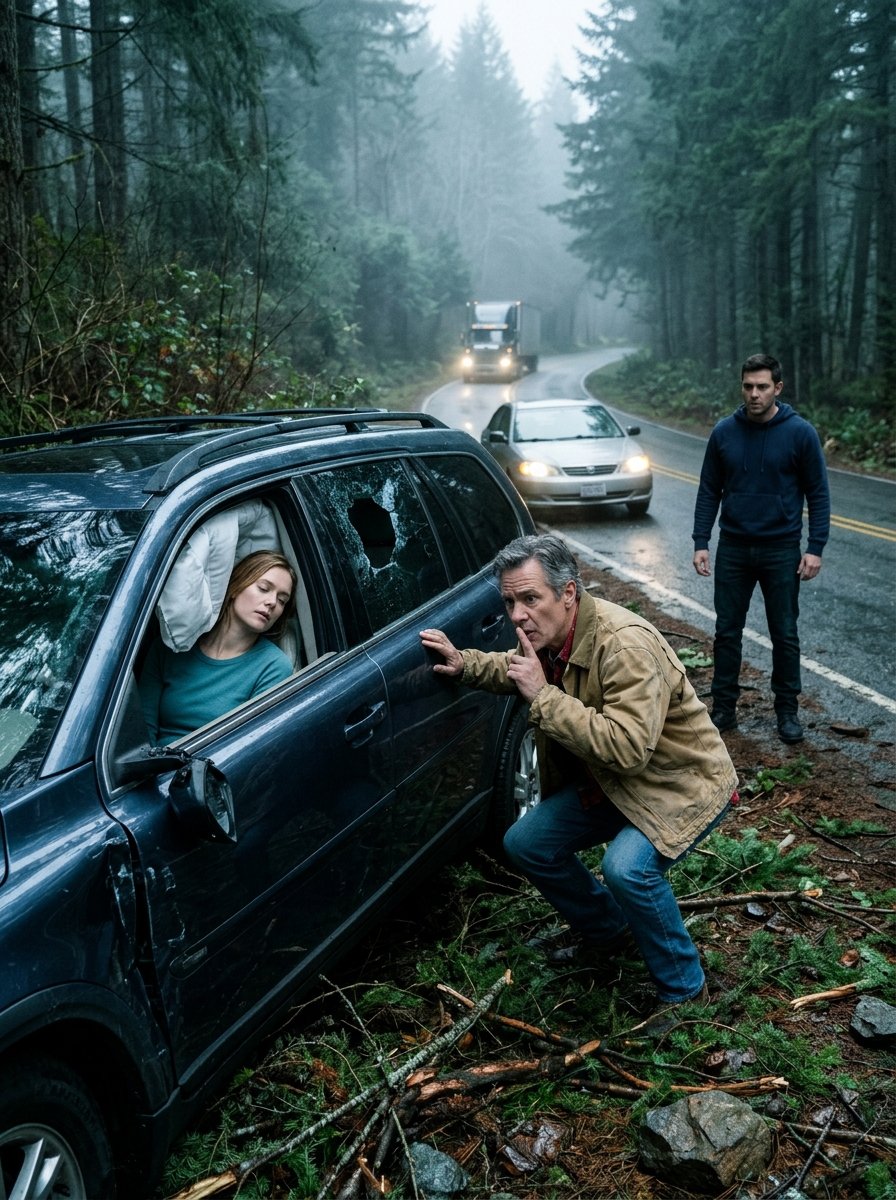
I kept calling until a shadow appeared outside the broken passenger-side window. A man wearing a rain-soaked trucker jacket climbed down toward us. He reached for the wreck, but then he suddenly stopped.
His attention shifted toward the road above.
His expression changed.
“Don’t move,” he whispered.
I tried to explain that I couldn’t move even if I wanted to. My leg was trapped. I needed help. But instead of reaching for his phone, he lowered himself beside the broken window and looked directly at me.
“Pretend you’re dead,” he said quietly. “He’s still here.”
The words made no sense at first.
Then I heard it.
Footsteps.
Someone was walking down the slope.
Slowly.
Carefully.
The trucker stayed hidden beside the wreck. I forced my eyes closed and let my head fall to the side. Every part of me wanted to scream. Every instinct told me to call out.
But something about the stranger’s fear stopped me.
The footsteps came closer.
Then I heard my stepson’s voice.
“Dad?”
My heart almost stopped.
If he had just discovered the crash, I expected panic. I expected him to run toward us, call emergency services, or shout for help.
Instead, he stayed quiet.
He walked around the vehicle.
He waited.
Then he said one word.
“Good.”
A cold feeling moved through me.
A few moments later, I heard him leave. A vehicle door closed above us. An engine started. The sound faded into the rain.
Only after the road became silent did the trucker stand up.
I opened my eyes, expecting him to call for rescue immediately.
Instead, he stared toward the road and looked troubled.
“That wasn’t the first time I saw him today,” he said.
I didn’t understand.
The trucker explained that he had been parked at a turnout before sunrise. From there, he had seen my stepson near our car.
Underneath our car.
He told me my stepson had not been alone.
Another man had been standing nearby, watching the road while my stepson worked underneath the vehicle.
The trucker admitted he could not clearly see the other man’s face, but he remembered their movements. He remembered my stepson crawling out from under the car, handing something to the stranger, and watching as the stranger placed it inside his own truck.
Then the trucker finally took out his phone and called for emergency help.
But before he gave our location, he looked back toward the wreck.
“There’s something else,” he said.
I followed his eyes.
He pointed toward the rear seat of the car.
The crash had thrown my husband’s leather bag across the vehicle. The bag was open, with papers scattered around it.
But something was missing.
A sealed envelope my husband had placed inside before we left home was gone.
That envelope had never left his side before.
My husband had been carrying it because it contained documents connected to a decision he had been preparing to make. He had told me he wanted to handle everything carefully and privately.
Now, trapped inside a wrecked car, I realized someone else knew about it.
The trucker stayed with us until emergency crews arrived. The rescue operation was slow because of the location, the rain, and the unstable ground around the vehicle.
When help finally reached us, the questions began.
How did the car leave the road?
Why did someone return to the crash scene and leave without helping?
And what was inside the missing envelope?
The answers did not come all at once.
My husband survived, but his injuries kept him from explaining everything immediately. While doctors treated us, investigators began looking into the condition of the vehicle.
The damage from the crash told only part of the story.
The missing evidence told another.
The trucker’s account changed the investigation completely because he had witnessed something before the accident happened. He was not only a person who arrived after the crash.
He was someone who had seen the beginning.
Investigators returned to Miller’s Ridge Road and reviewed the area around the turnout where the trucker had been parked. They searched for anything that could explain who the second person was and why that person had been involved.
Meanwhile, my relationship with my stepson became more complicated than I ever imagined.
The person I had spent months trying to understand was now connected to a moment when my family almost disappeared.
But there was still a question nobody could answer.
Why take the envelope?
The missing item was not random. Someone had known exactly where to look.
That meant the crash was not only about causing harm.
It was also about what someone wanted to find.
The days that followed revealed pieces of a hidden conflict that had existed long before the drive through the mountains. Conversations that once seemed harmless started to look different. Small disagreements gained new meaning. Old choices suddenly connected in ways we had never considered.
The trucker’s warning had saved my life, but it also opened a door to a truth my family had avoided.
The accident was only the moment when everything became impossible to hide.
Eventually, investigators uncovered more information about the people involved and the reason the envelope mattered. The truth did not come from one dramatic discovery. It came from small pieces placed together: witness statements, evidence from the vehicle, and the decisions people made after believing nobody was watching.
The most painful part was realizing that the danger had not started on the mountain road.
It had started much earlier, when trust was broken quietly.
The person I thought was trying to repair our family had been making choices I never saw coming.
But the trucker had seen something nobody else had.
He saw that the crash was not an accident.
He saw that someone returned afterward, not to save us, but to search for something.
And because he trusted what he witnessed, the truth had a chance to come out.
Months later, I still remember the sound of rain against broken glass and the moment a stranger whispered for me to pretend I was gone.
At that moment, I thought surviving the crash was the only thing that mattered.
I was wrong again.
Survival was only the beginning.
The real battle was discovering why someone wanted us gone, what they were willing to risk to hide it, and how much of our family had been built on a secret we never knew existed.