My In-Laws Gave Their Other Three Children $20,000 Each For Homes And Handed Us A Card Instead. Two Years Later, Grandma Opal Revealed The Shocking Secret Behind Their Cruel Choice.
PART 1
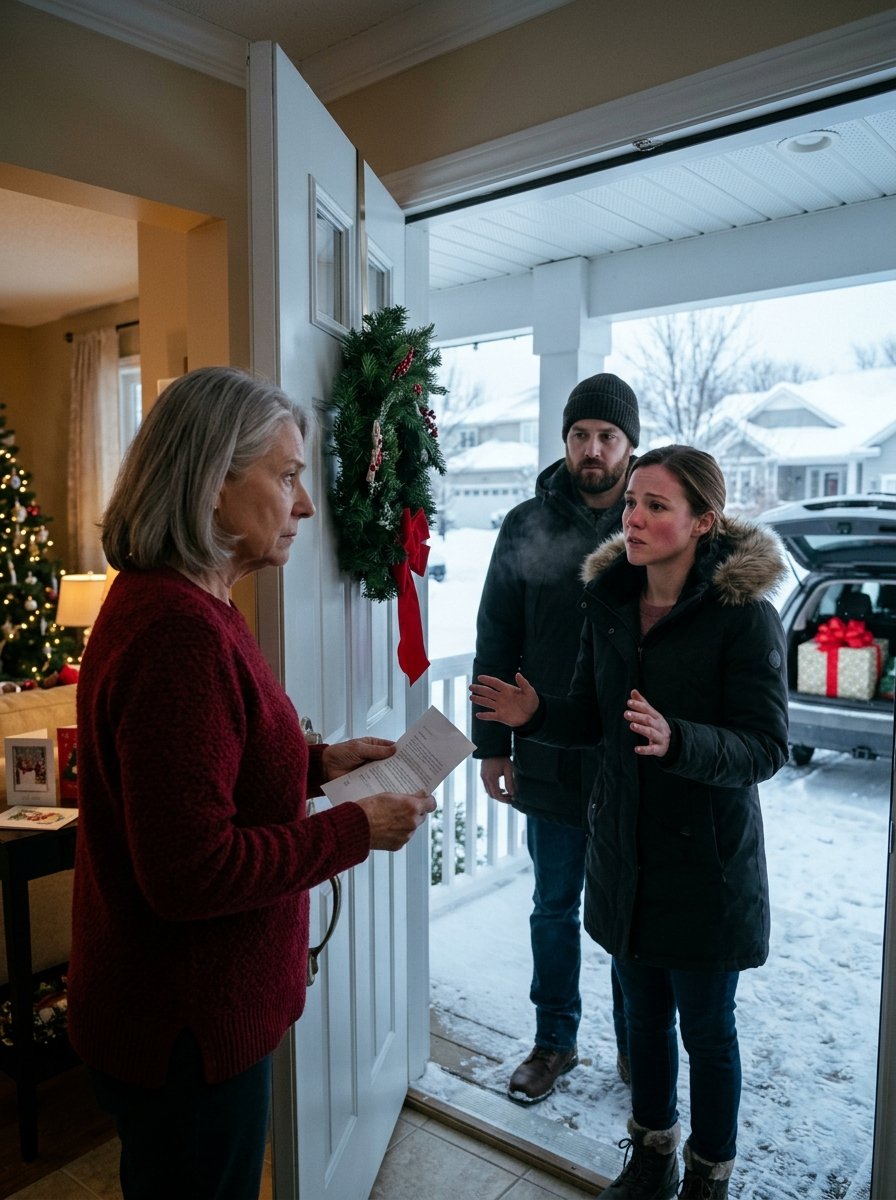
My in-laws gave their other three children $20,000 each to help them purchase homes. All my husband and I received was a card praising how independent we were. I thanked them anyway. Two years later, we bought the abandoned Miller property at a courthouse auction for $41,500.
The envelopes were hidden beneath our plates at Easter dinner.
Kim was the first to open hers. She immediately covered her mouth in surprise.
Jeff opened his next.
Then Stacy, who burst into tears and reached for her napkin.
Each had received $20,000 to put toward a home.
Our envelope held a greeting card decorated with a bluebird.
“You’ve always been such a capable couple,” Judy wrote. “We know you can handle anything.”
There was no check.
I even looked inside the envelope again.
Nate quietly read the message, folded the card, and slipped it into his shirt pocket.
His ears were bright red, a sure sign that he was upset.
Ron lifted his coffee mug in our direction.
“Every word is true. You should take it as a compliment.”
“Thank you,” I replied. “The card is beautiful.”
I wanted to ask why we’d been treated differently.
But demanding a gift wasn’t something I could bring myself to do, especially when his mother had spent the entire morning preparing dinner.
Nate didn’t criticize his parents once.
On our drive home, he finally spoke.
“How much money have we saved?”
“Six thousand two hundred dollars.”
“Then we’ll have to earn more. I’ll start taking extra harvest repair jobs.”
“And I’ll pick up shifts at the diner,” I answered.
During the week, I worked in the hospital’s insurance billing department.
Every Friday and Saturday night, plus Sunday mornings, I waited tables at a highway truck stop.
Nate spent his evenings repairing farm combines for extra cash.
He even sold his fishing boat.
Eggs became a regular part of nearly every meal.
We kept our plans to ourselves.
Mentioning our struggle to family might have sounded like we were asking for money.
Two springs passed before an opportunity appeared.
The county was auctioning the old Miller property because of unpaid taxes.
Nobody had lived there in six years.
Its porch was sinking, and the yard was filled with waist-high weeds.
Nate inspected the house, walking around its exterior.
“The structure’s still solid,” he decided.
The auction took place on the courthouse steps, with a man called Dobbs handling the bidding.
A property investor in a padded vest kept raising the price until it reached $41,000.
We couldn’t afford anything over $42,000.
“Forty-one thousand five hundred,” Nate called.
The investor finally stepped back and shook his head.
“Sold!” Dobbs announced.
I handed over a cashier’s check, along with $1,500 I’d saved from customer tips.
The clerk counted the payment twice before passing us a set of worn keys.
We didn’t share the news with our relatives.
After his regular shifts, Nate spent his nights replacing the electrical wiring, tackling one room at a time.
I peeled away layers of ancient wallpaper until the skin on my thumbs cracked.
But the property’s sale was eventually published in the newspaper’s legal notices.
And Nate’s grandmother never missed a single word of that section.
Opal was eighty-eight years old.
One afternoon, she called me at the hospital.
“Pick me up after church on Sunday,” she instructed. “And don’t mention this to Ronald.”
That Sunday, I drove her six miles along the rural road to our new house….
PART 2
Opal didn’t say a word the whole drive. She sat with her purse in her lap, both hands folded over the clasp, and watched the fence posts slide by like she was counting them.
When I turned onto the gravel lane, she leaned forward.
“Slow down here, Claire.”
I did. The lane curved around a stand of hedge apple trees, and the house came into view, white paint flaking, the porch still sagging on the left side where Nate hadn’t gotten to the new footings yet.
Opal made a small sound. Not quite a gasp. More like someone recognizing a face in a crowd after forty years.
“He kept the lilacs,” she whispered.
I looked where she was looking. Along the north side of the house, half-choked by weeds, an enormous hedge of lilacs was just starting to bud.
“You’ve been here before?” I asked.
She didn’t answer. She opened her door before I could come around to help and planted her cane in the gravel.
Nate was on a ladder at the side of the house, threading new wire through the eaves. When he saw who I’d brought, he nearly dropped his pliers.
“Grandma?”
“Get down off that thing before you break your neck,” Opal said. “I didn’t come out here to watch another Ellison man fall.”
He climbed down, wiping his hands on his jeans, and kissed her cheek. His ears were already going pink. I knew what he was thinking. Word had gotten out. Now the whole family would know, and it would look like we’d been hiding something. Which, I suppose, we had.
“We were going to tell everyone,” he started. “Once it was livable.”
“I know you were.” Opal patted his arm. “Show me inside.”
We gave her the tour, such as it was. The kitchen with its bare studs and the old cast-iron sink Nate refused to replace. The living room, where I’d stripped three walls down to plaster. The narrow stairs she insisted on climbing herself, one step at a time, gripping the rail.
At the top of the stairs, she stopped in front of the small back bedroom. The one with the slanted ceiling and the window that faced the ridge.
It was the room I hadn’t started on yet. Faded wallpaper with tiny blue flowers, peeling at the seams.
Opal stood in the doorway for a long time.
“This was his room,” she said finally. “When he was a boy. Before he took over the big bedroom.”
“Whose room, Grandma?” Nate asked gently.
“Earl’s.”
Nate frowned. “Earl Miller? The old man who lived here?”
“He wasn’t always old.” Her voice cracked a little, then steadied. “Neither was I.”
She turned and looked at Nate in a way I had never seen her look at anyone. Like she was searching his face for something she’d misplaced.
“Do you remember him at all? I used to bring you out here. You were six, seven years old. I told your father we were going to the library.”
Nate opened his mouth, then closed it. I watched something shift behind his eyes.
“There was a man,” he said slowly. “With birdhouses. He had birdhouses all along the fence line. He let me hold the drill.”
“Bluebird boxes,” Opal said. “He built over a hundred of them. Every one by hand.”
The bluebird card. I thought of it, still folded in Nate’s dresser drawer at our rental. I didn’t know why my skin went cold.
“Grandma,” Nate said, “why are we talking about this?”
Opal lowered herself onto the windowsill. She was quiet for so long that I thought she might not answer.
Then she reached into her purse and pulled out an old photograph, soft at the corners from handling. A young man in a work shirt stood beside a much younger Opal, both of them squinting into the sun in front of this very house. The lilacs were in full bloom behind them.
The young man had Nate’s jaw. Nate’s shoulders. Nate’s exact way of standing with his weight on one hip.
“I married your grandfather Walter in the fall of 1958,” Opal said. “Your father was born seven months later. Everyone in town said he came early.”
She handed Nate the photograph.
“He didn’t come early, sweetheart. Earl Miller was your father’s real father. Which makes him your grandfather.”
Nate stared at the picture. His hands had started to shake.
“And Ronald,” Opal added quietly, “has known since he was sixteen years old.”
PART 3
Nobody spoke. Somewhere outside, a mourning dove called from the hedge apples.
Nate set the photograph down on the windowsill very carefully, the way he handled engine parts he didn’t want to scratch. Then he walked out of the room and down the stairs. A moment later, I heard the screen door bang.
“Let him go,” Opal said when I moved to follow. “He’s Earl’s blood. He has to walk it off first.”
I sat down on an overturned paint bucket across from her. My heart was pounding.
“Opal, why are you telling us this now?”
“Because you bought this house.” She almost smiled. “Do you know what the odds are of that? Two years ago, I’d have said a hundred to one. And here you are, scraping Earl’s walls with your bare thumbs.”
Her smile faded.
“And because I owe you both an apology, and I’m too old to keep putting it off.”
She explained it slowly, the way people do when they’ve rehearsed something a hundred times in the dark.
Earl had never married. He’d loved Opal his whole life and kept his distance out of respect for Walter, who had raised Ron as his own and never once asked a question he didn’t want answered. When Walter died eleven years ago, Opal and Earl had started having coffee again. Just coffee. Two old people on a porch.
“He wanted to know Nathan,” she said. “He followed everything. Every report card I showed him. When Nate fixed the Hendersons’ combine in high school and they wrote him up in the paper, Earl cut out that article and kept it in his Bible.”
“Harlan’s still on board?”
“For fifteen thousand, Harlan will diagnose the Pope with dementia. One evaluation, one report, and the court appoints Daniel as guardian. After that, the deed doesn’t matter. He controls everything legally. The house, the business, the accounts.”
“And Daniel?”
A pause. A soft laugh.
“Daniel does what you tell him, sweetheart. He always has.”
I stopped the recording. The room was very quiet. Outside, a gull cried over the water.
A guardianship. They weren’t just stealing my money. They were planning to steal me. My right to decide where I lived, what I signed, who I saw. They wanted to make me a ward in my own life, with my son holding the leash and Vanessa holding him.
And who was Grant?
I called Ruth. She listened to the recording over the phone, and for the first time since I’d known her, she was silent for a long moment.
“Margaret,” she said finally, “I need you to do something for me tomorrow morning. I’m scheduling an independent cognitive evaluation with a geriatric psychiatrist I trust. Dr. Elaine Foster. The sooner we have it on record, the better.”
“You think they’ll actually try it?”
“I think they’ve already started. Your canceled dinner, your new locks, your eviction notice. If I were them, I’d call that erratic behavior.”
I almost laughed. Thirty years of running a hardware business, raising two children, burying a husband, and my first act of real self-defense would be presented as a symptom.
I went back to the banquet room to say goodbye. Most people had left. Patricia was helping the waitstaff pack leftovers into containers.
Then I saw him at the entrance. A young man in a cheap suit, holding a manila envelope, scanning the room.
“Margaret Hale?” he asked.
“Yes.”
He handed me the envelope. “You’ve been served.”
My name was printed on the front. Beneath it, the words: Emergency Petition for Appointment of Temporary Guardian.
Petitioner: Daniel W. Hale.
Supporting documentation: Psychiatric Evaluation of Margaret A. Hale, conducted by Richard Harlan, M.D.
I flipped to the report. It described my “progressive cognitive decline,” my “paranoid ideation regarding family members,” my “inability to manage financial affairs.” It quoted conversations I’d never had. It described an examination that had lasted ninety minutes in Dr. Harlan’s office.
It was dated March 28.
I had never met Dr. Richard Harlan in my life.
The hearing was set for nine days later. And attached to the last page, in Daniel’s handwriting, was a single yellow sticky note, as if he couldn’t help himself.
Mom, if you sign the house over now, I’ll withdraw this. Nobody has to know.
PART 4
Dr. Elaine Foster’s office smelled like peppermint tea and old books. She was about my age, with silver hair cut short and reading glasses on a beaded chain, and she asked me questions for three hours.
She asked me to draw a clock. To remember five words and repeat them twenty minutes later. To count backward from one hundred by sevens. To explain the difference between a lease and a deed, which I did in considerable detail. To tell her about my husband.
That last one wasn’t on any test. I think she just wanted to know.
“Walter sold nails,” I said. “That’s how he described it. ‘I sell nails, Margaret.’ But he knew every contractor in three counties by name. When the Kowalski family lost their house in a fire, he gave them everything they needed to rebuild at cost, and he never told anyone. I found out at his funeral.”
Dr. Foster wrote something down. Then she took off her glasses.
“Mrs. Hale, I’ll be completing a full report, but I can tell you now that I find no evidence of cognitive impairment. None. Your recall is better than mine.”
“And Dr. Harlan?”
Her mouth tightened. “I know Richard Harlan by reputation. He lost his hospital privileges in 2019. I’ll say no more than that.”
Ruth, meanwhile, had brought in reinforcements. Leon Marsh was a forensic accountant, a quiet man in his sixties with a bow tie and an alarming love of spreadsheets. He set up camp at my dining room table with three laptops and every bank statement from Hale & Son Hardware going back four years.
“Your son was not subtle,” Leon told me on the second day. “But he was persistent.”
He walked me through it. Small transfers at first, a few hundred dollars labeled “contractor reimbursement.” Then thousands. Then a pattern: every month, money moved from the business account into Daniel’s personal account, and within forty-eight hours, most of it left again.
“Where did it go?” I asked.
“Some of it, online sportsbooks. Quite a lot, actually.” He paused delicately. “Did you know your son gambled, Mrs. Hale?”
I closed my eyes. Walter had known. I remembered now, a fight between them years ago, before Daniel married, Walter’s voice coming through the closed door of the garage. You’re throwing it away, son. Every time, you’re throwing it away. Walter had never told me what it was about. He’d always tried to protect me from the worst of Daniel.
“And the rest?” I asked.
Leon turned the laptop toward me. “The rest went somewhere much more interesting.”
On the screen was a list of payments. Forty-one of them over eighteen months, totaling just over two hundred and thirty thousand dollars. All to an entity called Bright Harbor Holdings, LLC.
“It’s registered in Delaware,” Leon said. “Which normally makes ownership hard to trace. But whoever set it up got lazy with the bank account. The authorized signer is a man named Grant Pierce.”
Grant. The voice on the recording.
Ruth had been busy, too. She’d found Tara Delgado, the notary who had stamped my forged deed. Tara’s commission had expired six weeks before the date on the document. And Tara Delgado, it turned out, was Vanessa’s cousin on her mother’s side.
“She’s already lawyered up,” Ruth said. “Which tells me she’s scared. Scared people make deals.”
By the fifth day, my dining room looked like a war room. Patricia brought casseroles. Marcus Bell checked the locks every evening. Lily texted me once, a single line: They’re fighting. Mom keeps saying “stick to the plan.”
That night, Leon stayed late. Around ten, he called me into the dining room, and his expression had changed.
“I ran Grant Pierce through a few databases,” he said. “Public records. Court filings. Marriage licenses.”
He turned the screen.
It was a marriage certificate from Clark County, Nevada, dated eleven years ago. The groom was Grant Michael Pierce.
The bride was Vanessa Marie Kendall.
“That’s her maiden name,” I whispered.
“Yes,” Leon said. “And here’s the thing, Mrs. Hale. I can’t find a divorce. Not in Nevada, not here, not anywhere. As far as the State of Nevada is concerned, Vanessa is still married to Grant Pierce.”
Which meant that when she had stood in my garden five years ago in a white dress, promising to love my son for the rest of her life, she had already belonged to someone else.
And the man she was sending my money to wasn’t her accomplice.
He was her husband.
PART 5
I didn’t sleep that night. I sat in Walter’s old armchair in the den, the one that still held the shape of him, and I thought about all the ways I had been blind.
I thought about my daughter.
Claire was two years younger than Daniel. Artistic, stubborn, quick to laugh and quicker to argue. She had moved to Portland after college and built a life there, teaching high school art. She had come home for her father’s funeral, and then, three months later, she had simply stopped calling.
Daniel had explained it to me. Claire was angry about the will, he’d said. She felt she should have gotten more. She’d said terrible things about me, things he wouldn’t repeat because they would only hurt me. “Give her space, Mom,” he’d said. “She’ll come around.”
I’d written her letters. Four of them. She never answered.
At six in the morning, I called her.
It rang five times. I almost hung up. Then a sleepy, wary voice. “Mom?”
“Claire.” My throat closed. “Claire, I need to ask you something, and I need you to be honest with me. Did you ever receive my letters?”
A long silence. “What letters?”
I told her. All of it. The money, the deed, Vanessa, Grant, the guardianship petition. When I got to the part about what Daniel had said, about her wanting more of the inheritance, she made a sound I’ll never forget, half sob and half laugh.
“Mom, I never said that. I never said any of that. Daniel told me you didn’t want to hear from me. He said you blamed me for not being there when Dad got sick. He said you’d asked him to tell me to stop calling because it upset you too much.”
We had been living in the same lie from two different directions, each of us thinking the other had walked away.
“I wrote to you,” Claire said, crying now. “Christmas. Your birthday. I sent everything to the house.”
The house where Daniel collected the mail every afternoon. I’d always thought it was thoughtful of him.
“I’m getting on a plane,” Claire said. “Today.”
She arrived that evening, thinner than I remembered, with paint under her fingernails and Walter’s gray eyes. We stood in my front hallway and held each other for a long time without saying anything. Three years. Three years I would never get back because I had trusted the wrong child.
Later, at the kitchen table, over the last of the Easter lemon tart, Claire grew quiet.
“Mom, there’s something I should have told you a long time ago. I didn’t think it mattered. And then we weren’t speaking.”
“Tell me now.”
“Dad called me. About two weeks before he died. He was in the hospital, I think. He sounded tired. He asked me a lot of strange questions about Daniel. Whether Daniel had ever asked me for money. Whether I’d met Vanessa’s family.” She turned her fork over in her hands. “And then he said something I didn’t understand. He said, ‘If your mother ever needs it, I left something in the boathouse. Under the old green canoe. She’ll know what to do.’”
“The boathouse,” I repeated.
We had a little boathouse at the bottom of the property, on the edge of Miller’s Pond. Walter used to fish there on Sunday mornings. After he died, I couldn’t bring myself to go inside. I’d padlocked it and let the ivy take it.
“Did you ever tell Daniel about that call?”
Claire shook her head. “I didn’t tell anyone. It felt private. Like the last secret he gave me.”
I stood up and got my coat.
“Mom, it’s dark.”
“Your father waited three years,” I said. “He shouldn’t have to wait until morning.”
We took flashlights. Marcus, who had been sitting in his car at the end of the driveway, insisted on coming with us. The path to the pond was overgrown, and the night air was cold and smelled of wet leaves.
The padlock was rusted, and Marcus had to break it with a crowbar from my garage. Inside, everything was exactly as Walter had left it. His fishing rods on the wall. His thermos on the workbench. The old green canoe, upside down on two sawhorses, gray with dust.
Marcus and Claire lifted it together.
Underneath, taped to the floorboards and wrapped in a heavy plastic bag, was a metal lockbox.
My hands shook so badly I could barely turn the dial. But I knew the combination before I even tried it. Our wedding date. It was always our wedding date with Walter.
Inside were two things. A thick legal folder stamped Hale Family Irrevocable Trust.
And an envelope with my name on the front, in my husband’s handwriting.
Maggie. Read this when you’re ready to stop protecting him.
PART 6
I read Walter’s letter at the kitchen table at one in the morning, with Claire on one side of me and a cup of tea going cold on the other. Marcus waited outside. Some things aren’t meant for strangers, and he knew it.
My Maggie,
If you’re reading this, something has gone wrong, and I’m sorry I’m not there to stand next to you. I suspect it’s Daniel. I hope I’m wrong. I’ve spent a lot of years hoping I was wrong about our boy.
He has a sickness, Mag. Gambling. I’ve paid his debts three times that you don’t know about. The last time I told him it was the last time, and I meant it. He was angry. He said things a son shouldn’t say. I forgave him, because that’s what you do, but I didn’t forget.
I’m not sure about Vanessa. Something about her doesn’t sit right. She asks too many questions about the store. She asked me once what the house was worth, at our own dinner table, and laughed like it was a joke. It wasn’t.
So I’ve done something. I met with Harold Greene last month and put the business into a trust. You’re the trustee. The store, the building, the accounts, all of it. Nobody can transfer a dime without your signature and Harold’s, and Harold has instructions to call you directly about any unusual request. Daniel doesn’t know about it. Neither does Claire. I’m sorry for the secrecy. I just wanted one thing in this world that couldn’t be taken from you.
You always said I was the strong one. You were wrong. You were the one who kept this family together with casseroles and stubbornness and that lemon tart. You never once let anyone make you feel small, until it came to your children. You’d let them walk all over you and call it love.
Love doesn’t mean letting them, Maggie. Sometimes love means locking the door.
Make him face it. That’s the only way he’ll ever get better.
Yours, always and after,
Walter
I don’t know how long I cried. Claire made more tea. Neither of us drank it.
Harold Greene had been Walter’s attorney for thirty years. He had died of a heart attack eight months after Walter, and his practice had been absorbed by a larger firm. Whatever instructions Walter had given him had likely been buried in some filing cabinet. Daniel had walked straight through a door his father had locked, because no one had been standing guard.
At seven a.m., I drove the trust documents to Ruth’s office. She read them twice, then sat back in her chair and actually smiled.
“Margaret, do you understand what this is?”
“Walter’s last gift.”
“It’s a weapon. Every dollar Daniel transferred out of the business wasn’t just stolen from you. It was stolen from an irrevocable trust. That’s breach of fiduciary duty, embezzlement from a trust, and it means the business was never yours to lose in a guardianship, because legally it was never just yours. Even if they’d won, Daniel couldn’t have touched it without going through a trust court.” She tapped the folder. “Their whole plan was built on sand.”
That evening, a storm rolled in. Rain hammered the windows. Claire was upstairs unpacking. I was in the kitchen, making soup because my hands needed something to do, when someone pounded on the back door.
Marcus was there before me, one hand raised. Through the glass, I saw Daniel.
He was soaked through. No coat. His hair plastered to his forehead, his eyes red. He looked like the little boy who used to come home from Little League after losing, trying very hard not to cry in front of his father.
“Let him in,” I said.
Marcus hesitated, then opened the door and stayed close.
Daniel didn’t come any further than the doormat. Water pooled around his shoes.
“I didn’t know about the doctor,” he said. His voice was raw. “Mom, I swear to God. I signed the petition, but Vanessa said it was just leverage. That we’d never actually file it. That it was just to scare you into giving us the house.”
“You put your name on a document saying I was losing my mind, Daniel.”
“I know.” He pressed the heels of his hands against his eyes. “I know.”
“Why are you here?”
He looked up. And for the first time in years, I saw something real in my son’s face. Not a smirk. Not a performance. Fear.
“Because I found something tonight. In Vanessa’s car. A second phone.” He swallowed hard. “She’s been texting a man named Grant. For years. Since before we met.”
“I know about Grant,” I said.
Daniel stared at me. “Then do you know she’s still married to him?”
I nodded slowly.
He made a sound, a terrible, broken sound, and sank down onto the step of the back porch in the rain.
“Then our marriage was never real,” he whispered. “Five years. None of it was real.”
I should have felt triumph. I didn’t. I felt like a mother watching her son bleed.
Then he said the thing that turned my blood cold.
“Mom, there’s more. In the texts. Grant said something about the hearing on Thursday. He said, ‘If the judge doesn’t give us the old lady, we go with the warehouse.’”
PART 7
The guardianship hearing was held in Courtroom 4B of the county probate court on a bright Thursday morning, nine days after Easter.
I wore my navy suit, the one I’d worn to Walter’s funeral, because it made me stand up straight. Claire sat behind me. So did Patricia, Ben, both Morrison twins, Luis from the store, and Leon Marsh with his bow tie and three binders of spreadsheets.
Across the aisle sat Daniel, alone at the petitioner’s table, with a lawyer I’d never seen before. Vanessa sat in the row behind him in a cream silk blouse, every inch the devoted wife. She smiled at me as I walked in.
Daniel didn’t look at either of us.
Daniel’s lawyer, a nervous young man named Kyle Brandt, presented Dr. Harlan’s report. He described my “sudden, erratic decisions,” my “irrational accusations against family members,” my “inability to manage complex finances.” He described the canceled Easter dinner as “a public episode of paranoid hostility.”
Then Ruth stood up.
She was not loud. Ruth was never loud. She simply laid out the facts like a woman setting a table.
First, Dr. Elaine Foster’s report, three hours of testing, concluding that I was “cognitively intact, with memory and executive function well above the expected range for her age.”
Then the hotel receipts.
“Dr. Harlan’s report states that he examined Mrs. Hale in his office for ninety minutes on March 28,” Ruth said. “On March 28, Mrs. Hale was at the Copley Square Hotel in Boston, attending her late husband’s college roommate’s memorial service. We have the hotel receipt, a restaurant receipt from that evening, time-stamped photographs from the service, and a sworn statement from the widow, who sat beside her for three hours.”
The judge, a stern woman named Honorable Grace Whitfield, removed her glasses.
“Mr. Brandt. Is Dr. Harlan present to testify?”
Kyle Brandt looked at his notes. Then at Daniel. Then at Vanessa. “He, ah, was unable to attend today, Your Honor.”
“I’ll bet he was,” the judge said.
Ruth then played twenty-two seconds of Lily’s recording. Just Grant’s voice. For fifteen thousand, Harlan will diagnose the Pope with dementia.
Someone in the gallery gasped. I didn’t turn around to see who.
Vanessa was on her feet. “That’s an illegal recording! That’s fabricated!”
“Sit down, ma’am,” Judge Whitfield said, in a voice like a closing door. Vanessa sat.
Then Ruth produced the trust documents. Walter’s signature. Harold Greene’s notarization. The provisions naming me sole trustee.
“Your Honor, even setting aside the fraudulent medical evidence, this petition was designed to grant the petitioner control over assets held in an irrevocable trust he was never entitled to administer. We ask that the petition be dismissed with prejudice, and that the court refer this matter to the district attorney’s office for investigation of fraud, forgery, and conspiracy.”
Judge Whitfield looked at Daniel for a long moment.
“Mr. Hale. Do you have anything to say?”
Daniel stood. His hands were trembling. He opened his mouth, and I saw him glance back at Vanessa, the old reflex, the dog checking for its owner’s signal.
Then he turned back to the judge.
“I withdraw the petition, Your Honor,” he said. “My mother is the sanest person I know.”
Behind him, Vanessa made a small, sharp sound, like a hiss.
“The petition is dismissed with prejudice,” Judge Whitfield said. “This court is referring the matter, including Dr. Harlan’s report, to the district attorney and the state medical board. Mr. Hale, I suggest you retain different counsel. You’ll need it.”
The gavel fell.
Outside the courtroom, in the hallway with its scuffed linoleum and bad fluorescent light, Vanessa caught up with me.
“You think you’ve won,” she said quietly, still smiling for anyone watching. “You think a dead man’s paperwork and a teenager’s stolen recordings make you clever. You’re a lonely old woman with a ham and a grudge, Margaret. And when this is over, you’ll still be alone.”
“I’m not alone,” I said. Claire was behind me. Patricia, Ben, Leon. “I’m just not alone with you anymore.”
She walked away without another word. I watched Daniel watch her go. He didn’t follow.
That night, I tried to rest. Claire made spaghetti. For the first time in weeks, I let myself believe the worst was over.
At 1:47 a.m., my phone buzzed on the nightstand. Lily.
Grandma, Mom left the house an hour ago with Grant. I heard them. They took the keys to the store warehouse. Grant said “if we can’t have the house, we take the inventory and sell it in Jersey before anyone knows it’s gone.”
A second message, seconds later.
Mom packed my suitcase too. She said we’re leaving tomorrow. I don’t want to go.
PART 8
I called the police first. Walter would have wanted me to be brave, but he’d have wanted me to be smart even more. Then I called Marcus, who had gone home for the night but answered on the first ring.
“Stay in the house, Mrs. Hale,” he said. “I’ll meet the officers there.”
“Marcus, that’s my husband’s warehouse. Forty years of his life is in that building.”
A pause. “Then stay in the car.”
Claire drove. I sat in the passenger seat in my bathrobe and coat, clutching my phone, watching the dark streets slide past. Hale & Son Hardware’s warehouse sat on Industrial Way on the edge of town, a long brick building Walter had bought in 1991 when the business outgrew the back room of the store. Inside were power tools, generators, lumber, plumbing fixtures. Close to four hundred thousand dollars in inventory, Luis had told me once.
When we turned onto Industrial Way, I saw the lights.
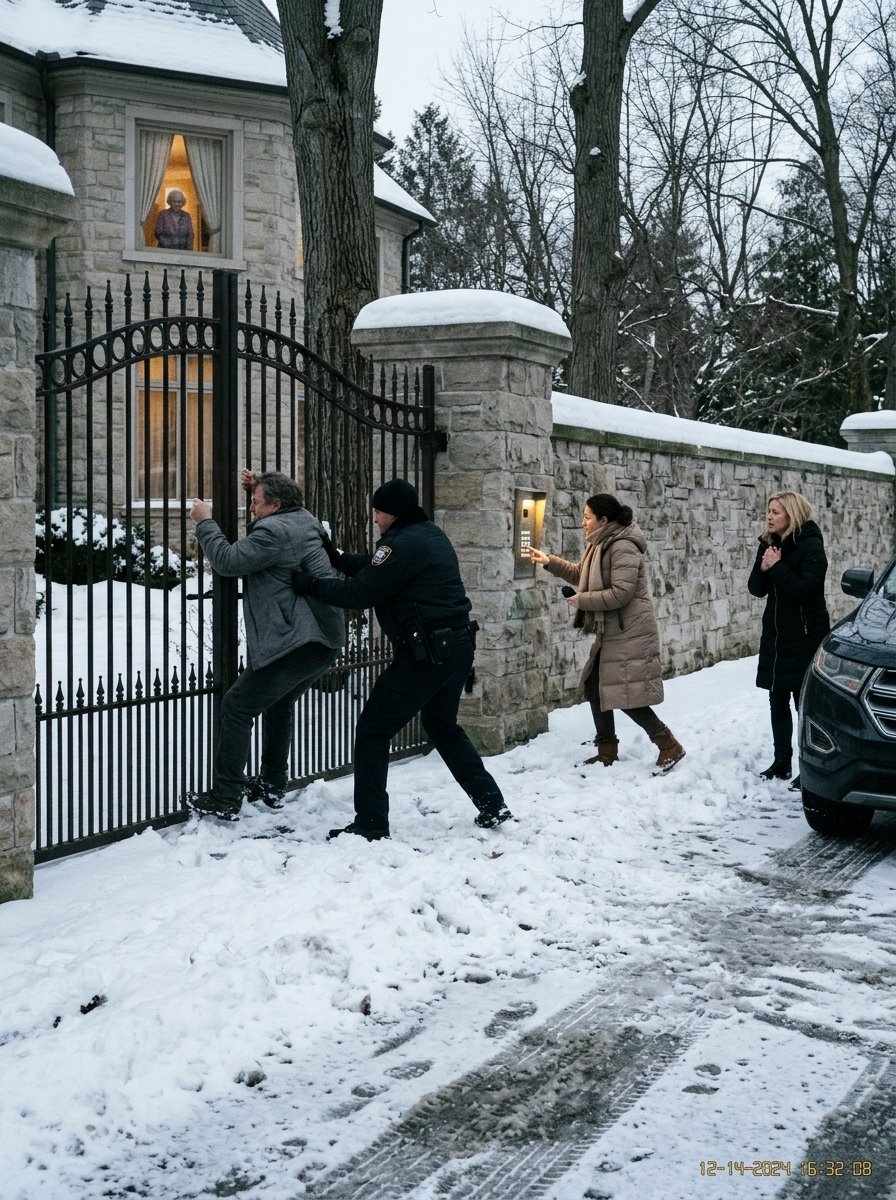
Two police cruisers, blue and red flashing against the brick. A rented box truck backed up to the loading dock, its rear door open, half full of boxed generators. And on the asphalt, his hands cuffed behind his back, a tall man in an expensive leather jacket, his silver hair glinting in the strobe lights.
Grant Pierce.
I had imagined him for weeks. A shadowy figure, a voice on a recording. In person, he was simply a man in his fifties with a good tan and a weak chin, shouting at a patrol officer about his rights.
Claire parked. I got out despite her protests. Marcus was standing beside one of the cruisers, and he came to meet me.
“They got here about four minutes before the truck was full,” he said. “Officer Reyes caught him with the warehouse keys in his pocket.”
“And Vanessa?”
Marcus’s jaw tightened. “Not here.”
Then I saw the third car, parked at the far end of the lot. Daniel’s old gray pickup.
My son was sitting on the curb beside it, an officer standing over him. His head was in his hands.
My heart dropped. “Was he helping them?”
“No, ma’am.” A detective I hadn’t noticed approached, a woman in her forties with a raincoat over a sweatshirt. “I’m Detective Sharon Ochoa. Your son called us. About ten minutes before you did. He told us exactly where they’d be and what they were taking.”
I looked across the lot. Daniel lifted his head, saw me, and looked away again, like he couldn’t bear it.
I walked over to him. My bathrobe flapped around my ankles. I didn’t care.
“Daniel.”
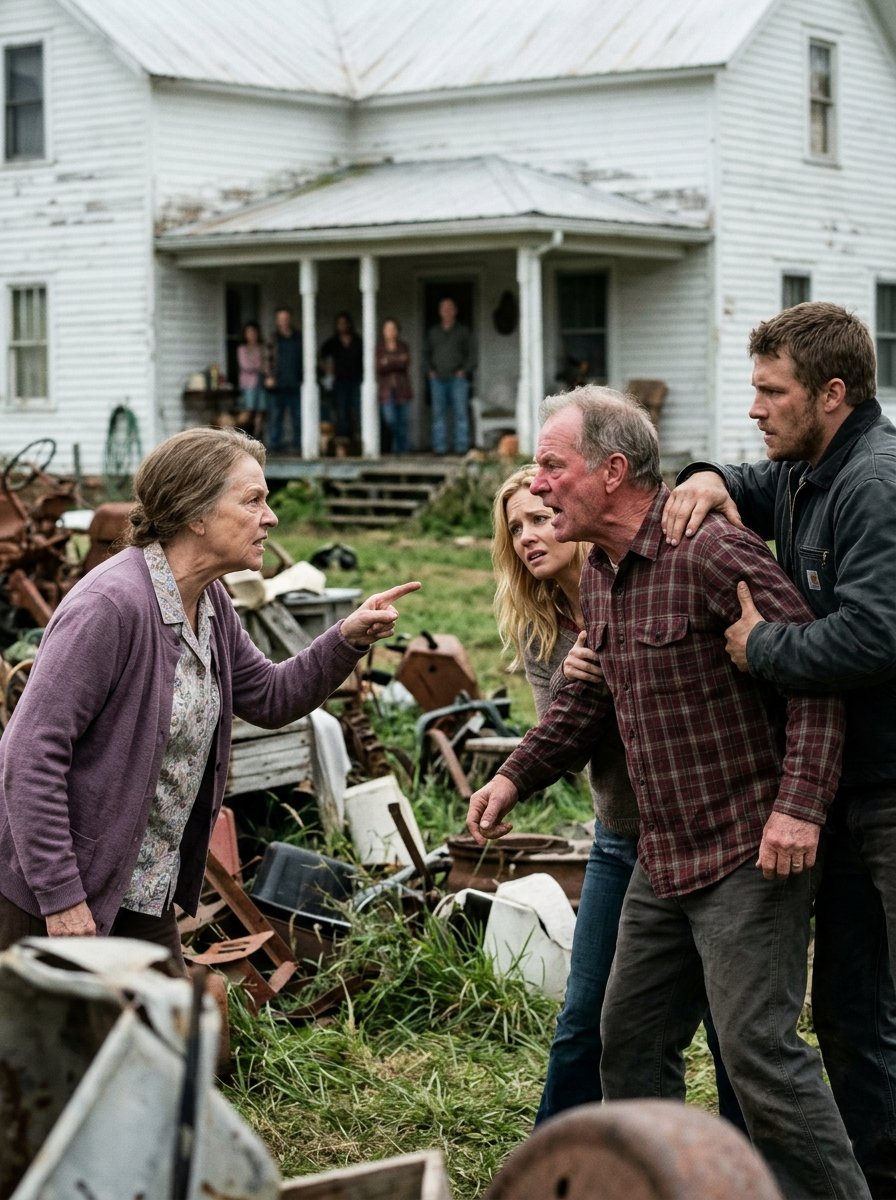
“I followed them,” he said, without looking up. “I saw them leave together. I knew where they were going.” His voice cracked. “Mom, I did all of it. The money. The transfers. I signed your name on the first ones myself, before Vanessa ever got involved. I was in debt. Eighty thousand dollars to people who don’t send letters, they send guys. And Vanessa said she knew how to fix it. She said the business was half mine anyway, that Dad would have wanted me to have it.”
“Your father,” I said, “spent his last month on earth trying to protect me from exactly this.”
He nodded, crying openly now. “I know. Ruth sent my lawyer a copy of the trust. And the letter.” He wiped his face with the back of his hand. “I read what he wrote about me.”
We were quiet for a moment. The police lights pulsed over us.
“I found something else,” Daniel said. “On Vanessa’s second phone. Bright Harbor Holdings, the company. It isn’t in my name. It never was. It’s in hers and Grant’s. Every dollar I took, she was moving into an account I couldn’t touch. When this was all over, when they had the house and the business, she was going to leave me holding the debt and the fraud charges.” He laughed, a terrible hollow laugh. “She never loved me, Mom. I was just the key to your front door.”
I wanted to hold him. I wanted to slap him. I did neither. I sat down on the curb beside my son, in my bathrobe, in a parking lot at two in the morning, and I let him cry the way I hadn’t let him cry since he was seven years old.
Detective Ochoa approached again, a phone pressed to her ear. Her expression had changed.
“Mrs. Hale, I just got off with the airport. We flagged Vanessa Kendall’s name, all variations. She booked a one-way flight to Costa Rica this afternoon. Departs at 6:10 a.m.”
“Costa Rica,” Daniel repeated numbly. “We honeymooned there.”
“There’s something else,” the detective said. She looked at me carefully. “She booked a second ticket. Same flight. In the name of Lily Kendall.”
PART 9
The airport at five in the morning was a strange, half-lit world of rolling suitcases and closed coffee shops. Detective Ochoa had insisted I stay home. I had insisted on coming. We had compromised with me sitting in the back of an unmarked car at the curb of Terminal B, with Claire beside me and my phone clutched in both hands.
At 5:12, it buzzed.
Lily: We’re past security. Gate 23. Mom keeps checking her phone. She knows Grant got caught. She said we have to be on this plane.
Me: Where are you right now?
Lily: Bathroom. Told her I was sick.
Me: Stay there, sweetheart. Help is coming. You did everything right.
Lily: I’m scared, Grandma.
Me: I know. So am I. That’s how you know you’re being brave.
I forwarded every message to Detective Ochoa.
At 5:31, two airport police officers and Detective Ochoa approached Gate 23. Lily told me later what it looked like. How her mother saw them coming and stood up very slowly. How she didn’t run. Vanessa never ran. She smoothed her blouse and lifted her chin and said, “Is there a problem, officers?” like she was returning a cold entrée.
At 5:44, Lily came through the sliding doors of Terminal B with a female officer beside her, wearing an oversized hoodie and clutching her backpack straps. She saw me in the car. She broke into a run.
I got out just in time to catch her.
She was shaking. She was sixteen and fierce and terrified, and she had saved my life with a thumb drive and a strip of masking tape.
“I didn’t know if you’d believe me,” she said into my shoulder. “Nobody ever believes me.”
“I believe you,” I said. “I’ll always believe you.”
Two days later, I asked to see Vanessa.
Ruth thought it was a bad idea. Claire thought it was a worse one. But I needed to look at her without a kitchen between us.
The visiting room at the county detention center was beige and bare. Vanessa sat across a metal table from me in an orange jumpsuit. Without the makeup and the silk and the perfume, she looked smaller. Older. Tired.
“Come to gloat?” she asked.
“No,” I said. “I came to ask you why.”
She laughed. “Why? Because you had everything, Margaret. The house. The business. The husband who adored you. The perfect little family dinners. Do you know what I had growing up? A mother who sold our furniture for rent. I met Grant when I was twenty-two. He taught me that people like you don’t deserve what you have. You just got there first.”
“And Daniel?”
She shrugged. “Daniel was easy. Lonely men with debts are always easy. You raised a son who’d sell his mother for a little attention. Don’t blame me for that.”
It was meant to wound. And it did, a little. Because there was a sliver of truth in it.
“Maybe I did make mistakes with Daniel,” I said. “I protected him when I should have held him accountable. I’ll live with that. But you want to know the difference between us, Vanessa? When I make a mistake, I fix it. Even when it costs me. You’ve never fixed anything in your life. You just take the next thing.”
She leaned forward. “You’ll never get all that money back. Grant spent most of it.”
“I know,” I said, standing. “I wasn’t fighting for the money.”
At the door, I turned back.
“And by the way. The sauce was perfect. It was Walter’s mother’s recipe. You just never learned how to taste anything you didn’t steal.”
Daniel was released on his own recognizance after agreeing to cooperate fully with the district attorney. His new lawyer, a sensible, gray-haired woman named Diane Russo, advised him to plead guilty to embezzlement and forgery in exchange for testimony against Grant, Vanessa, Dr. Harlan, and Tara Delgado. He agreed before she finished the sentence.
He moved into a small rented room above a laundromat across town. He started attending Gamblers Anonymous meetings in a church basement three nights a week. He didn’t call me. I didn’t call him. Some silences need to be earned before they can be broken.
Then, one evening in late May, my doorbell rang.
Daniel stood on the porch. Thinner. Clean-shaven. Holding something wrapped in a faded dish towel.
“I’m not here to ask for anything,” he said quickly. “I just need to give you something back. Before I go to court. It’s the last thing I took.” His voice wavered. “And it’s the only one I can actually return.”
He unwrapped the towel.
It was a small wooden box, its corners worn smooth by decades of hands. The lid was carved with a single word.
Recipes.
PART 10
My mother-in-law, Rose Hale, had kept that box on her kitchen counter for fifty years. When she died, she left it to me, not to Walter, with a note that said, You’re the only one who’ll actually use it. Inside were two hundred handwritten index cards, stained with butter and vanilla and the fingerprints of three generations. The wine reduction. The rosemary rolls. The lemon tart.
It had vanished from my kitchen about a year earlier. I’d searched everywhere. I’d cried over it, privately, and assumed I’d misplaced it in grief, the way you lose things after a death.
“Vanessa threw it in the trash,” Daniel said. “Last spring. She was redoing the kitchen shelves and said it was clutter. Old junk. I took it out of the bin when she wasn’t looking and hid it in my truck.” He stared at the porch boards. “I didn’t give it back because then I’d have had to explain why she threw it away. And I’d have had to admit I let her.”
I held the box in both hands. It was lighter than I remembered. It was heavier than anything.
“You saved it,” I said.
“It’s the only good thing I did all year.”
“No,” I said. “It isn’t. You called the police that night. You told the judge the truth. You’re going to those meetings.” I looked at him. “Those count, Daniel. They count a lot.”
He cried then, on my front porch, and this time I put my arms around him.
The trials took most of the summer and part of the fall.
Grant Pierce was convicted of conspiracy, wire fraud, grand theft, and attempted theft of the warehouse inventory. Because of a prior fraud conviction in Arizona that Leon Marsh dug up, the judge sentenced him to eight years in state prison.
Vanessa Kendall was convicted of forgery, conspiracy to commit fraud, identity theft, and bigamy. Lily did not have to testify in person; her recordings, authenticated by a forensic audio expert, spoke for themselves. Vanessa was sentenced to six years. She did not look at anyone when the verdict was read.
Dr. Richard Harlan surrendered his medical license and pleaded guilty to filing false reports. Tara Delgado lost her notary commission, received probation, and wrote me a long, tearful letter of apology that I read once and kept.
Daniel pleaded guilty to embezzlement and forgery. Because of his cooperation, his clean record, and his ongoing treatment, he was sentenced to five years of probation, four hundred hours of community service, and full restitution, to be paid from his wages over time. He took a job at a lumberyard two towns over. Every month, a check arrived, sometimes for only a few hundred dollars. I deposited every one. Not because I needed the money. Because he needed to pay it.
Through civil recovery, Ruth managed to claw back about sixty percent of what had been stolen, most of it frozen in Bright Harbor’s accounts before Grant could move it. Hale & Son Hardware survived. Luis became general manager. Claire, to everyone’s surprise including her own, decided to stay. She took a teaching job at the high school and started running Saturday art classes in the back of the store, where children painted birdhouses made from Walter’s leftover lumber.
Lily’s father, a kind, overwhelmed man named Tom who lived in Oregon, flew out in June. We talked for a long time on my back porch. In the end, we agreed together, with Lily’s blessing, that she would finish high school here, living with me, and spend summers with him. She painted her room purple. She left her headphones off more often. She started calling me Grandma without hesitating first.
And Frank Delaney, the retired fire captain who lived across the street and had quietly mowed my lawn every week since Walter died without ever being asked, finally worked up the nerve to invite me to dinner. I said yes. He took me to a diner and ordered meatloaf and told me it wasn’t as good as mine, though he’d never tasted mine. I told him he’d have to earn that.
The following Easter, I hosted dinner in my own home.
Twenty-six people this time. Patricia and Ben. The Morrison twins. Luis and his wife. Leon in a pastel bow tie. Ruth Kaplan, who brought deviled eggs and pretended not to be moved when I hugged her at the door. Marcus Bell and his two little boys. Frank, carrying folding chairs. Claire, flour on her cheek, laughing at something Lily said in the kitchen as they glazed the ham together.
I made the wine reduction from Rose’s card. I made the rosemary rolls. I let Lily make the candied carrots, and they were a little burned, and everyone had seconds.
At four o’clock, the doorbell rang.
Daniel stood on the porch, wearing a pressed shirt, holding a pie plate covered in foil. He looked nervous. He looked like a man who had learned the difference between being forgiven and being welcomed, and wasn’t sure yet which one he’d been given.
“I wasn’t sure I should come,” he said.
“I invited you,” I said. “That’s how you know.”
He held out the plate. “It’s the lemon tart. From Grandma Rose’s card. I’ve made it nine times. The first eight were terrible.” He swallowed. “This one’s still probably not right.”
I lifted the foil. The crust was uneven. The filling had cracked down the middle. It was, without a doubt, the most beautiful dessert I had ever seen.
At the table, after the ham and the rolls and the burned carrots, I cut the tart into twenty-six slivers so everyone would get a piece. The room grew quiet as people tasted it.
Daniel watched me take a bite. His hands were folded so tightly his knuckles were white.
It was a little too tart. The crust was a little too thick.
“Well?” he asked. “Is it good?”
I thought about a year ago. A crystal spoon in my sauce. You call this cooking? My son leaning against the refrigerator, smirking, choosing silence over his mother.
I thought about Walter’s letter. Sometimes love means locking the door.
And I thought about what comes after, if you’re very lucky and very patient. Because love also means knowing when to unlock it again.
“Daniel,” I said, and I reached across the table and covered his hand with mine. “This is cooking.”
He laughed, and he cried, and so did half the table. Lily rolled her eyes and passed him a napkin. Claire squeezed his shoulder. Frank asked for a second sliver.
That night, after everyone had gone, I washed the dishes alone in my quiet kitchen. The house smelled like rosemary and butter and lemon. No perfume. No bleach. Just home.
I opened Rose’s recipe box and slid the lemon tart card back into its place. On the back, in my own handwriting, I added a small note for whoever might hold this box someday.
Never let anyone tell you that what you make with love isn’t worth anything. Not your cooking. Not your home. Not yourself.
Respect is the first ingredient. Everything else follows.
Then I turned off the light and went to bed, a widow in her own house, owing no one an apology for standing up in her own kitchen.
THE END