For four years, my teenage son mowed our elderly neighbor’s lawn every Saturday and refused every dollar the man offered him.
When Mr. Vance died, Noah borrowed a black tie and sat in the back of the church.
He expected to say goodbye quietly.
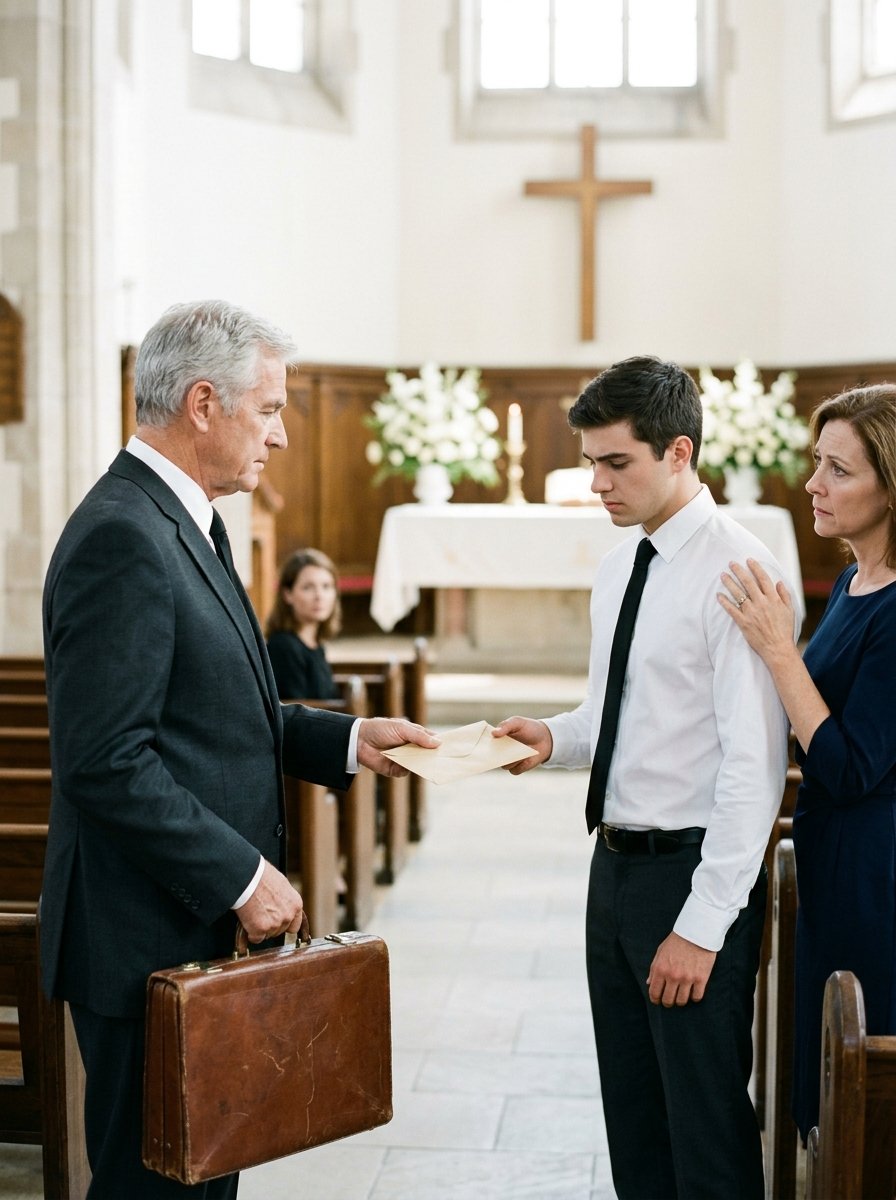
Instead, the lawyer handling the estate walked past the grieving relatives, stopped beside my son, and handed him a sealed envelope.
“Mr. Vance wanted you to have this personally.”
Noah looked toward the family in the front row.
“Are you sure?”
“Very sure.”
Then the lawyer said something that made my son’s fingers tighten around the envelope.
“He also left instructions. But before we discuss those, you and your mother need to read his letter.”
Until that moment, I thought I understood what those Saturdays had meant.
I knew almost nothing.
I had raised Noah alone.
His father left before he was born, leaving me to figure out everything that followed.
The bills. The fevers. The school meetings I attended in my work uniform because there wasn’t time to change.
We managed, although some months required more managing than others.
Noah learned early to check prices before asking for anything.
What I couldn’t teach him was the thing people noticed most.
He paid attention.
He noticed the grocery clerk struggling with a broken cart wheel. He noticed when a classmate stopped bringing lunch.
And one June morning, when he was fourteen, he noticed Mr. Vance trying to mow his lawn.
Our neighbor lived directly across the street.
After his wife died, he spent most afternoons in a faded porch chair, his hands resting on the wooden arms.
People waved as they passed.
He usually lifted a hand.
That morning, however, he was behind his mower.
He pushed it several feet, stopped, and leaned heavily on the handle.
From our kitchen window, Noah watched him try again.
The following Saturday, I heard our garage door opening before I had finished my coffee.
Noah was wheeling our mower down the driveway.
“Where are you taking that?”
“Across the street.”
“Did Mr. Vance ask you to help?”
“No.”
I glanced toward the house.
“Have you talked about what he’ll pay you?”
Noah looked puzzled.
“Mom, he can barely push it.”
Then he crossed the road.
Mr. Vance stood when he saw him coming. They spoke briefly beside the porch.
The old man shook his head once.
Noah pointed toward the grass.
A minute later, the mower started.
I expected it to be a kind gesture he would repeat once or twice.
By the end of that summer, Saturday mornings belonged to Mr. Vance.
Noah cut the lawn, trimmed along the walkway, and swept the clippings off the porch steps.
When autumn came, he cleared leaves.
During colder weeks, he picked up fallen branches and checked whether anything outside needed doing.
Some Saturdays, he had homework waiting.
Other Saturdays, his friends were already texting.
He went anyway.
Mr. Vance tried to pay him.
I saw it happen one afternoon when the old man followed Noah down the walkway with folded bills in his hand.
Noah backed away, smiling, then hurried across the street before he could insist.
“What’s wrong with accepting a little money?” I asked when he came inside.
He put a glass beneath the kitchen faucet.
“Nothing.”
“Then why won’t you?”
He watched the water fill.
“I don’t want him saving things up because he thinks he has to pay me.”
I leaned against the counter.
“What things?”
Noah shrugged.
“If something needs doing, I want him to ask.”
After that, I stopped bringing it up.
Gradually, the visits grew longer.
The mower would go quiet, but Noah wouldn’t come home.
I would find him sitting on the porch steps while Mr. Vance talked from his chair.
Sometimes there were two glasses of lemonade between them.
Sometimes Noah did most of the talking.
Once, I looked over and saw them sitting in silence, watching rain gather beyond the porch roof.
I almost called him home.
Then Mr. Vance said something, and Noah laughed.
I went back inside.
Their friendship developed without much help from me.
I knew they talked about school. Mr. Vance once asked how Noah’s chemistry exam had gone before I remembered to ask myself.
But there were other conversations Noah kept private.
I respected that.
What I noticed was how carefully the old man watched our driveway on Saturdays.
His porch door would already be open.
His chair would face the road.
If Noah ran late, Mr. Vance stayed outside.
One morning, Noah overslept after studying past midnight.
When he finally appeared in the kitchen, I nodded toward the window.
“I think someone’s waiting for you.”
He looked across the street.
Mr. Vance was sitting in his usual place, still wearing a cardigan despite the warming day.
Noah grabbed a piece of toast.
“Why didn’t you wake me?”
“You needed sleep.”
He was already reaching for the garage key.
“He’ll think I forgot.”
Four years passed that way.
Noah grew taller. His voice deepened. College brochures began arriving in our mailbox.
Across the street, Mr. Vance walked more slowly.
But on Saturday mornings, his porch door still opened.
Then, two weeks ago, an ambulance stopped outside his house.
Noah was standing beside me when the paramedics brought out the stretcher.
He stepped forward, then stopped at the edge of our driveway.
There was nothing he could do.
Mr. Vance never came home.
When I told Noah he had died, my son stared at me for a moment before looking across the street.
“All right,” he said quietly.
He went upstairs.
Later, I found him sitting on his bed, still wearing his shoes.
“Mom?”
“Yes?”
“Can we go to the funeral?”
I sat beside him.
“Of course we can.”
The service was the following Saturday.
Noah wore his best shirt and a borrowed tie he had tried three times to straighten.
At the church, Mr. Vance’s son and daughter sat near the front, surrounded by relatives.
Noah led me toward an empty pew in the back.
“We can sit closer,” I whispered.
He shook his head.
“Those seats are probably for family.”
I looked at him, but he had already lowered himself onto the pew.
During the service, photographs appeared on a screen beside the flowers.
Mr. Vance as a young man.
Mr. Vance holding a little girl.
Mr. Vance beside his wife, both of them laughing at something beyond the photograph.
At that one, Noah smiled.
Then he pressed his lips together and looked down at his hands.
When the service ended, people moved toward the family.
Noah waited until the aisle cleared.
“Ready?” I asked.
He nodded.
We had taken only a few steps when a man carrying a leather briefcase approached us.
He passed two relatives who seemed to recognize him.
Then he stopped directly in front of my son.
“Are you Noah?”
“Yes, sir.”
The man introduced himself as Mr. Vance’s attorney.
“I was asked to find you today.”
Noah glanced at me.
The attorney opened his briefcase and took out a thick cream envelope.
My son’s full name was written across the front.
Noah didn’t reach for it.
“I think there’s been a mistake.”
“There hasn’t.”
“His family’s over there.”
“I know.”
The lawyer held the envelope a little closer.
“This is for you.”
Noah accepted it carefully, as though something inside might break.
“Why would he leave me anything?”
“Mr. Vance was quite specific about that.”
My son swallowed.
“I only helped with his yard.”
The attorney studied him for a moment.
“Every Saturday?”
“Yes.”
“For four years?”
“About that.”
“And you never accepted payment?”
Noah’s shoulders stiffened.
“I wasn’t keeping track.”
“I didn’t suggest you were.”
“I mean, I didn’t do it for—”
“I understand.”
The lawyer waited until Noah looked at him.
“So did Mr. Vance.”
Behind him, people were still talking softly near the front pews.
Someone laughed through tears.
A church door opened, letting in a brief rush of cool air.
Noah turned the envelope over.
“What am I supposed to do?”
“First, read his letter.”
“Here?”
“There’s a private room beside the church office. Your mother should come with you.”
I felt Noah’s arm brush mine.
“Is something wrong?” I asked.
“No,” the lawyer said gently. “But he wanted you both to hear this together.”
Noah looked down again.
“And then?”
“Then I’ll explain the instructions concerning what he left you.”
My son’s expression changed.
“What kind of instructions?”
The attorney paused.
“He asked me to let him explain why first.”
“Why what?”
For the first time, the lawyer looked toward the front of the church before answering.
“Why those Saturdays mattered so much.”
Noah said nothing.
I thought about the open porch door.
The chair facing our driveway.
That morning my son had rushed outside because he couldn’t bear the thought of Mr. Vance believing he had forgotten.
We followed the attorney down a short hallway.
Inside the little room, Noah sat beside me at a wooden table.
The lawyer remained near the door.
“Take your time,” he said.
Noah slipped a finger beneath the seal.
He drew out several handwritten pages and unfolded the first one.
I watched his eyes move across the opening line.
Then stop.
“Mom?”
His voice had changed.
He slid the letter toward me, keeping one hand on the page.
I had expected gratitude.
Perhaps a few words about friendship, or a farewell my son could keep.
But Mr. Vance had begun somewhere else entirely.
Noah, before you decide whether to accept what I’ve left you, there is something I should have told you while I was alive.
Beneath the table, my son reached for my hand.
And I began to read.
You know how much trouble a page can give me.
You do not know how many years I spent making other people pay for that trouble.
The handwriting leaned sharply to the right.
Some words had been crossed out. Above them, replacements stood in cramped little rows.
I looked at Noah.
He was staring at the table.
“What does he mean?”
My son pressed his thumb against the edge of the envelope.
“He had trouble reading.”
“His eyesight?”
“No.”
The attorney quietly pulled out the chair across from us.
“Would you prefer some privacy?”
Noah shook his head.
“I think you already know.”
“I know what he chose to tell me.”
The lawyer sat.
On his business card, which he placed beside the envelope, his name was Daniel Mercer.
I looked back at the letter.
When your mother reads this, she may wonder why you never told her.
Please tell her that was my doing.
You kept a confidence. I used one.
I read those three sentences twice.
Noah had taken his hand away.
“It wasn’t like that,” he said.
“What wasn’t?”
“He makes it sound like I was trapped.”
“Were you?”
“No. We just read things.”
“What things?”
“Mail, mostly. At first.”
The first time had been during his second summer across the street.
Mr. Vance had received a notice concerning his homeowner’s insurance.
He claimed the print was too small.
Noah read it aloud.
A week later, there was a letter about a prescription.
Then an instruction sheet.
Then an envelope his daughter had sent.
“He always said he forgot his glasses,” Noah told me.
“One day they were on the table.”
He had noticed the old man looking at a paragraph without moving his eyes.
Not squinting. Not searching.
Waiting.
“So I asked whether he wanted me to go slower.”
“What did he say?”
“He got angry.”
My son’s voice remained careful.
“He said he wasn’t stupid.”
Across the table, Mr. Mercer folded his hands.
“And you?”
“I said I knew.”
Noah looked toward the window.
“Then I asked again.”
The old man had ordered him home.
The following Saturday, Noah returned with the mower.
He cut the lawn, swept the steps, and left without knocking.
At our kitchen window, I had seen only a boy hurrying home before lunch.
I hadn’t seen the closed porch door.
Or understood why it opened again the next week.
“He apologized,” Noah said.
“Did he explain?”
“Some.”
I lowered my eyes.
I left school at thirteen.
There were reasons, but a reason can become a hiding place if a man lives inside it long enough.
I learned enough to work.
I could measure a door, price lumber, recognize familiar names, and copy what needed copying.
Your neighbors knew me as the man who could fix anything.
I encouraged that opinion.
It kept them from discovering the ordinary things I could not do.
Mr. Vance had owned a small cabinet shop.
I remembered the lettering on his old truck.
VANCE CUSTOM WOODWORK.
His wife had handled invoices and appointments.
After she died, the business closed.
I had assumed grief alone explained it.
My wife helped me more than I admitted.
When she died, I did not merely lose her company.
I lost the person who stood between me and the parts of the world I was afraid to touch.
Noah rubbed at the knot in his borrowed tie.
“He knew more than he thought.”
“Did you teach him?”
“I’m not a teacher.”
“What did you do?”
“We practiced.”
He made the answer sound small.
They read grocery advertisements.
Then newspaper articles.
Noah brought a library book about repairing wooden boats because Mr. Vance knew enough about the subject to recognize unfamiliar words.
When the book grew frustrating, they put it down.
Sometimes they sat without speaking.
I remembered the rain.
The two glasses.
My son laughing on the porch.
“He didn’t want children’s books,” Noah said.
“So we didn’t use them.”
A sound escaped me before I could stop it.
Not a sob exactly.
More like the breath of someone discovering a door where she had always seen a wall.
“You could have told me.”
“He asked me not to.”
“I could have helped.”
“I know.”
That answer hurt differently.
Noah wasn’t accusing me.
He had simply known something I hadn’t, and had carried it without needing me to become part of it.
I continued reading.
You never called our Saturdays lessons.
You said we were working something out.
That distinction allowed an old fool to remain in his chair long enough to learn.
But you must understand something else.
I was not an unfortunate man without choices.
I had children.
They offered help.
I made accepting it harder than it needed to be.
A knock sounded.
Mr. Mercer stood and opened the door a few inches.
A woman’s voice reached us.
“Daniel, can we speak?”
I recognized Mr. Vance’s daughter from the front pew.
She wore a navy coat over her black dress.
Up close, she looked more tired than stern.
Her eyes moved from the lawyer to Noah.
Then to the letter.
“You’ve started.”
Mr. Mercer nodded.
“I asked you to wait.”
“You asked me to delay discussing the financial documents.”
Her jaw tightened.
“That’s not what I meant.”
Noah began gathering the pages.
“We can leave.”
The woman’s face changed.
“No. Please don’t.”
She took a step backward, leaving the doorway clear.
“I’m sorry. That sounded wrong.”
Mr. Mercer introduced her as Caroline Ward.
She looked at my son.
“I know who you are.”
Noah stood halfway.
“I’m sorry about your dad.”
“Thank you.”
For a moment, she seemed unable to say anything else.
Then she looked at the envelope again.
“Has he explained the offer?”
“What offer?” I asked.
Mr. Mercer answered before she could.
“We haven’t reached that.”
Caroline closed her eyes briefly.
“Then I would like to be here when you do.”
“This letter was addressed to Noah.”
“I understand.”
The way she said it suggested understanding had not made anything easier.
Her gaze settled on my son’s hands.
“I don’t want him agreeing to something because he feels grateful.”
“He hasn’t agreed to anything,” I said.
“Good.”
The word landed too sharply.
She heard it too.
“I mean he deserves time.”
Mr. Mercer stepped into the hallway with her.
They spoke quietly beyond the partly closed door.
I caught only fragments.
“Current documents.”
“Let him finish.”
“And the earlier version?”
Noah looked at me.
“What did I do?”
“Nothing.”
“Then why is she upset?”
“I don’t know yet.”
It was the only honest answer available.
He touched the first page.
“Maybe I shouldn’t read the rest.”
“Do you want to stop?”
“No.”
“Then don’t.”
Outside, Caroline said something too softly for me to hear.
Mr. Mercer returned alone.
“Ms. Ward has concerns about an earlier proposal her father discussed.”
“What proposal?” I asked.
“He considered several arrangements before settling on his final instructions.”
“Arrangements involving my son?”
“Yes.”
I straightened.
“Then I think we need plain language.”
“You will have it.”
His voice stayed level.
“But the letter explains matters the legal paperwork cannot.”
Noah laid the pages flat again.
“Keep reading, Mom.”
The next section began with Caroline’s name.
My daughter wanted to study architecture.
I wanted a son or daughter who would take over my shop.
Those were different wishes.
I treated mine as if it were a debt she owed me.
I glanced toward the door.
The hallway was quiet now.
When Caroline received a place at a university, I told her I would not help her leave.
I had money set aside.
I said I did not.
When she found out, I told myself her anger proved she only valued what I could provide.
It was a useful lie.
It allowed me to be the injured party in a situation I had created.
I stopped.
Noah looked stricken.
“He told me they argued.”
“Did he tell you this?”
“No.”
The letter continued.
She went anyway.
She worked nights.
She changed programs when she could no longer afford the first one.
She built a life that did not require my approval.
For years, I called that stubbornness.
You can imagine where she learned it.
There was no excuse hidden in the next paragraph.
No childhood hardship offered as a pardon.
No sudden claim that he had acted for her benefit.
My difficulty reading did not make me cruel.
My pride made me cruel.
Please do not confuse the two.
I rested my hand on the page, grateful that he had written the distinction himself.
Noah had admired this man.
I had watched that admiration make him more patient, more curious, more willing to listen.
I did not want the price of a final gift to be pretending the man had never caused harm.
Mr. Mercer watched us without interrupting.
“Did she come back?” Noah asked.
“Yes,” he said.
“Often?”
“More often during the last year.”
Noah frowned.
He had seen her car twice.
Once in winter.
Once on a Thursday after school.
Both times, Mr. Vance had said Caroline was checking on the house.
The explanation had sounded ordinary.
Now I wondered what else it had concealed.
Last winter, your friend asked you to read a letter.
You remember the one.
Noah swallowed.
“I do.”
“What was it?”
“From her.”
“What did it say?”
He glanced at the attorney.
“That wasn’t mine to tell.”
I waited.
Mr. Mercer spoke gently.
“Her father refers to it here because Caroline permitted him to explain its substance.”
Noah looked down.
“She said she loved him.”
His voice thinned.
“But she couldn’t keep visiting if every conversation became an argument about what she should have done.”
He had read the letter twice.
The first time, Mr. Vance interrupted after every other sentence.
The second time, Noah asked whether they could reach the end before talking.
“What happened?”
“He let me.”
The letter under my hand answered what came next.
For the first time, I heard everything she had written without preparing a defense between the words.
I had asked you to help me read.
You made it possible for me to listen.
A chair scraped in the hallway.
Through the frosted glass, I could see Caroline’s outline.
She was still waiting.
I began writing to her.
Not dictating.
Writing.
You helped with the words I could not spell.
You did not know all the letters were going to the same person.
Noah gave a small, astonished shake of his head.
“He said they were practice.”
Some Saturdays, the old man wrote only a few lines.
He tore up pages.
Once, he shoved an entire notebook into a drawer.
Noah thought he was ashamed of his handwriting.
“Maybe he was,” I said.
Mr. Mercer looked toward the door.
“Among other things.”
The letter grew less steady near the bottom.
Caroline answered.
She did not forgive everything.
I am grateful she did not pretend.
There are things you cannot repair by asking another person to stop noticing the damage.
I turned the page.
Tucked between two sheets was a small photograph.
It showed the porch.
Mr. Vance sat in his chair.
Noah knelt beside a loose board, concentrating on a screwdriver.
I stood behind them with a pitcher in my hand.
I remembered that afternoon.
The photograph had been taken from the sidewalk.
“Who took this?”
“My sister,” Mr. Mercer said.
I looked up, startled.
“Your sister?”
“She lives nearby. Your neighbor asked her to take a photograph one Saturday.”
“Why?”
“He wanted an ordinary day.”
Noah touched the white border.
“He never showed me.”
“He had a copy.”
I looked at my face in the picture.
I was smiling at something outside the frame.
I couldn’t remember what.
That bothered me more than it should have.
A day important enough for a dying man to preserve had disappeared into the long blur of my errands.
The letter continued beneath the photograph.
Now I need to tell you what I have left.
Not because you earned payment for mowing.
Not because kindness is an investment.
And certainly not because I believe money makes me right.
My pulse quickened despite myself.
There is a fund for your education.
Noah’s eyes lifted.
Mr. Mercer reached into his briefcase but waited.
It is large enough to give you choices.
It is not large enough to remove the need for them.
Daniel will explain the amount and the paperwork.
But first, there is a mistake I nearly made again.
I heard movement outside.
Caroline stood in the open doorway.
No one had heard her knock.
“I’m sorry,” she said.
“May I sit down?”
Noah looked at me.
I nodded.
She chose the chair farthest from him.
Her hands remained folded around a tissue she hadn’t used.
Mr. Mercer put a thin folder on the table.
“Noah hasn’t reached the final section.”
“I know what it says.”
“Have you read this letter?”
“No.”
He waited.
Caroline looked at Noah.
“Then I know what I hope it says.”
My son stared at the photograph.
“Was he going to leave me the house?”
Her face became still.
“What makes you ask that?”
“Last month, he asked whether I liked living here.”
“Here in town?”
Noah nodded.
“He asked if I could imagine staying.”
Caroline looked at Mr. Mercer.
“That was after our conversation.”
“We need to distinguish questions from executed instructions,” he said.
“Then distinguish them.”
He opened the folder.
“An early draft proposed a house transfer with conditions.”
I felt the room contract.
“What conditions?”
“Residence. Maintenance. Participation in a program Mr. Vance hoped to establish.”
“For how long?”
“Several years.”
My son had gone pale.
I heard myself say his name.
“Noah.”
He wouldn’t look at me.
Caroline leaned forward.
“Did he ask you to promise?”
“No.”
“Did he imply you owed him anything?”
“No.”
“Then why do you look frightened?”
My son’s fingers tightened around the photograph.
“Because I told him I was staying.”
The church hallway emptied outside us.
Someone switched off a light.
I looked at the child I had raised, whose whole future had recently arrived in thick college envelopes.
“Staying where?”
“Here.”
“Instead of school?”
“There’s a program at the community college.”
“You told me you were still deciding.”
“I was.”
“Noah.”
His voice broke through mine.
“I couldn’t leave you here by yourself.”
For four years, I had watched my son cross the street to help a lonely man.
I had never wondered whether he believed coming home was the same kind of obligation.
Caroline lowered her eyes.
Mr. Mercer slowly closed the folder.
Noah pulled his hand out from beneath mine.
“I didn’t want you to find out this way.”