The thermometer read ninety-one degrees.
Cornfields stretched along both sides of County Road 6, their tall green stalks swaying slightly in the warm breeze.
There were no trees nearby.
No buildings offering shade.
Just a narrow stretch of highway surrounded by farmland.
I was sitting in the passenger seat of my mother’s Buick, carefully balancing a pan of homemade lemon bars across my knees.
We were on our way to a church gathering.
Mom was driving, as she usually preferred to do.
At seventy-one, Shirley Hagen was one of the most cautious drivers I’d ever known.
If the speed limit was fifty-five, she’d drive forty-eight.
She’d been doing that for as long as I could remember.
So when flashing red and blue lights appeared in the rearview mirror, I was genuinely surprised.
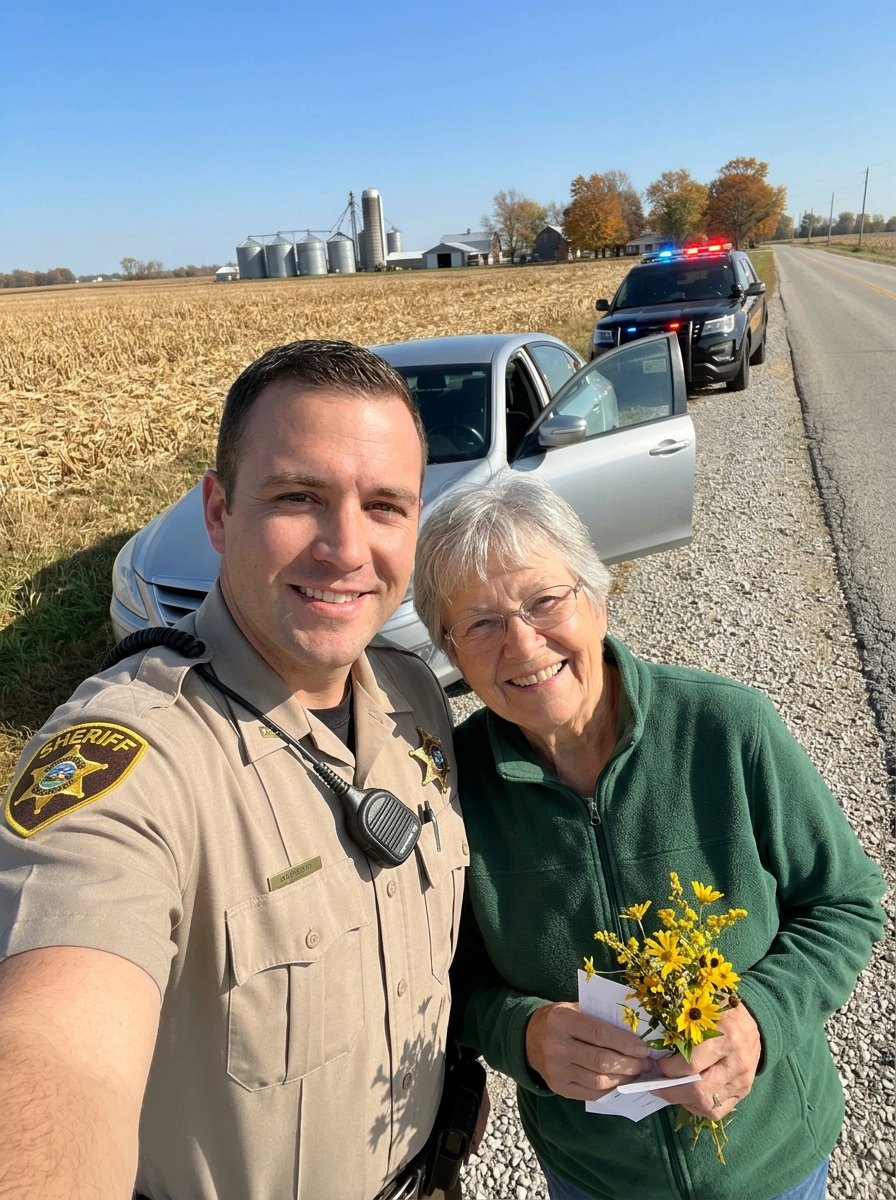
Mom immediately pulled onto the gravel shoulder.
A young deputy stepped out of his patrol vehicle and approached her window.
He wore dark sunglasses and carried himself with the confidence of someone who expected every instruction to be followed without question.
“License and insurance,” he said.
No greeting.
No explanation for stopping us.
Mom calmly opened her handbag and handed him the requested documents.
Her driver’s license had recently been renewed at the courthouse.
Because the permanent replacement hadn’t arrived in the mail, she’d been given a yellow temporary document.
The deputy took one look at it and frowned.
He held the paper between two fingers, lifting it toward the sunlight.
“Where’d you get this, ma’am? Print it out at the library?”
He gave a quiet laugh.
Mom remained polite.
“No, Deputy. The courthouse issued it when I renewed my license. My new card hasn’t arrived yet.”
He studied the paper again.
Then he looked at her.
“Step outside the vehicle.”
Mom nodded and slowly opened her door.
She stepped onto the gravel shoulder wearing her favorite flowered Sunday dress.
Her handbag remained looped over one arm.
The deputy pointed toward the rear of the Buick.
“Stand back there where I can see you.”
I leaned toward the driver’s side.
“Officer, my mother is seventy-one years old.”
He bent slightly to look at me.
“Sir, remain inside the vehicle.”
I started to respond, but Mom turned toward me.
“Jeffrey, stay in the car.”
Her voice was calm.
Firm.
The same voice she’d used when I was a child and needed reminding to behave.
So I stayed.
The deputy returned to his patrol car.
He climbed inside and closed the door.
The engine continued running.
The air conditioning was clearly on.
Meanwhile, my mother stood beside her Buick beneath the blazing afternoon sun.
Ten minutes passed.
Then fifteen.
Then twenty.
I kept watching her through the side mirror.
She shifted her weight occasionally, but otherwise remained perfectly still.
The heat radiating from the pavement was so intense that even the metal of the car had become uncomfortable to touch.
She couldn’t lean against it for support.
There was nowhere else to sit.
And the deputy showed no sign of returning.
I glanced at the lemon bars resting on my knees.
The powdered sugar covering them had begun melting into the surface.
Even inside the car, the heat felt oppressive.
I couldn’t imagine how uncomfortable Mom must have been standing outside.
After nearly thirty minutes, she finally turned toward the patrol vehicle.
“Officer,” she called politely, “would it be possible for me to wait inside my car?”
The deputy lowered his window.
“You can sit down when I tell you to, ma’am.”
Then he rolled it back up.
I felt my face grow hot with frustration.
But Mom looked toward me and gave a small, reassuring smile.
She was determined not to escalate the situation.
And because she’d asked me to remain seated, I did.
There’s something about that afternoon that still embarrasses me.
For thirty-four years, my mother had worked overnight shifts in the basement of the county courthouse.
Whenever someone asked what she did for a living, I usually gave the same answer.
“She mostly answers phones.”
I said it casually.
Almost dismissively.
As though her job wasn’t particularly interesting or important.
I knew she worked long hours.
I knew she’d spent countless nights away from home.
But I had never really asked what happened during those shifts.
To me, she was simply my mother.
The woman who reminded me to wear a jacket.
Who baked lemon bars for church events.
Who drove several miles below the speed limit and kept tissues in her handbag.
So as I watched that deputy leave her standing beside the road, part of me assumed he saw her the same way.
Just another older woman.
Someone holding an unfamiliar yellow document.
Someone he believed he could dismiss without a second thought.
At the forty-minute mark, the deputy finally opened his patrol car door.
He stepped outside carrying a citation book.
My mother straightened slightly as he approached.
“Well, ma’am,” he said, “I’m going to have to issue some tickets.”
He glanced toward the Buick.
“And I’ll be calling for a tow truck.”
I couldn’t believe what I was hearing.
Mom had been driving carefully.
Her temporary license had come directly from the courthouse.
And we’d now spent forty minutes waiting in dangerous summer heat.
But before I could say anything, Mom spoke.
“Deputy, may I ask you for a small favor?”
He stopped writing.
“What is it?”
“Would you press the button on your radio and say my name?”
He stared at her.
“My radio?”
“Yes, please.”
“Why?”
“Just say my name. Shirley Hagen.”
The deputy glanced toward me through the rear window.
Then he smiled.
It wasn’t a friendly smile.
It was the expression of someone who thought he’d just heard something absurd.
“You think your name makes you important around here?”
Mom gently shook her head.
“No, Deputy. Not at all.”
I wanted to disappear beneath the dashboard.
I couldn’t understand why she’d make such an unusual request.
For a moment, I wondered whether the heat was affecting her.
But Mom appeared completely composed.
She stood there holding her handbag, looking at the deputy with quiet patience.
Finally, he gave a dismissive shrug.
“All right. If that’s what you want.”
He lifted the microphone attached to his shoulder.
Pressed the button.
And spoke into the radio.
“Dispatch, I’ve got a woman out here on County Road 6 with a temporary license that looks homemade.”
He chuckled.
“She insists I broadcast her name, so here it is.”
He paused dramatically.
“Shirley Hagen.”
Then he released the microphone.
At first, there was no response.
Only silence.
But it felt different from the ordinary pauses between radio transmissions.
The deputy glanced at his equipment.
Then back toward Mom.
A blackbird settled on the fence wire beside the road.
The corn rustled softly in the hot wind.
I watched my mother’s expression.
She wasn’t smiling.
She wasn’t nervous either.
She simply waited.
Then the radio crackled.
A woman’s voice came through.
Slow.
Careful.
Almost disbelieving.
“Unit Fourteen… could you repeat that name?”
The deputy frowned.
He rolled his eyes and reached for the microphone again.
But before he could press the button, my mother leaned slightly toward him.
And for the first time that afternoon, I noticed something in her expression.
Not anger.
Not fear.
Recognition.
As though she’d been expecting that exact response.
I sat motionless in the passenger seat, suddenly realizing that there might be far more to Shirley Hagen’s thirty-four years of answering phones than I’d ever bothered to learn.
If your 71-year-old mother told you to stay in the car, would you have listened—or stepped outside to defend her?