“We all agreed there won’t be Christmas presents this year,” my daughter told me – while gifting US$50.000 flight tickets to her in-laws.
That same night, I packed my bags. What she didn’t know was that I was the one paying for the house and all the cards…
I never thought a single sentence could shatter 28 years of motherhood. But there I was, standing in my own kitchen on December 15th, watching my daughter Nola deliver what felt like a knife to my chest with the casualness of someone discussing the weather.
“We all agreed that this year we won’t have Christmas presents,” she said, not even looking up from her phone as she scrolled through something that seemed far more important than our conversation.
Her manicured nails tapped against the screen with an irritating rhythm that I’d grown to associate with her dismissive attitude toward anything I had to say.
I stood there holding a dish towel, my hands trembling slightly as the words sank in. We all agreed, as if I had been part of some family meeting where this decision was made, as if my opinion mattered enough to be consulted. The truth was, I hadn’t agreed to anything because no one had bothered to ask me.
“What do you mean, no presents?” I asked, my voice coming out smaller than I intended.
At 68, I shouldn’t have to ask permission to give gifts to my own family. But somehow, Nola had made me feel like I needed her approval for everything.
She finally looked up, her expression carrying that familiar mix of impatience and condescension that had become her default way of looking at me over the past few years.
“Mom, we talked about this. Money’s tight for everyone right now. It’s better if we just focus on being together.”
Money’s tight. I almost laughed at the irony, but the sound died in my throat.
If money was so tight, how had she afforded the weekly nail appointments, the designer handbag I’d seen her carrying just last week, the expensive dinner she posted about on social media with her husband’s family?
But I said nothing. I’d learned that questioning Nola’s decisions only led to lectures about how I didn’t understand the modern world, how things were different now, how I needed to trust her judgment about family matters.
So, I nodded and went back to washing dishes, swallowing the disappointment that had become as familiar as my morning coffee.
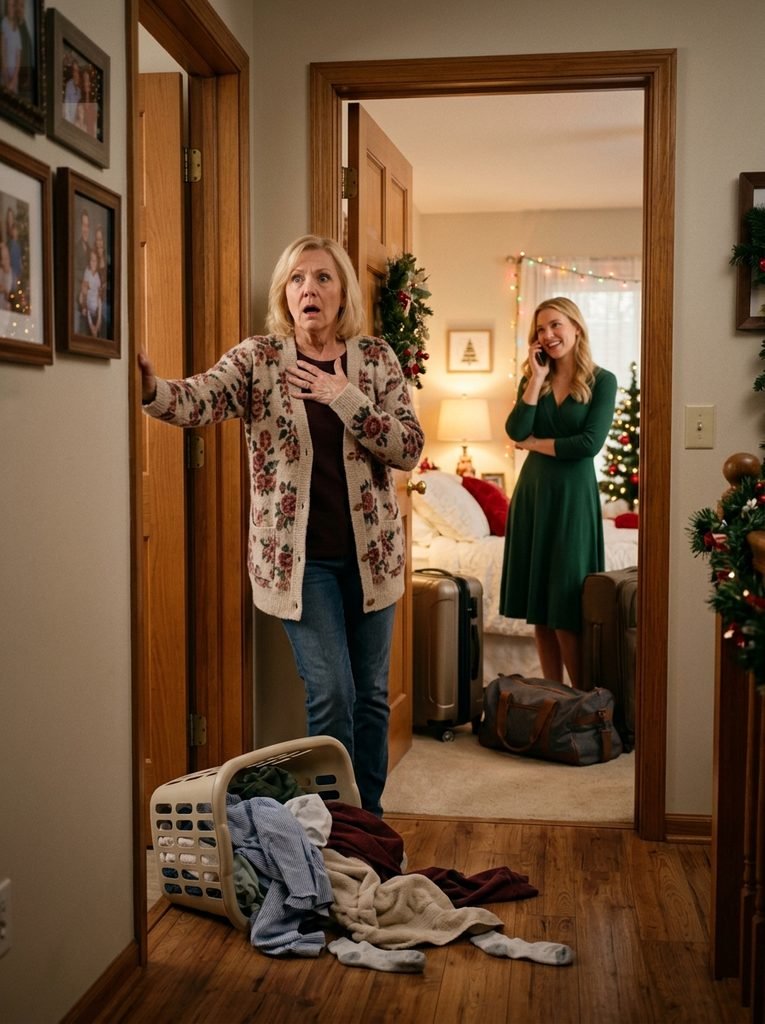
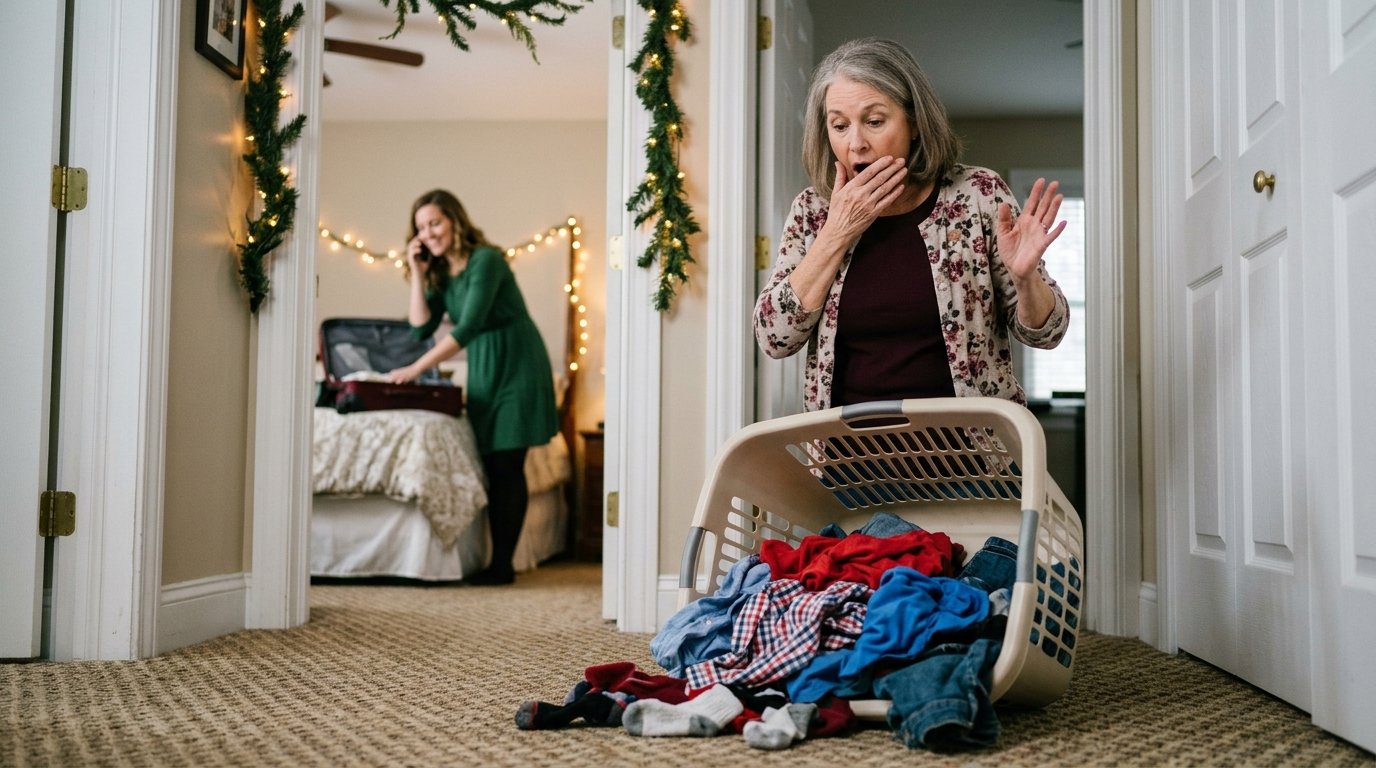
That evening, I was putting away laundry when I passed by Nola’s room. The door was slightly open, and I could hear her talking excitedly on the phone.
I shouldn’t have stopped to listen, but something in her tone made me pause. She sounded happier than I’d heard her in months.
“I know, I know. $50,000 for first class tickets to Europe for Christmas. Can you believe David’s parents wanted to surprise us like this?”
She laughed, a sound full of genuine joy that I rarely heard anymore when she spoke to me.
“We’re going to London, then Paris, then Rome. 3 weeks of complete luxury.”
I felt the blood drain from my face.
$50,000 for plane tickets while she just told me we couldn’t afford Christmas presents. While she’d made me feel guilty for even suggesting we exchange small gifts as we done every year since she was born.
My legs felt weak, and I had to lean against the wall to steady myself. The laundry basket slipped from my hands and clothes scattered across the hallway floor, but I barely noticed.
All I could think about was the cruel irony of it all. No money for a $20 book or a small gift card for me, but $50,000 for a luxury vacation with her in-laws.
I bent down slowly to gather the fallen clothes, my arthritic knees protesting with each movement. As I picked up one of Nola’s expensive blouses, the kind that cost more than I spent on groceries in a month, I realized something that made my chest tighten with a pain that had nothing to do with my physical ailments.
I wasn’t part of their family. I was just the woman who happened to give birth to Nola. Someone to be managed and controlled, not loved or included.
The grandmother who was useful for babysitting when convenient, but not worthy of honesty or consideration when real decisions were made.
Standing there in that hallway, surrounded by designer clothes that I’d probably helped pay for without realizing it, I made a decision that surprised even me.
I walked to my bedroom, pulled out the old suitcase from under my bed, and began to pack.
I wasn’t running away. I was finally waking up.
As I folded my clothes with shaking hands, memories flooded back of all the times I’d been excluded, dismissed, or treated like an inconvenience rather than a mother.
The family dinners where I felt like an outsider at my own table. The holidays where my traditions were quietly replaced with new ones that somehow never included my input. The gradual way I’d been moved from decision maker to bystander in my own family.
But it wasn’t until that moment, hearing about $50,000 being spent while I was told we couldn’t afford simple Christmas gifts, that I truly understood how little I meant to the daughter I’d given everything to raise.
The suitcase felt heavier than it should have as I zipped it closed, but my heart felt lighter than it had in years.
Whatever came next, I wouldn’t spend another day pretending that being treated like a burden was the same thing as being loved.
Sitting in my old Buick in the driveway at 3:00 in the morning, suitcase in the back seat, I couldn’t bring myself to start the engine just yet.
Instead, I found myself thinking about how we’d gotten here. How the sweet little girl who used to bring me dandelions and call them flowers had become someone who could lie to my face about money while planning a $50,000 vacation.
It hadn’t happened overnight. Looking back, I could see the signs stretching back years, like breadcrumbs leading to this moment of devastating clarity.
It started small, the way these things always do.
About 3 years ago, when Nola’s husband, Marcus, lost his job, she’d come to me with tears in her eyes, asking for help with their mortgage payment.
“Just one month,” she promised. “Just until Marcus found something new.”
The payment was $3,200. And I wrote the check without hesitation because that’s what mothers do.
Marcus found a new job 6 weeks later, but somehow that one-time help had morphed into something else entirely.
First, it was the utilities.
“Mom, could you help with the electric bill this month? It’s just been so high with the new baby.”
Then it was the car payment.
“We need reliable transportation for little Sarah.”
Then it was daycare costs, grocery money, credit card minimums that somehow never seemed to get smaller, no matter how much I contributed.
I should have kept track, but I trusted her. When your daughter looks you in the eye and says she’s struggling, when she brings your granddaughter over and mentions how worried she is about making ends meet, you don’t pull out a calculator.
You open your checkbook and hope things get better.
But things never got better. If anything, the requests became more frequent and larger.
Last month alone, I’d given her 2,000 for what she called unexpected car repairs and another 1,500 for Sarah’s school expenses. Private preschool, she explained, was necessary for Sarah’s development.
Now, sitting in the darkness, I pulled out my phone and opened my banking app. The screen glowed harsh and blue in the darkness as I scrolled through months of transactions.
Check to Nola. Transfer to Nola. Cash withdrawal for Nola.
The amounts made my stomach turn.
In the past year alone, I’d given her over $43,000.
$43,000, while she told me we couldn’t afford Christmas presents.
My hands shook as I continued scrolling.
There, 3 months ago, a charge for $800 at a high-end restaurant where Nola had taken Marcus’ parents for their anniversary.
Last month, a $600 charge at a spa that she’d called necessary self-care when I’d questioned it.
Two weeks ago, a $1,000 shopping spree that she justified as investing in her professional wardrobe for a job she claimed to be looking for but never seemed to actually pursue.
The job search that had been going on for 3 years now, the same 3 years I’d been supporting her family.
I closed the banking app and leaned back against the headrest, feeling nauseated.
How had I been so blind? How had I let myself become an ATM machine instead of a mother? When had Nola stopped seeing me as a person with feelings and needs of her own?
The answer came to me with painful clarity.
She’d stopped seeing me as a person the moment she realized I would always say yes. The moment she understood that my love for her and for Sarah could be weaponized against my own financial security and emotional well-being.
I thought about the conversation we’d had just last week about my car.
My faithful Buick was 16 years old and starting to have problems, and I’d mentioned maybe needing to replace it soon.
Nola’s response had been swift and sharp.
“Mom, you don’t need a new car. You barely drive anywhere. It’s wasteful to spend money on something like that when there are more important things to worry about.”
More important things like $50,000 vacation packages, apparently.
I thought about the times I’d mentioned wanting to visit my sister Eleanor in Arizona, how Nola would immediately find reasons why it wasn’t practical: the cost of the flight, the stress of travel at my age, how much Sarah would miss me if I left.
But when Marcus’ mother wanted to visit from Colorado, suddenly travel was important and necessary, and somehow I was the one buying the plane tickets.
I remembered the book club I’d wanted to join at the community center. How Nola had convinced me it was too expensive at $30 a month.
“You can read library books for free, Mom. You don’t need to pay for some social club.”
But her own monthly spa membership at $250 was a necessity for her mental health.
The pattern was so clear now that I wondered how I’d missed it for so long.
Every time I expressed a want or need of my own, it was questioned, minimized, or dismissed as unnecessary.
But every time Nola wanted something, no matter how expensive or frivolous, it became my responsibility to provide it.
I pulled out my checkbook and flipped through the register. Seeing three years of my life reduced to a series of payments to my daughter, college fund withdrawals, retirement savings transfers, even the money I’d been setting aside for a small renovation to make my house more accessible as I aged.
All of it funneled to Nola’s lifestyle while she convinced me that I was being selfish for wanting anything for myself.
The worst part wasn’t the money, though the amount was staggering. The worst part was the realization that I’d been systematically isolated from my own life.
Nola had become the gatekeeper of my relationships, my activities, my decisions. She had opinions about everything I did, everywhere I went, every person I talked to.
And somehow I’d let her convince me that this was normal, that this was love.
But love doesn’t make you feel guilty for wanting to buy yourself a birthday present.
Love doesn’t make you apologize for spending your own money on your own needs.
Love doesn’t convince you that you’re selfish for wanting to live your own life.
As dawn began to break over the horizon, painting the sky in soft shades of pink and gold, I finally understood what I’d really lost over these past 3 years.
It wasn’t just the money. It was myself.
Somewhere along the way, I’d stopped being Dolores, a woman with her own dreams and desires, and had become just mom, a resource to be managed and depleted.
But sitting there in my car with my suitcase packed and the truth finally clear in my mind, I made myself a promise.
I was going to find Dolores again, even if it meant leaving everything else behind.
I drove to Elellanar’s house in Phoenix, a 12-hour journey that gave me too much time to think.
My sister welcomed me with the kind of warmth I’d forgotten existed, asking no questions about why I’d shown up unannounced with a suitcase and red rimmed eyes.
She simply made tea, sat me down at her kitchen table, and waited.
When I finally told her everything, Elellanar’s face grew darker with each detail.
“Dolores,” she said quietly when I finished. “How long has it been since you’ve actually looked at your finances? I mean, really looked at them?”
The question hit me like a slap.
I realized I couldn’t remember the last time I’d sat down and reviewed my accounts properly.
Nola had gradually taken over so many of the household management tasks, claiming she wanted to help me as I got older.
She’d convinced me it was easier if she handled the bill paying, the insurance calls, the banking questions.
All I had to do was sign the checks and transfers she prepared for me.
“We need to see everything,” Ellaner said, pulling out her laptop. “Every account, every transaction, everything Nola has had access to.”
Sitting in Elellanar’s sunny kitchen, I spent the next 4 hours going through my finances with a thoroughess I should have applied years ago.
What I found made me physically sick.
The $43,000 I discovered in the car was just the tip of the iceberg.
Over the past 3 years, I had given Nola $137,000.
$137,000 of my retirement savings, my emergency fund, my late husband’s life insurance money that was supposed to secure my future.
Money I’d planned to use for my own care as I aged, for small luxuries and comfort, for leaving something meaningful to my granddaughter.
But it was worse than just the direct payments.
Elellanar helped me discover transactions I’d completely forgotten about.
Credit cards that Nola had convinced me to add her name to for emergencies only. Those cards now carried balances totaling $28,000.
The emergency fund I thought I still had: empty.
The CD that was supposed to mature next year for my 75th birthday: cashed out 18 months ago for what Nola had called urgent home repairs that I now couldn’t even remember seeing completed.
“Look at this,” Eleanor said, pointing to a series of charges on one of the credit cards.
“Burgdorf Goodman, $3,000. Tiffany and Company, $1,800. Four Seasons Hotel, $2,200.”
She looked up at me with a mixture of anger and sadness.
“These aren’t emergency expenses, Dolores. This is someone living a luxury lifestyle on your dime.”
I stared at the charges, my hands trembling.
While I’d been buying generic groceries and putting off my own dental work to save money, Nola had been shopping at stores I couldn’t even afford to walk into.
While I’d been worrying about the cost of my arthritis medication, she’d been staying at five-star hotels and buying jewelry that cost more than most people’s monthly salary.
But the financial devastation was only part of the story.
As Eleanor and I dug deeper, we uncovered something even more disturbing.
Nola hadn’t just been taking my money. She’d been systematically isolating me from anyone who might question what was happening.
“When was the last time you talked to your friend Margaret?” Elellanar asked.
Margaret had been my closest friend for over 20 years. Someone I used to speak with almost daily.
I had to think about it.
“I’m not sure. Maybe 6 months ago. Nola said Margaret was asking too many personal questions about our family finances, that it wasn’t appropriate.”
Eleanor’s expression hardened.
“And cousin Robert, Uncle Jim, your old neighbor Mrs. Patterson?”
One by one, I realized that Nola had found reasons for me to distance myself from every person in my life who might have noticed what was happening.
Margaret was nosy and inappropriate.
Robert was jealous of our close relationship.
Uncle Jim was too old-fashioned to understand modern family dynamics.
Mrs. Patterson was a gossip who couldn’t be trusted.
Each time someone expressed concern about how much I was helping Nola financially or suggested that maybe she should be more independent, Nola would later explain to me why that person was toxic, negative, or harmful to our family harmony.
And like a fool, I’d believed her.
I’d let her convince me that anyone who questioned our arrangement was the problem.
“She’s been gaslighting you,” Ellaner said bluntly, “making you doubt your own perceptions, your own relationships, your own judgment. It’s a classic manipulation tactic.”
The word manipulation hit me like a physical blow.
I’d never thought of my daughter as manipulative. Selfish maybe, immaturer, certainly, but manipulative implied a level of calculated cruelty that I hadn’t wanted to believe Nola was capable of.
But the evidence was right there in black and white.
Every time I’d tried to set a boundary, Nola had found a way around it.
When I’d said I couldn’t afford to help with their vacation fund, suddenly Sarah needed expensive medical tests.
When I’d suggested they should budget more carefully, Marcus would lose his job again or the car would break down or some other crisis would emerge that required my immediate financial intervention.
And always, always there was the underlying threat that if I didn’t help, I would lose access to Sarah.
It was never stated directly, but the message was clear.
Good grandmothers support their families without question.
Selfish grandmothers who put their own needs first don’t get to see their granddaughters.
“Look at this,” Elellanor said, showing me another set of transactions. “She’s been telling Marcus’s family that she’s supporting you. Look at these Venmo transactions from Marcus’ mother to Nola.”
The notes say things like, “For your mom’s groceries and to help with your mother’s medication costs.”
I stared at the screen in shock.
Marcus’ family thought they were helping an elderly woman in need, not funding their daughter-in-law’s shopping sprees.
Nola had been collecting money from both sides, telling them she was taking care of me while telling me she was struggling to make ends meet.
The sophistication of the deception was breathtaking.
Nola hadn’t just been taking my money. She’d been actively working to ensure that I had no one to turn to when I finally figured out what was happening.
She’d isolated me from my friends, my family, and even from the truth about my own financial situation.
“There’s more,” Elellanar said grimly, pulling up another screen. “She’s been forging your signature on some of these transactions. And look at this. She applied for a power of attorney over your finances 6 months ago.”
My blood ran cold.
“Did it go through?”
“It looks like the lawyer required you to appear in person to finalize it and you never showed up. But Dolores, she tried to get legal control over your money without telling you.”
I thought I’d already hit bottom, but this revelation opened up a whole new level of betrayal.
Nola hadn’t just been stealing from me. She’d been planning to make it legal.
If I’d been a little more trusting, a little more willing to sign papers without reading them carefully, she would have had complete control over every dollar I owned.
The picture was finally complete, and it was uglier than I’d ever imagined.
For 3 years, my daughter had been systematically draining my life savings while positioning herself to take complete control of what remained.
She’d isolated me from anyone who might have helped me see what was happening.
And she’d very nearly succeeded in making me a prisoner in my own life.
But she’d made one crucial mistake.
She’d assumed that I would never have the courage to leave, never have the strength to fight back.
She’d underestimated the woman who’d raised her, worked two jobs to put her through college, and survived the death of her husband with dignity and grace.
As I sat in Elanor’s kitchen, surrounded by the evidence of my daughter’s betrayal, I felt something I hadn’t experienced in years.
Anger.
Not the helpless frustration I’d been living with, but clean, powerful rage at being treated like a victim instead of a person.
Nola had taken my money, my relationships, and my peace of mind.
But she hadn’t taken my intelligence, my strength, or my capacity to fight for myself.
And now that I knew exactly what I was fighting against, I was ready to take back everything she’d stolen from me.
After 3 days at Eleanor’s house, armed with printouts of every fraudulent transaction and a clear understanding of how thoroughly I’d been deceived, I decided to give Nola one last chance to do the right thing.
Eleanor thought I was making a mistake, but I needed to look my daughter in the eye and give her the opportunity to explain herself, to apologize, to show me that somewhere inside the woman who’d been systematically robbing me was still the little girl I’d raised, to know right from wrong.
I called her from Eleanor’s landline since I’d turned off my cell phone to avoid the constant barrage of increasingly frantic messages she’d been leaving since discovering I wasn’t at home.
“Mom.” Her voice was sharp with anxiety when she answered. “Where are you? I’ve been worried sick. You can’t just disappear like this without telling anyone.”
The immediate attempt to make me feel guilty for protecting myself was so typical that I almost hung up right then, but I forced myself to stay calm.
“I’m fine, Nola. I’m visiting Eleanor. We need to talk.”
“Thank God you’re okay. When can you come home? Sarah’s been asking for you and I’ve been dealing with some financial issues that really need your attention.”
Financial issues that needed my attention.
Even now, even after I’d discovered the extent of her theft, her first concern was getting access to my money again.
“That’s exactly what I want to talk about, the financial issues.”
There was a long pause.
“What do you mean?”
“I mean, I’ve been looking at my bank statements, Nola. All of them. And I think we need to have a very honest conversation about where my money has been going.”
Another pause, longer this time.
When she spoke again, her voice had shifted into the tone she used when she was trying to manage a difficult situation.
“Mom, you know how hard it’s been for us. We’ve talked about this. Marcus has been looking for steady work and with Sarah’s needs—”
“Nola, stop.”
The firmness in my own voice surprised me.
“I know about the $50,000 vacation. I know about the shopping sprees, the luxury hotels, the jewelry. I know you’ve been telling Marcus’s family that you’re supporting me while telling me that you’re struggling. I know about the power of attorney application.”
The silence that followed was so complete, I thought she might have hung up.
Finally, she spoke, and her voice was cold in a way I’d never heard before.
“I don’t know what Elellaner’s been telling you, but you’re obviously confused. You’re almost 70, Mom. Sometimes older people get mixed up about financial things.”
The gaslighting was so immediate and so vicious that it took my breath away.
In the space of 30 seconds, she’d gone from pretending innocence to attacking my mental competence.
“I’m not confused, Nola. I have documentation of every transaction. I have proof of everything.”
“Proof of what? That I’ve been taking care of you? That I’ve been managing your finances because you can’t handle them anymore? Mom, you’ve been getting forgetful. You repeat yourself. You lose track of conversations. I’ve been protecting you from making financial mistakes.”
I gripped the phone so tightly my knuckles went white.
She was trying to rewrite 3 years of theft as elder care.
“I’m not forgetful and I’m not incompetent. You’ve stolen over $130,000 from me.”
“Stolen?”
Her voice rose with what sounded like genuine outrage.
“How can you say that to me after everything I’ve done for you? I gave up my career to take care of you and Sarah. I’ve sacrificed everything for this family.”
“You gave up your career? Nola, you haven’t worked in 3 years because I’ve been supporting you. There was no career to give up.”
“That’s not true and you know it. I’ve been freelancing, contributing however I can, while also managing your household and making sure you don’t make dangerous decisions. Do you remember last month when you almost sent money to that phone scammer? If I hadn’t been there to stop you—”
I felt a chill run down my spine.
There had been no phone scammer.
I remembered the incident she was referring to. I’d been about to donate $100 to a legitimate charity when Nola had convinced me it was a scam.
She was using a completely fabricated memory to support her narrative about my supposed incompetence.
“That charity was legitimate, Nola. I checked.”
“See, this is exactly what I’m talking about. You can’t tell the difference anymore between legitimate organizations and scammers. Mom, I think you need to come home so we can talk about getting you some help.”
The word help in her mouth sounded like a threat.
I realized that this conversation wasn’t going to result in an apology or an admission of wrongdoing.
Instead, Nola was doubling down, trying to convince me that I was mentally ill and that her theft had actually been protection.
“I’m not coming home tonight,” I said. “I need time to think.”
“Mom, please. You’re scaring me. This isn’t like you, running away, making wild accusations, refusing to come home to your family. I’m really worried about your mental state.”
Every word was calculated to make me doubt myself, to make me question whether what I discovered was real or the product of an aging mind losing its grip on reality.
If I hadn’t spent the last 3 days with Elellanar, looking at hard evidence and checking every detail twice, I might have fallen for it.
“I’ll call you tomorrow,” I said, and hung up before she could respond.
I sat in Eleanor’s kitchen, shaking, not from fear, but from rage.
Nola hadn’t just refused to apologize. She’d tried to gaslight me into believing that I was losing my mind.
She’d attempted to turn my discovery of her crimes into evidence of my own incompetence.
Eleanor came into the kitchen and took one look at my face.
“How did it go?”
“She tried to convince me I’m mentally incompetent. She said I’ve been getting forgetful and making dangerous financial decisions and that she’s been protecting me from myself.”
Ellaner’s jaw dropped.
“She’s claiming that stealing your money was actually helping you?”
“Not just claiming it. She’s building a case for it. She mentioned an incident that never happened. Tried to make me think I couldn’t remember things correctly. Eleanor, if someone who didn’t know the truth heard that conversation, they might believe her.”
We both understood what that meant.
Nola wasn’t just going to give up access to my money quietly.
She was prepared to fight for it by attacking my competence and my right to control my own finances.
That night, lying in Elellanar’s guest bedroom, I realized that the daughter I’d loved and raised was truly gone.
The woman who’d been on the phone with me wasn’t someone who’d made mistakes or poor choices.
She was someone who’d calculated every theft, planned every manipulation, and was now prepared to destroy my reputation and my autonomy to cover her tracks.
But I also realized something else.
For the first time in 3 years, I was thinking clearly.
I was seeing the situation for exactly what it was, without the fog of guilt and manipulation that Nola had surrounded me with.
And from that clarity came a cold, hard determination.
Nola had declared war on my independence, my dignity, and my right to control my own life.
She’d shown me that she was willing to paint me as mentally incompetent rather than take responsibility for her actions.
She’d made it clear that she saw me not as her mother, but as an obstacle to her financial security.
If that’s how she wanted to play this, then I would show her exactly how sharp and competent the woman she’d been robbing really was.
She thought she knew all my financial accounts, all my resources, all my capabilities.
But Nola had made the same mistake that every successful predator makes.
She’d underestimated her victim.
I hadn’t survived 68 years, raised a child alone after my husband’s death, and built a comfortable retirement by being weak or foolish.
I’d simply been trusting the wrong person.
But trust, once broken, could become something much more dangerous to the person who’d broken it.
Tomorrow, I would start the process of taking back everything Nola had stolen from me.
And this time, I wouldn’t be fighting with love and hope.
I’d be fighting with the cold, calculating precision of someone who finally understood exactly who she was dealing with.
Elellanar and I spent the next morning at her kitchen table planning my counterattack with the precision of generals preparing for battle.
I’d always been good with numbers and organization skills that Nola had somehow convinced me I was losing.
And now I was grateful for every spreadsheet I’d ever created and every detail I’d ever tracked.
The first step was securing what remained of my finances.
Working with Elellaner’s help, I called every bank, every credit card company, every investment firm where I had accounts.
The conversations were surprisingly straightforward once I explained that I needed to remove an authorized user who had been making unauthorized purchases.
“Mrs. Holloway,” the bank representative said when I called about the credit cards Nola had been using, “I see that your daughter has made some rather large purchases recently. Are you saying these weren’t authorized?”
“That’s exactly what I’m saying. I want her removed from all my accounts immediately, and I want new cards issued to me with different numbers.”
Within 2 hours, Nola’s access to my money was completely cut off.
Every card she carried in her wallet was now useless.
Every automatic transfer she’d set up was cancelled.
Every account she thought she could access was locked down tighter than Fort Knox.
But I wasn’t done.
The second step was documentation.
Ellaner helped me prepare a comprehensive file of every fraudulent transaction, every forged signature, every lie Nola had told to various family members about who was supporting whom.
We organized everything chronologically with bank statements, credit card records, and even screenshots of her social media posts showing expensive purchases she’d claimed she couldn’t afford.
“Dolores,” Ellaner said as we worked through the paperwork, “you need to report this to the police. What she’s done isn’t just morally wrong, it’s criminal.”
I’d been thinking the same thing, but hearing Ellaner say it out loud made it real.
My own daughter was a criminal.
She’d committed fraud, forgery, and elder abuse.
The evidence was overwhelming, and any prosecutor would have an easy case to make.
But as I stared at the mountain of evidence against Nola, I realized I wanted something more satisfying than criminal prosecution.
I wanted her to experience exactly what she’d put me through.
The slow, dawning realization that everything she thought she could count on was disappearing.
By 3:00 that afternoon, my phone started ringing.
Nola’s number appeared on the screen repeatedly, but I let every call go to voicemail.
I wanted her to panic a little, to wonder why her credit cards weren’t working, to start understanding that the gravy train had come to a permanent stop.
Finally, around 6:00, I answered.
“Mom.” Her voice was tight with barely controlled hysteria. “What did you do? My cards aren’t working, and the bank says my access has been revoked. This has to be some kind of mistake.”
“It’s not a mistake, Nola. I removed you from all my accounts.”
“You can’t do that. I need those cards for emergencies. What if something happens to Sarah? What if we have a crisis?”
The immediate focus on her access to my money rather than any concern about our relationship or acknowledgement of what she’d done wrong told me everything I needed to know about her priorities.
“If you have a real emergency, you can call 911 like everyone else. Or you can ask Marcus’s parents for help since they seem to think you’re such a responsible financial manager.”
There was a pause, and I could practically hear her mind racing, trying to figure out how much I knew and how much damage control she needed to do.
“Mom, I think you’re overreacting. Can we please just sit down and talk about this calmly? You’re making decisions when you’re upset, and that’s not like you.”
Even now, she was trying to manipulate me.
Trying to suggest that my perfectly rational response to discovering her theft was somehow evidence of emotional instability.
“I’m perfectly calm, Nola. In fact, I’m calmer than I’ve been in 3 years. For the first time, I can see the situation clearly.”
“What situation? Mom, you’re talking like I’m some kind of enemy, but I’m your daughter. I’ve been taking care of you.”
“Taking care of me? Nola, you’ve stolen $137,000 from me. You’ve isolated me from my friends and family. You tried to get power of attorney over my finances without telling me. That’s not taking care of me. That’s elder abuse.”
The words hung in the air like a thunderclap.
I’d said it out loud, given it its proper name.
Elder abuse.
My daughter was an elder abuser.
“That’s… That’s insane. Mom, you can’t seriously believe that. I’ve never abused you. I’ve dedicated my life to helping you and raising Sarah.”
“You’ve dedicated your life to spending my money while convincing me I was selfish for wanting to spend it myself.”
“I never said you were selfish.”
“You said I was selfish for wanting a new car. You said I was selfish for wanting to visit Eleanor. You said I was selfish for wanting to join the book club.
Every single thing I wanted for myself, you found a way to make me feel guilty about it.”
I could hear her breathing hard on the other end of the line, and I knew she was realizing that her carefully constructed narrative was falling apart.
“Mom, please come home and we’ll figure this out together. You’re my mother and I love you. We can work through this.”
“No, Nola. We can’t work through this. You’ve had 3 years to work through this, and instead you’ve spent every day stealing from me and lying to me. I’m done.”
“What do you mean you’re done?”
“I mean, I’m done being your personal ATM. I’m done pretending that your financial abuse is normal family support. I’m done letting you convince me that I’m too old and stupid to manage my own life.”
There was a long silence, and when she spoke again, her voice had changed completely.
The fake sweetness was gone, replaced by something cold and calculating that I’d only heard glimpses of before.
“Fine. If that’s how you want to play this, then you should know that I’ve been documenting your mental decline for months. I have notes about your forgetfulness, your confusion, your poor decision-making. If you want to make this ugly, I can make it very ugly for you.”
There it was.
The threat I’d been expecting.
She was going to try to have me declared incompetent rather than lose access to my money.
“Document away, Nola. I’ve been documenting, too. Every forged signature, every fraudulent transaction, every lie you’ve told to Marcus’s family about supporting me. And unlike your fictional notes about my supposed mental decline, my documentation is backed up by bank records and federal law.”
“You wouldn’t dare try me.”
I hung up and immediately called Eleanor into the room.
“She just threatened to try to have me declared incompetent. And I threatened her with criminal prosecution. I think we’re past the point of family reconciliation.”
Ellaner nodded grimly.
“Are you ready for what comes next? Because this is going to get worse before it gets better.”
I thought about the question seriously.
Was I ready for my daughter to try to destroy my reputation to cover her own crimes?
Was I ready for family members to take sides?
Was I ready for the possibility that I might never see my granddaughter again?
The answer came to me with surprising clarity.
Yes, I was ready because the alternative was spending whatever years I had left as a prisoner in my own life, watching my resources disappear while pretending that being financially abused was the same thing as being loved.
“I’m ready,” I told Eleanor. “For the first time in 3 years, I know exactly who I’m dealing with and exactly what I need to do.”
That night, I slept better than I had in months.
Tomorrow, Nola would probably escalate her threats and her manipulation.
She might try to turn other family members against me.
She might even follow through on her threat to question my mental competence.
But she would be doing all of that without access to my money, without the ability to forge my signature, and without the power to control my decisions.
For the first time since this nightmare began, I held all the cards, and I was finally ready to play them.
Three weeks later, I sat in my lawyer’s office in Phoenix, signing the final papers that would transfer my house in California to a property management company for sale.
Eleanor had helped me find both the lawyer and a reputable real estate agent.
And within 2 weeks, I’d had three solid offers on the house where I’d raised Nola and lived for 32 years.
“The sale should close within 45 days,” my lawyer said, sliding the documents across his desk. “And you’re sure about not giving your daughter any forwarding information?”
“I’m absolutely certain.”
I’d given this decision a lot of thought.
Nola had called 17 times in the past 3 weeks, leaving increasingly desperate voicemails that ranged from tearful apologies to vicious threats.
But every message had the same underlying theme.
She needed access to my money, and she was willing to say or do anything to get it back.
The messages had actually made my decision easier.
Not once had she expressed genuine remorse for what she’d done to me.
Not once had she acknowledged the pain she’d caused or taken responsibility for her actions.
Every apology was followed by an excuse.
Every admission of wrongdoing was qualified with explanations about how difficult her life had been.
More telling, “Not once had she asked how I was doing or whether I was okay.”
Her only concern was the financial impact of my absence on her lifestyle.
“What about your granddaughter?” the lawyer asked gently. “I know that’s often the hardest part of these situations.”
I felt the familiar ache in my chest when I thought about Sarah.
She was 5 years old now, bright and beautiful, and completely innocent of her mother’s crimes.
Walking away from her felt like tearing off a piece of my heart.
But I’d realized something important over the past few weeks.
The relationship I thought I had with Sarah had been just as controlled and manipulated as everything else in my life with Nola.
I was allowed to see Sarah when it was convenient for Nola, when it served her purposes, when she needed a babysitter or wanted to make me feel guilty about some financial request.
The time I spent with my granddaughter had been weaponized against me, used as leverage to ensure my compliance with Nola’s demands.
Every visit came with strings attached.
Every moment of joy was tainted with the underlying threat that it could be taken away if I didn’t continue to fund Nola’s lifestyle.
“My granddaughter deserves better than to grow up watching her mother manipulate and financially abuse her grandmother,” I said finally.
“Maybe someday when she’s older and can make her own decisions about relationships, we’ll reconnect, but I won’t be held hostage by my love for her anymore.”
The lawyer nodded with the understanding of someone who’d seen too many families destroyed by financial abuse.
And the criminal complaint.
I’d spent a lot of time thinking about this decision, too.
I had more than enough evidence to press charges against Nola for elder abuse, fraud, and forgery.
The district attorney had been very interested in the case when I’d spoken with him, particularly the attempted power of attorney fraud.
“I’m not pressing charges,” I said. “But I want the complaint on file in case she tries to come after me legally or tries this with someone else.”
It wasn’t mercy that drove this decision.
It was strategy.
As long as the threat of prosecution hung over Nola’s head, she was unlikely to escalate her harassment or try to involve other family members in her schemes.
She knew I had the evidence to destroy her if she pushed too far.
More importantly, I’d realized that I didn’t need her to be punished by the legal system.
The natural consequences of her actions were already punishment enough.
Without access to my money, Nola and Marcus had been forced to face their real financial situation for the first time in 3 years.
The house I’d been paying the mortgage on was now in foreclosure proceedings.
The credit cards I’d been making payments on were maxed out and in default.
The lifestyle they’d been living on my dime had crashed into the reality of Marcus’ actual income and Nola’s complete lack of job skills.
I’d heard through a mutual acquaintance that Nola had been forced to take a job at a retail store for $12 an hour, her first real job in over 3 years.
Marcus was working double shifts at a warehouse, trying to dig them out of the debt they’d accumulated while living off my savings.
The $50,000 European vacation had been cancelled.
Of course, the designer clothes were being sold on consignment websites.
The luxury lifestyle that had seemed so sustainable when someone else was paying for it had evaporated the moment they had to fund it themselves.
“Have you thought about what you want to do next?” Ellaner asked as we drove away from the lawyer’s office.
I’d been staying with her for almost a month, and while she’d never made me feel unwelcome, I knew I needed to start building my own independent life.
“Actually, I have.”
I pulled out a brochure I’d been carrying around for the past week.
“There’s a senior community in Sedona that’s not a nursing home or assisted living. It’s more like a neighborhood where people my age choose to live because they want to be around peers who are active and independent.”
Ellaner glanced at the brochure and smiled.
“This looks perfect for you. Independent living with built-in social opportunities, and it’s only 2 hours from you, so we can see each other regularly.”
I’d missed my sister terribly during the years when Nola had gradually convinced me that long-distance relationships were too difficult to maintain.
“I put a deposit down yesterday.”
Elellanar pulled the car over and turned to look at me.
“Dolores, I’m so proud of you. A month ago, you were convinced you were too old and confused to manage your own life. Now look at you. You’ve outsmarted a con artist, protected your assets, and planned a whole new future for yourself.”
I felt tears prick my eyes, but they were good tears this time.
“I feel like I’m waking up from a three-year nightmare. Like I’m remembering who I used to be before I let Nola convince me I was helpless.”
“You were never helpless. You were just trusting the wrong person.”
That evening, I called my old friend Margaret for the first time in over a year.
Nola had convinced me that Margaret was nosy and inappropriate, but I now realized that Margaret had simply been asking the questions that any good friend would ask when they noticed something was wrong.
“Dolores.”
Margaret’s voice was warm with genuine affection.
“I’ve been wondering about you. How are you doing?”
I took a deep breath and told her everything about Nola’s financial abuse, about the isolation, about finally finding the courage to walk away.
Margaret listened without judgment, offering support and understanding that reminded me why we’d been friends for over 20 years.
“I’m not surprised,” she said when I finished. “I could see that something was wrong, but every time I tried to talk to you about it, you’d shut down the conversation. I was worried that I was losing you to something I couldn’t understand.”
“You were, but I’m back now.”
“What can I do to help?”
The simple offer of help given freely without expectation of payment or manipulation brought tears to my eyes again.
This was what real relationships felt like.
This was what I’d been missing during my years as Nola’s personal ATM.
2 months later, I moved into my new home in Sedona.
It was a beautiful two-bedroom cottage with a small garden and a view of the red rocks that made me feel peaceful every morning when I opened my curtains.
My neighbors were people like me, retirees who’ chosen to live independently while enjoying the security and social opportunities of a community designed for their needs.
I joined the book club I’d always wanted to join.
I started taking art classes.
I made new friends who valued my company for who I was, not for what I could provide financially.
For the first time in years, I felt like a whole person rather than just a resource to be managed.
The money Nola had stolen was gone, but what remained was still enough to live comfortably for the rest of my life, especially now that I wasn’t supporting two additional adults and their expensive lifestyle.
The house sale had provided a nice cushion, and my retirement funds, while depleted, were still sufficient for my actual needs rather than my daughter’s manufactured crisis.
I kept my phone number, but I changed it to unlisted.
Nola had stopped calling after the first month, probably because she’d finally realized that I meant what I said about being done.
Occasionally, I wondered about Sarah, but I’d made peace with the decision to prioritize my own well-being over a relationship that had been used as a weapon against me.
6 months after moving to Sedona, I received a letter forwarded from my old address.
It was from Nola, and for a moment, I considered throwing it away unopened, but curiosity won.
And I slid the envelope open with the same careful attention I now applied to all my financial decisions.
The letter was three pages of the same manipulation I’d learned to recognize.
Apologies mixed with blame, expressions of love mixed with guilt tripping, and ultimately a request for money.
Sarah needed dental work.
Marcus had been injured at work.
They were facing eviction.
The same cycle of crisis that had funded their lifestyle for three years.
But this time, reading about their problems felt like reading news about strangers.
I felt no guilt, no urge to rescue them, no responsibility for fixing problems that adults should handle themselves.
They’d made their choices, and now they were living with the consequences.
I folded the letter carefully, walked to my fireplace, and burned it.
Then I made myself a cup of tea, sat on my patio watching the sunset paint the red rocks in brilliant oranges and purples and felt genuinely happy.
For the first time in years, I was 70 years old, living independently, managing my own finances, and making my own decisions.
I had real friends, genuine interests, and a future that belonged entirely to me.
I’d walked away from a daughter who saw me as an ATM and found a life where I was valued as a person.
Some people might call that selfish.
I called it survival.
And for the first time in 3 years, I was truly completely free.
Now, I’m curious about you who listened to my story. What would you do if you were in my place? Have you ever been through something similar?“We all agreed there won’t be Christmas presents this year,” my daughter told me – while gifting US$50.000 flight tickets to her in-laws.
That same night, I packed my bags. What she didn’t know was that I was the one paying for the house and all the cards…
I never thought a single sentence could shatter 28 years of motherhood. But there I was, standing in my own kitchen on December 15th, watching my daughter Nola deliver what felt like a knife to my chest with the casualness of someone discussing the weather.
“We all agreed that this year we won’t have Christmas presents,” she said, not even looking up from her phone as she scrolled through something that seemed far more important than our conversation.
Her manicured nails tapped against the screen with an irritating rhythm that I’d grown to associate with her dismissive attitude toward anything I had to say.
I stood there holding a dish towel, my hands trembling slightly as the words sank in. We all agreed, as if I had been part of some family meeting where this decision was made, as if my opinion mattered enough to be consulted. The truth was, I hadn’t agreed to anything because no one had bothered to ask me.
“What do you mean, no presents?” I asked, my voice coming out smaller than I intended.
At 68, I shouldn’t have to ask permission to give gifts to my own family. But somehow, Nola had made me feel like I needed her approval for everything.
She finally looked up, her expression carrying that familiar mix of impatience and condescension that had become her default way of looking at me over the past few years.
“Mom, we talked about this. Money’s tight for everyone right now. It’s better if we just focus on being together.”
Money’s tight. I almost laughed at the irony, but the sound died in my throat.
If money was so tight, how had she afforded the weekly nail appointments, the designer handbag I’d seen her carrying just last week, the expensive dinner she posted about on social media with her husband’s family?
But I said nothing. I’d learned that questioning Nola’s decisions only led to lectures about how I didn’t understand the modern world, how things were different now, how I needed to trust her judgment about family matters.
So, I nodded and went back to washing dishes, swallowing the disappointment that had become as familiar as my morning coffee.
That evening, I was putting away laundry when I passed by Nola’s room. The door was slightly open, and I could hear her talking excitedly on the phone.
I shouldn’t have stopped to listen, but something in her tone made me pause. She sounded happier than I’d heard her in months.
“I know, I know. $50,000 for first class tickets to Europe for Christmas. Can you believe David’s parents wanted to surprise us like this?”
She laughed, a sound full of genuine joy that I rarely heard anymore when she spoke to me.
“We’re going to London, then Paris, then Rome. 3 weeks of complete luxury.”
I felt the blood drain from my face.
$50,000 for plane tickets while she just told me we couldn’t afford Christmas presents. While she’d made me feel guilty for even suggesting we exchange small gifts as we done every year since she was born.
My legs felt weak, and I had to lean against the wall to steady myself. The laundry basket slipped from my hands and clothes scattered across the hallway floor, but I barely noticed.
All I could think about was the cruel irony of it all. No money for a $20 book or a small gift card for me, but $50,000 for a luxury vacation with her in-laws.
I bent down slowly to gather the fallen clothes, my arthritic knees protesting with each movement. As I picked up one of Nola’s expensive blouses, the kind that cost more than I spent on groceries in a month, I realized something that made my chest tighten with a pain that had nothing to do with my physical ailments.
I wasn’t part of their family. I was just the woman who happened to give birth to Nola. Someone to be managed and controlled, not loved or included.
The grandmother who was useful for babysitting when convenient, but not worthy of honesty or consideration when real decisions were made.
Standing there in that hallway, surrounded by designer clothes that I’d probably helped pay for without realizing it, I made a decision that surprised even me.
I walked to my bedroom, pulled out the old suitcase from under my bed, and began to pack.
I wasn’t running away. I was finally waking up.
As I folded my clothes with shaking hands, memories flooded back of all the times I’d been excluded, dismissed, or treated like an inconvenience rather than a mother.
The family dinners where I felt like an outsider at my own table. The holidays where my traditions were quietly replaced with new ones that somehow never included my input. The gradual way I’d been moved from decision maker to bystander in my own family.
But it wasn’t until that moment, hearing about $50,000 being spent while I was told we couldn’t afford simple Christmas gifts, that I truly understood how little I meant to the daughter I’d given everything to raise.
The suitcase felt heavier than it should have as I zipped it closed, but my heart felt lighter than it had in years.
Whatever came next, I wouldn’t spend another day pretending that being treated like a burden was the same thing as being loved.
Sitting in my old Buick in the driveway at 3:00 in the morning, suitcase in the back seat, I couldn’t bring myself to start the engine just yet.
Instead, I found myself thinking about how we’d gotten here. How the sweet little girl who used to bring me dandelions and call them flowers had become someone who could lie to my face about money while planning a $50,000 vacation.
It hadn’t happened overnight. Looking back, I could see the signs stretching back years, like breadcrumbs leading to this moment of devastating clarity.
It started small, the way these things always do.
About 3 years ago, when Nola’s husband, Marcus, lost his job, she’d come to me with tears in her eyes, asking for help with their mortgage payment.
“Just one month,” she promised. “Just until Marcus found something new.”
The payment was $3,200. And I wrote the check without hesitation because that’s what mothers do.
Marcus found a new job 6 weeks later, but somehow that one-time help had morphed into something else entirely.
First, it was the utilities.
“Mom, could you help with the electric bill this month? It’s just been so high with the new baby.”
Then it was the car payment.
“We need reliable transportation for little Sarah.”
Then it was daycare costs, grocery money, credit card minimums that somehow never seemed to get smaller, no matter how much I contributed.
I should have kept track, but I trusted her. When your daughter looks you in the eye and says she’s struggling, when she brings your granddaughter over and mentions how worried she is about making ends meet, you don’t pull out a calculator.
You open your checkbook and hope things get better.
But things never got better. If anything, the requests became more frequent and larger.
Last month alone, I’d given her 2,000 for what she called unexpected car repairs and another 1,500 for Sarah’s school expenses. Private preschool, she explained, was necessary for Sarah’s development.
Now, sitting in the darkness, I pulled out my phone and opened my banking app. The screen glowed harsh and blue in the darkness as I scrolled through months of transactions.
Check to Nola. Transfer to Nola. Cash withdrawal for Nola.
The amounts made my stomach turn.
In the past year alone, I’d given her over $43,000.
$43,000, while she told me we couldn’t afford Christmas presents.
My hands shook as I continued scrolling.
There, 3 months ago, a charge for $800 at a high-end restaurant where Nola had taken Marcus’ parents for their anniversary.
Last month, a $600 charge at a spa that she’d called necessary self-care when I’d questioned it.
Two weeks ago, a $1,000 shopping spree that she justified as investing in her professional wardrobe for a job she claimed to be looking for but never seemed to actually pursue.
The job search that had been going on for 3 years now, the same 3 years I’d been supporting her family.
I closed the banking app and leaned back against the headrest, feeling nauseated.
How had I been so blind? How had I let myself become an ATM machine instead of a mother? When had Nola stopped seeing me as a person with feelings and needs of her own?
The answer came to me with painful clarity.
She’d stopped seeing me as a person the moment she realized I would always say yes. The moment she understood that my love for her and for Sarah could be weaponized against my own financial security and emotional well-being.
I thought about the conversation we’d had just last week about my car.
My faithful Buick was 16 years old and starting to have problems, and I’d mentioned maybe needing to replace it soon.
Nola’s response had been swift and sharp.
“Mom, you don’t need a new car. You barely drive anywhere. It’s wasteful to spend money on something like that when there are more important things to worry about.”
More important things like $50,000 vacation packages, apparently.
I thought about the times I’d mentioned wanting to visit my sister Eleanor in Arizona, how Nola would immediately find reasons why it wasn’t practical: the cost of the flight, the stress of travel at my age, how much Sarah would miss me if I left.
But when Marcus’ mother wanted to visit from Colorado, suddenly travel was important and necessary, and somehow I was the one buying the plane tickets.
I remembered the book club I’d wanted to join at the community center. How Nola had convinced me it was too expensive at $30 a month.
“You can read library books for free, Mom. You don’t need to pay for some social club.”
But her own monthly spa membership at $250 was a necessity for her mental health.
The pattern was so clear now that I wondered how I’d missed it for so long.
Every time I expressed a want or need of my own, it was questioned, minimized, or dismissed as unnecessary.
But every time Nola wanted something, no matter how expensive or frivolous, it became my responsibility to provide it.
I pulled out my checkbook and flipped through the register. Seeing three years of my life reduced to a series of payments to my daughter, college fund withdrawals, retirement savings transfers, even the money I’d been setting aside for a small renovation to make my house more accessible as I aged.
All of it funneled to Nola’s lifestyle while she convinced me that I was being selfish for wanting anything for myself.
The worst part wasn’t the money, though the amount was staggering. The worst part was the realization that I’d been systematically isolated from my own life.
Nola had become the gatekeeper of my relationships, my activities, my decisions. She had opinions about everything I did, everywhere I went, every person I talked to.
And somehow I’d let her convince me that this was normal, that this was love.
But love doesn’t make you feel guilty for wanting to buy yourself a birthday present.
Love doesn’t make you apologize for spending your own money on your own needs.
Love doesn’t convince you that you’re selfish for wanting to live your own life.
As dawn began to break over the horizon, painting the sky in soft shades of pink and gold, I finally understood what I’d really lost over these past 3 years.
It wasn’t just the money. It was myself.
Somewhere along the way, I’d stopped being Dolores, a woman with her own dreams and desires, and had become just mom, a resource to be managed and depleted.
But sitting there in my car with my suitcase packed and the truth finally clear in my mind, I made myself a promise.
I was going to find Dolores again, even if it meant leaving everything else behind.
I drove to Elellanar’s house in Phoenix, a 12-hour journey that gave me too much time to think.
My sister welcomed me with the kind of warmth I’d forgotten existed, asking no questions about why I’d shown up unannounced with a suitcase and red rimmed eyes.
She simply made tea, sat me down at her kitchen table, and waited.
When I finally told her everything, Elellanar’s face grew darker with each detail.
“Dolores,” she said quietly when I finished. “How long has it been since you’ve actually looked at your finances? I mean, really looked at them?”
The question hit me like a slap.
I realized I couldn’t remember the last time I’d sat down and reviewed my accounts properly.
Nola had gradually taken over so many of the household management tasks, claiming she wanted to help me as I got older.
She’d convinced me it was easier if she handled the bill paying, the insurance calls, the banking questions.
All I had to do was sign the checks and transfers she prepared for me.
“We need to see everything,” Ellaner said, pulling out her laptop. “Every account, every transaction, everything Nola has had access to.”
Sitting in Elellanar’s sunny kitchen, I spent the next 4 hours going through my finances with a thoroughess I should have applied years ago.
What I found made me physically sick.
The $43,000 I discovered in the car was just the tip of the iceberg.
Over the past 3 years, I had given Nola $137,000.
$137,000 of my retirement savings, my emergency fund, my late husband’s life insurance money that was supposed to secure my future.
Money I’d planned to use for my own care as I aged, for small luxuries and comfort, for leaving something meaningful to my granddaughter.
But it was worse than just the direct payments.
Elellanar helped me discover transactions I’d completely forgotten about.
Credit cards that Nola had convinced me to add her name to for emergencies only. Those cards now carried balances totaling $28,000.
The emergency fund I thought I still had: empty.
The CD that was supposed to mature next year for my 75th birthday: cashed out 18 months ago for what Nola had called urgent home repairs that I now couldn’t even remember seeing completed.
“Look at this,” Eleanor said, pointing to a series of charges on one of the credit cards.
“Burgdorf Goodman, $3,000. Tiffany and Company, $1,800. Four Seasons Hotel, $2,200.”
She looked up at me with a mixture of anger and sadness.
“These aren’t emergency expenses, Dolores. This is someone living a luxury lifestyle on your dime.”
I stared at the charges, my hands trembling.
While I’d been buying generic groceries and putting off my own dental work to save money, Nola had been shopping at stores I couldn’t even afford to walk into.
While I’d been worrying about the cost of my arthritis medication, she’d been staying at five-star hotels and buying jewelry that cost more than most people’s monthly salary.
But the financial devastation was only part of the story.
As Eleanor and I dug deeper, we uncovered something even more disturbing.
Nola hadn’t just been taking my money. She’d been systematically isolating me from anyone who might question what was happening.
“When was the last time you talked to your friend Margaret?” Elellanar asked.
Margaret had been my closest friend for over 20 years. Someone I used to speak with almost daily.
I had to think about it.
“I’m not sure. Maybe 6 months ago. Nola said Margaret was asking too many personal questions about our family finances, that it wasn’t appropriate.”
Eleanor’s expression hardened.
“And cousin Robert, Uncle Jim, your old neighbor Mrs. Patterson?”
One by one, I realized that Nola had found reasons for me to distance myself from every person in my life who might have noticed what was happening.
Margaret was nosy and inappropriate.
Robert was jealous of our close relationship.
Uncle Jim was too old-fashioned to understand modern family dynamics.
Mrs. Patterson was a gossip who couldn’t be trusted.
Each time someone expressed concern about how much I was helping Nola financially or suggested that maybe she should be more independent, Nola would later explain to me why that person was toxic, negative, or harmful to our family harmony.
And like a fool, I’d believed her.
I’d let her convince me that anyone who questioned our arrangement was the problem.
“She’s been gaslighting you,” Ellaner said bluntly, “making you doubt your own perceptions, your own relationships, your own judgment. It’s a classic manipulation tactic.”
The word manipulation hit me like a physical blow.
I’d never thought of my daughter as manipulative. Selfish maybe, immaturer, certainly, but manipulative implied a level of calculated cruelty that I hadn’t wanted to believe Nola was capable of.
But the evidence was right there in black and white.
Every time I’d tried to set a boundary, Nola had found a way around it.
When I’d said I couldn’t afford to help with their vacation fund, suddenly Sarah needed expensive medical tests.
When I’d suggested they should budget more carefully, Marcus would lose his job again or the car would break down or some other crisis would emerge that required my immediate financial intervention.
And always, always there was the underlying threat that if I didn’t help, I would lose access to Sarah.
It was never stated directly, but the message was clear.
Good grandmothers support their families without question.
Selfish grandmothers who put their own needs first don’t get to see their granddaughters.
“Look at this,” Elellanor said, showing me another set of transactions. “She’s been telling Marcus’s family that she’s supporting you. Look at these Venmo transactions from Marcus’ mother to Nola.”
The notes say things like, “For your mom’s groceries and to help with your mother’s medication costs.”
I stared at the screen in shock.
Marcus’ family thought they were helping an elderly woman in need, not funding their daughter-in-law’s shopping sprees.
Nola had been collecting money from both sides, telling them she was taking care of me while telling me she was struggling to make ends meet.
The sophistication of the deception was breathtaking.
Nola hadn’t just been taking my money. She’d been actively working to ensure that I had no one to turn to when I finally figured out what was happening.
She’d isolated me from my friends, my family, and even from the truth about my own financial situation.
“There’s more,” Elellanar said grimly, pulling up another screen. “She’s been forging your signature on some of these transactions. And look at this. She applied for a power of attorney over your finances 6 months ago.”
My blood ran cold.
“Did it go through?”
“It looks like the lawyer required you to appear in person to finalize it and you never showed up. But Dolores, she tried to get legal control over your money without telling you.”
I thought I’d already hit bottom, but this revelation opened up a whole new level of betrayal.
Nola hadn’t just been stealing from me. She’d been planning to make it legal.
If I’d been a little more trusting, a little more willing to sign papers without reading them carefully, she would have had complete control over every dollar I owned.
The picture was finally complete, and it was uglier than I’d ever imagined.
For 3 years, my daughter had been systematically draining my life savings while positioning herself to take complete control of what remained.
She’d isolated me from anyone who might have helped me see what was happening.
And she’d very nearly succeeded in making me a prisoner in my own life.
But she’d made one crucial mistake.
She’d assumed that I would never have the courage to leave, never have the strength to fight back.
She’d underestimated the woman who’d raised her, worked two jobs to put her through college, and survived the death of her husband with dignity and grace.
As I sat in Elanor’s kitchen, surrounded by the evidence of my daughter’s betrayal, I felt something I hadn’t experienced in years.
Anger.
Not the helpless frustration I’d been living with, but clean, powerful rage at being treated like a victim instead of a person.
Nola had taken my money, my relationships, and my peace of mind.
But she hadn’t taken my intelligence, my strength, or my capacity to fight for myself.
And now that I knew exactly what I was fighting against, I was ready to take back everything she’d stolen from me.
After 3 days at Eleanor’s house, armed with printouts of every fraudulent transaction and a clear understanding of how thoroughly I’d been deceived, I decided to give Nola one last chance to do the right thing.
Eleanor thought I was making a mistake, but I needed to look my daughter in the eye and give her the opportunity to explain herself, to apologize, to show me that somewhere inside the woman who’d been systematically robbing me was still the little girl I’d raised, to know right from wrong.
I called her from Eleanor’s landline since I’d turned off my cell phone to avoid the constant barrage of increasingly frantic messages she’d been leaving since discovering I wasn’t at home.
“Mom.” Her voice was sharp with anxiety when she answered. “Where are you? I’ve been worried sick. You can’t just disappear like this without telling anyone.”
The immediate attempt to make me feel guilty for protecting myself was so typical that I almost hung up right then, but I forced myself to stay calm.
“I’m fine, Nola. I’m visiting Eleanor. We need to talk.”
“Thank God you’re okay. When can you come home? Sarah’s been asking for you and I’ve been dealing with some financial issues that really need your attention.”
Financial issues that needed my attention.
Even now, even after I’d discovered the extent of her theft, her first concern was getting access to my money again.
“That’s exactly what I want to talk about, the financial issues.”
There was a long pause.
“What do you mean?”
“I mean, I’ve been looking at my bank statements, Nola. All of them. And I think we need to have a very honest conversation about where my money has been going.”
Another pause, longer this time.
When she spoke again, her voice had shifted into the tone she used when she was trying to manage a difficult situation.
“Mom, you know how hard it’s been for us. We’ve talked about this. Marcus has been looking for steady work and with Sarah’s needs—”
“Nola, stop.”
The firmness in my own voice surprised me.
“I know about the $50,000 vacation. I know about the shopping sprees, the luxury hotels, the jewelry. I know you’ve been telling Marcus’s family that you’re supporting me while telling me that you’re struggling. I know about the power of attorney application.”
The silence that followed was so complete, I thought she might have hung up.
Finally, she spoke, and her voice was cold in a way I’d never heard before.
“I don’t know what Elellaner’s been telling you, but you’re obviously confused. You’re almost 70, Mom. Sometimes older people get mixed up about financial things.”
The gaslighting was so immediate and so vicious that it took my breath away.
In the space of 30 seconds, she’d gone from pretending innocence to attacking my mental competence.
“I’m not confused, Nola. I have documentation of every transaction. I have proof of everything.”
“Proof of what? That I’ve been taking care of you? That I’ve been managing your finances because you can’t handle them anymore? Mom, you’ve been getting forgetful. You repeat yourself. You lose track of conversations. I’ve been protecting you from making financial mistakes.”
I gripped the phone so tightly my knuckles went white.
She was trying to rewrite 3 years of theft as elder care.
“I’m not forgetful and I’m not incompetent. You’ve stolen over $130,000 from me.”
“Stolen?”
Her voice rose with what sounded like genuine outrage.
“How can you say that to me after everything I’ve done for you? I gave up my career to take care of you and Sarah. I’ve sacrificed everything for this family.”
“You gave up your career? Nola, you haven’t worked in 3 years because I’ve been supporting you. There was no career to give up.”
“That’s not true and you know it. I’ve been freelancing, contributing however I can, while also managing your household and making sure you don’t make dangerous decisions. Do you remember last month when you almost sent money to that phone scammer? If I hadn’t been there to stop you—”
I felt a chill run down my spine.
There had been no phone scammer.
I remembered the incident she was referring to. I’d been about to donate $100 to a legitimate charity when Nola had convinced me it was a scam.
She was using a completely fabricated memory to support her narrative about my supposed incompetence.
“That charity was legitimate, Nola. I checked.”
“See, this is exactly what I’m talking about. You can’t tell the difference anymore between legitimate organizations and scammers. Mom, I think you need to come home so we can talk about getting you some help.”
The word help in her mouth sounded like a threat.
I realized that this conversation wasn’t going to result in an apology or an admission of wrongdoing.
Instead, Nola was doubling down, trying to convince me that I was mentally ill and that her theft had actually been protection.
“I’m not coming home tonight,” I said. “I need time to think.”
“Mom, please. You’re scaring me. This isn’t like you, running away, making wild accusations, refusing to come home to your family. I’m really worried about your mental state.”
Every word was calculated to make me doubt myself, to make me question whether what I discovered was real or the product of an aging mind losing its grip on reality.
If I hadn’t spent the last 3 days with Elellanar, looking at hard evidence and checking every detail twice, I might have fallen for it.
“I’ll call you tomorrow,” I said, and hung up before she could respond.
I sat in Eleanor’s kitchen, shaking, not from fear, but from rage.
Nola hadn’t just refused to apologize. She’d tried to gaslight me into believing that I was losing my mind.
She’d attempted to turn my discovery of her crimes into evidence of my own incompetence.
Eleanor came into the kitchen and took one look at my face.
“How did it go?”
“She tried to convince me I’m mentally incompetent. She said I’ve been getting forgetful and making dangerous financial decisions and that she’s been protecting me from myself.”
Ellaner’s jaw dropped.
“She’s claiming that stealing your money was actually helping you?”
“Not just claiming it. She’s building a case for it. She mentioned an incident that never happened. Tried to make me think I couldn’t remember things correctly. Eleanor, if someone who didn’t know the truth heard that conversation, they might believe her.”
We both understood what that meant.
Nola wasn’t just going to give up access to my money quietly.
She was prepared to fight for it by attacking my competence and my right to control my own finances.
That night, lying in Elellanar’s guest bedroom, I realized that the daughter I’d loved and raised was truly gone.
The woman who’d been on the phone with me wasn’t someone who’d made mistakes or poor choices.
She was someone who’d calculated every theft, planned every manipulation, and was now prepared to destroy my reputation and my autonomy to cover her tracks.
But I also realized something else.
For the first time in 3 years, I was thinking clearly.
I was seeing the situation for exactly what it was, without the fog of guilt and manipulation that Nola had surrounded me with.
And from that clarity came a cold, hard determination.
Nola had declared war on my independence, my dignity, and my right to control my own life.
She’d shown me that she was willing to paint me as mentally incompetent rather than take responsibility for her actions.
She’d made it clear that she saw me not as her mother, but as an obstacle to her financial security.
If that’s how she wanted to play this, then I would show her exactly how sharp and competent the woman she’d been robbing really was.
She thought she knew all my financial accounts, all my resources, all my capabilities.
But Nola had made the same mistake that every successful predator makes.
She’d underestimated her victim.
I hadn’t survived 68 years, raised a child alone after my husband’s death, and built a comfortable retirement by being weak or foolish.
I’d simply been trusting the wrong person.
But trust, once broken, could become something much more dangerous to the person who’d broken it.
Tomorrow, I would start the process of taking back everything Nola had stolen from me.
And this time, I wouldn’t be fighting with love and hope.
I’d be fighting with the cold, calculating precision of someone who finally understood exactly who she was dealing with.
Elellanar and I spent the next morning at her kitchen table planning my counterattack with the precision of generals preparing for battle.
I’d always been good with numbers and organization skills that Nola had somehow convinced me I was losing.
And now I was grateful for every spreadsheet I’d ever created and every detail I’d ever tracked.
The first step was securing what remained of my finances.
Working with Elellaner’s help, I called every bank, every credit card company, every investment firm where I had accounts.
The conversations were surprisingly straightforward once I explained that I needed to remove an authorized user who had been making unauthorized purchases.
“Mrs. Holloway,” the bank representative said when I called about the credit cards Nola had been using, “I see that your daughter has made some rather large purchases recently. Are you saying these weren’t authorized?”
“That’s exactly what I’m saying. I want her removed from all my accounts immediately, and I want new cards issued to me with different numbers.”
Within 2 hours, Nola’s access to my money was completely cut off.
Every card she carried in her wallet was now useless.
Every automatic transfer she’d set up was cancelled.
Every account she thought she could access was locked down tighter than Fort Knox.
But I wasn’t done.
The second step was documentation.
Ellaner helped me prepare a comprehensive file of every fraudulent transaction, every forged signature, every lie Nola had told to various family members about who was supporting whom.
We organized everything chronologically with bank statements, credit card records, and even screenshots of her social media posts showing expensive purchases she’d claimed she couldn’t afford.
“Dolores,” Ellaner said as we worked through the paperwork, “you need to report this to the police. What she’s done isn’t just morally wrong, it’s criminal.”
I’d been thinking the same thing, but hearing Ellaner say it out loud made it real.
My own daughter was a criminal.
She’d committed fraud, forgery, and elder abuse.
The evidence was overwhelming, and any prosecutor would have an easy case to make.
But as I stared at the mountain of evidence against Nola, I realized I wanted something more satisfying than criminal prosecution.
I wanted her to experience exactly what she’d put me through.
The slow, dawning realization that everything she thought she could count on was disappearing.
By 3:00 that afternoon, my phone started ringing.
Nola’s number appeared on the screen repeatedly, but I let every call go to voicemail.
I wanted her to panic a little, to wonder why her credit cards weren’t working, to start understanding that the gravy train had come to a permanent stop.
Finally, around 6:00, I answered.
“Mom.” Her voice was tight with barely controlled hysteria. “What did you do? My cards aren’t working, and the bank says my access has been revoked. This has to be some kind of mistake.”
“It’s not a mistake, Nola. I removed you from all my accounts.”
“You can’t do that. I need those cards for emergencies. What if something happens to Sarah? What if we have a crisis?”
The immediate focus on her access to my money rather than any concern about our relationship or acknowledgement of what she’d done wrong told me everything I needed to know about her priorities.
“If you have a real emergency, you can call 911 like everyone else. Or you can ask Marcus’s parents for help since they seem to think you’re such a responsible financial manager.”
There was a pause, and I could practically hear her mind racing, trying to figure out how much I knew and how much damage control she needed to do.
“Mom, I think you’re overreacting. Can we please just sit down and talk about this calmly? You’re making decisions when you’re upset, and that’s not like you.”
Even now, she was trying to manipulate me.
Trying to suggest that my perfectly rational response to discovering her theft was somehow evidence of emotional instability.
“I’m perfectly calm, Nola. In fact, I’m calmer than I’ve been in 3 years. For the first time, I can see the situation clearly.”
“What situation? Mom, you’re talking like I’m some kind of enemy, but I’m your daughter. I’ve been taking care of you.”
“Taking care of me? Nola, you’ve stolen $137,000 from me. You’ve isolated me from my friends and family. You tried to get power of attorney over my finances without telling me. That’s not taking care of me. That’s elder abuse.”
The words hung in the air like a thunderclap.
I’d said it out loud, given it its proper name.
Elder abuse.
My daughter was an elder abuser.
“That’s… That’s insane. Mom, you can’t seriously believe that. I’ve never abused you. I’ve dedicated my life to helping you and raising Sarah.”
“You’ve dedicated your life to spending my money while convincing me I was selfish for wanting to spend it myself.”
“I never said you were selfish.”
“You said I was selfish for wanting a new car. You said I was selfish for wanting to visit Eleanor. You said I was selfish for wanting to join the book club.
Every single thing I wanted for myself, you found a way to make me feel guilty about it.”
I could hear her breathing hard on the other end of the line, and I knew she was realizing that her carefully constructed narrative was falling apart.
“Mom, please come home and we’ll figure this out together. You’re my mother and I love you. We can work through this.”
“No, Nola. We can’t work through this. You’ve had 3 years to work through this, and instead you’ve spent every day stealing from me and lying to me. I’m done.”
“What do you mean you’re done?”
“I mean, I’m done being your personal ATM. I’m done pretending that your financial abuse is normal family support. I’m done letting you convince me that I’m too old and stupid to manage my own life.”
There was a long silence, and when she spoke again, her voice had changed completely.
The fake sweetness was gone, replaced by something cold and calculating that I’d only heard glimpses of before.
“Fine. If that’s how you want to play this, then you should know that I’ve been documenting your mental decline for months. I have notes about your forgetfulness, your confusion, your poor decision-making. If you want to make this ugly, I can make it very ugly for you.”
There it was.
The threat I’d been expecting.
She was going to try to have me declared incompetent rather than lose access to my money.
“Document away, Nola. I’ve been documenting, too. Every forged signature, every fraudulent transaction, every lie you’ve told to Marcus’s family about supporting me. And unlike your fictional notes about my supposed mental decline, my documentation is backed up by bank records and federal law.”
“You wouldn’t dare try me.”
I hung up and immediately called Eleanor into the room.
“She just threatened to try to have me declared incompetent. And I threatened her with criminal prosecution. I think we’re past the point of family reconciliation.”
Ellaner nodded grimly.
“Are you ready for what comes next? Because this is going to get worse before it gets better.”
I thought about the question seriously.
Was I ready for my daughter to try to destroy my reputation to cover her own crimes?
Was I ready for family members to take sides?
Was I ready for the possibility that I might never see my granddaughter again?
The answer came to me with surprising clarity.
Yes, I was ready because the alternative was spending whatever years I had left as a prisoner in my own life, watching my resources disappear while pretending that being financially abused was the same thing as being loved.
“I’m ready,” I told Eleanor. “For the first time in 3 years, I know exactly who I’m dealing with and exactly what I need to do.”
That night, I slept better than I had in months.
Tomorrow, Nola would probably escalate her threats and her manipulation.
She might try to turn other family members against me.
She might even follow through on her threat to question my mental competence.
But she would be doing all of that without access to my money, without the ability to forge my signature, and without the power to control my decisions.
For the first time since this nightmare began, I held all the cards, and I was finally ready to play them.
Three weeks later, I sat in my lawyer’s office in Phoenix, signing the final papers that would transfer my house in California to a property management company for sale.
Eleanor had helped me find both the lawyer and a reputable real estate agent.
And within 2 weeks, I’d had three solid offers on the house where I’d raised Nola and lived for 32 years.
“The sale should close within 45 days,” my lawyer said, sliding the documents across his desk. “And you’re sure about not giving your daughter any forwarding information?”
“I’m absolutely certain.”
I’d given this decision a lot of thought.
Nola had called 17 times in the past 3 weeks, leaving increasingly desperate voicemails that ranged from tearful apologies to vicious threats.
But every message had the same underlying theme.
She needed access to my money, and she was willing to say or do anything to get it back.
The messages had actually made my decision easier.
Not once had she expressed genuine remorse for what she’d done to me.
Not once had she acknowledged the pain she’d caused or taken responsibility for her actions.
Every apology was followed by an excuse.
Every admission of wrongdoing was qualified with explanations about how difficult her life had been.
More telling, “Not once had she asked how I was doing or whether I was okay.”
Her only concern was the financial impact of my absence on her lifestyle.
“What about your granddaughter?” the lawyer asked gently. “I know that’s often the hardest part of these situations.”
I felt the familiar ache in my chest when I thought about Sarah.
She was 5 years old now, bright and beautiful, and completely innocent of her mother’s crimes.
Walking away from her felt like tearing off a piece of my heart.
But I’d realized something important over the past few weeks.
The relationship I thought I had with Sarah had been just as controlled and manipulated as everything else in my life with Nola.
I was allowed to see Sarah when it was convenient for Nola, when it served her purposes, when she needed a babysitter or wanted to make me feel guilty about some financial request.
The time I spent with my granddaughter had been weaponized against me, used as leverage to ensure my compliance with Nola’s demands.
Every visit came with strings attached.
Every moment of joy was tainted with the underlying threat that it could be taken away if I didn’t continue to fund Nola’s lifestyle.
“My granddaughter deserves better than to grow up watching her mother manipulate and financially abuse her grandmother,” I said finally.
“Maybe someday when she’s older and can make her own decisions about relationships, we’ll reconnect, but I won’t be held hostage by my love for her anymore.”
The lawyer nodded with the understanding of someone who’d seen too many families destroyed by financial abuse.
And the criminal complaint.
I’d spent a lot of time thinking about this decision, too.
I had more than enough evidence to press charges against Nola for elder abuse, fraud, and forgery.
The district attorney had been very interested in the case when I’d spoken with him, particularly the attempted power of attorney fraud.
“I’m not pressing charges,” I said. “But I want the complaint on file in case she tries to come after me legally or tries this with someone else.”
It wasn’t mercy that drove this decision.
It was strategy.
As long as the threat of prosecution hung over Nola’s head, she was unlikely to escalate her harassment or try to involve other family members in her schemes.
She knew I had the evidence to destroy her if she pushed too far.
More importantly, I’d realized that I didn’t need her to be punished by the legal system.
The natural consequences of her actions were already punishment enough.
Without access to my money, Nola and Marcus had been forced to face their real financial situation for the first time in 3 years.
The house I’d been paying the mortgage on was now in foreclosure proceedings.
The credit cards I’d been making payments on were maxed out and in default.
The lifestyle they’d been living on my dime had crashed into the reality of Marcus’ actual income and Nola’s complete lack of job skills.
I’d heard through a mutual acquaintance that Nola had been forced to take a job at a retail store for $12 an hour, her first real job in over 3 years.
Marcus was working double shifts at a warehouse, trying to dig them out of the debt they’d accumulated while living off my savings.
The $50,000 European vacation had been cancelled.
Of course, the designer clothes were being sold on consignment websites.
The luxury lifestyle that had seemed so sustainable when someone else was paying for it had evaporated the moment they had to fund it themselves.
“Have you thought about what you want to do next?” Ellaner asked as we drove away from the lawyer’s office.
I’d been staying with her for almost a month, and while she’d never made me feel unwelcome, I knew I needed to start building my own independent life.
“Actually, I have.”
I pulled out a brochure I’d been carrying around for the past week.
“There’s a senior community in Sedona that’s not a nursing home or assisted living. It’s more like a neighborhood where people my age choose to live because they want to be around peers who are active and independent.”
Ellaner glanced at the brochure and smiled.
“This looks perfect for you. Independent living with built-in social opportunities, and it’s only 2 hours from you, so we can see each other regularly.”
I’d missed my sister terribly during the years when Nola had gradually convinced me that long-distance relationships were too difficult to maintain.
“I put a deposit down yesterday.”
Elellanar pulled the car over and turned to look at me.
“Dolores, I’m so proud of you. A month ago, you were convinced you were too old and confused to manage your own life. Now look at you. You’ve outsmarted a con artist, protected your assets, and planned a whole new future for yourself.”
I felt tears prick my eyes, but they were good tears this time.
“I feel like I’m waking up from a three-year nightmare. Like I’m remembering who I used to be before I let Nola convince me I was helpless.”
“You were never helpless. You were just trusting the wrong person.”
That evening, I called my old friend Margaret for the first time in over a year.
Nola had convinced me that Margaret was nosy and inappropriate, but I now realized that Margaret had simply been asking the questions that any good friend would ask when they noticed something was wrong.
“Dolores.”
Margaret’s voice was warm with genuine affection.
“I’ve been wondering about you. How are you doing?”
I took a deep breath and told her everything about Nola’s financial abuse, about the isolation, about finally finding the courage to walk away.
Margaret listened without judgment, offering support and understanding that reminded me why we’d been friends for over 20 years.
“I’m not surprised,” she said when I finished. “I could see that something was wrong, but every time I tried to talk to you about it, you’d shut down the conversation. I was worried that I was losing you to something I couldn’t understand.”
“You were, but I’m back now.”
“What can I do to help?”
The simple offer of help given freely without expectation of payment or manipulation brought tears to my eyes again.
This was what real relationships felt like.
This was what I’d been missing during my years as Nola’s personal ATM.
2 months later, I moved into my new home in Sedona.
It was a beautiful two-bedroom cottage with a small garden and a view of the red rocks that made me feel peaceful every morning when I opened my curtains.
My neighbors were people like me, retirees who’ chosen to live independently while enjoying the security and social opportunities of a community designed for their needs.
I joined the book club I’d always wanted to join.
I started taking art classes.
I made new friends who valued my company for who I was, not for what I could provide financially.
For the first time in years, I felt like a whole person rather than just a resource to be managed.
The money Nola had stolen was gone, but what remained was still enough to live comfortably for the rest of my life, especially now that I wasn’t supporting two additional adults and their expensive lifestyle.
The house sale had provided a nice cushion, and my retirement funds, while depleted, were still sufficient for my actual needs rather than my daughter’s manufactured crisis.
I kept my phone number, but I changed it to unlisted.
Nola had stopped calling after the first month, probably because she’d finally realized that I meant what I said about being done.
Occasionally, I wondered about Sarah, but I’d made peace with the decision to prioritize my own well-being over a relationship that had been used as a weapon against me.
6 months after moving to Sedona, I received a letter forwarded from my old address.
It was from Nola, and for a moment, I considered throwing it away unopened, but curiosity won.
And I slid the envelope open with the same careful attention I now applied to all my financial decisions.
The letter was three pages of the same manipulation I’d learned to recognize.
Apologies mixed with blame, expressions of love mixed with guilt tripping, and ultimately a request for money.
Sarah needed dental work.
Marcus had been injured at work.
They were facing eviction.
The same cycle of crisis that had funded their lifestyle for three years.
But this time, reading about their problems felt like reading news about strangers.
I felt no guilt, no urge to rescue them, no responsibility for fixing problems that adults should handle themselves.
They’d made their choices, and now they were living with the consequences.
I folded the letter carefully, walked to my fireplace, and burned it.
Then I made myself a cup of tea, sat on my patio watching the sunset paint the red rocks in brilliant oranges and purples and felt genuinely happy.
For the first time in years, I was 70 years old, living independently, managing my own finances, and making my own decisions.
I had real friends, genuine interests, and a future that belonged entirely to me.
I’d walked away from a daughter who saw me as an ATM and found a life where I was valued as a person.
Some people might call that selfish.
I called it survival.
And for the first time in 3 years, I was truly completely free.
Now, I’m curious about you who listened to my story. What would you do if you were in my place? Have you ever been through something similar?
Comment below. And meanwhile, I’m leaving on the final screen two other stories that are channel favorites, and they will definitely surprise you.
Thank you for watching until here.
Comment below. And meanwhile, I’m leaving on the final screen two other stories that are channel favorites, and they will definitely surprise you.
Thank you for watching until here.