The Envelope Contained a Truth Daniel Had Never Been Told 031
The paper inside the envelope made a soft, almost ordinary sound as I unfolded it.
Yet in the silence that followed, it seemed louder than the orchestra, louder than the clinking glasses and the distant hum of three hundred uneasy guests.
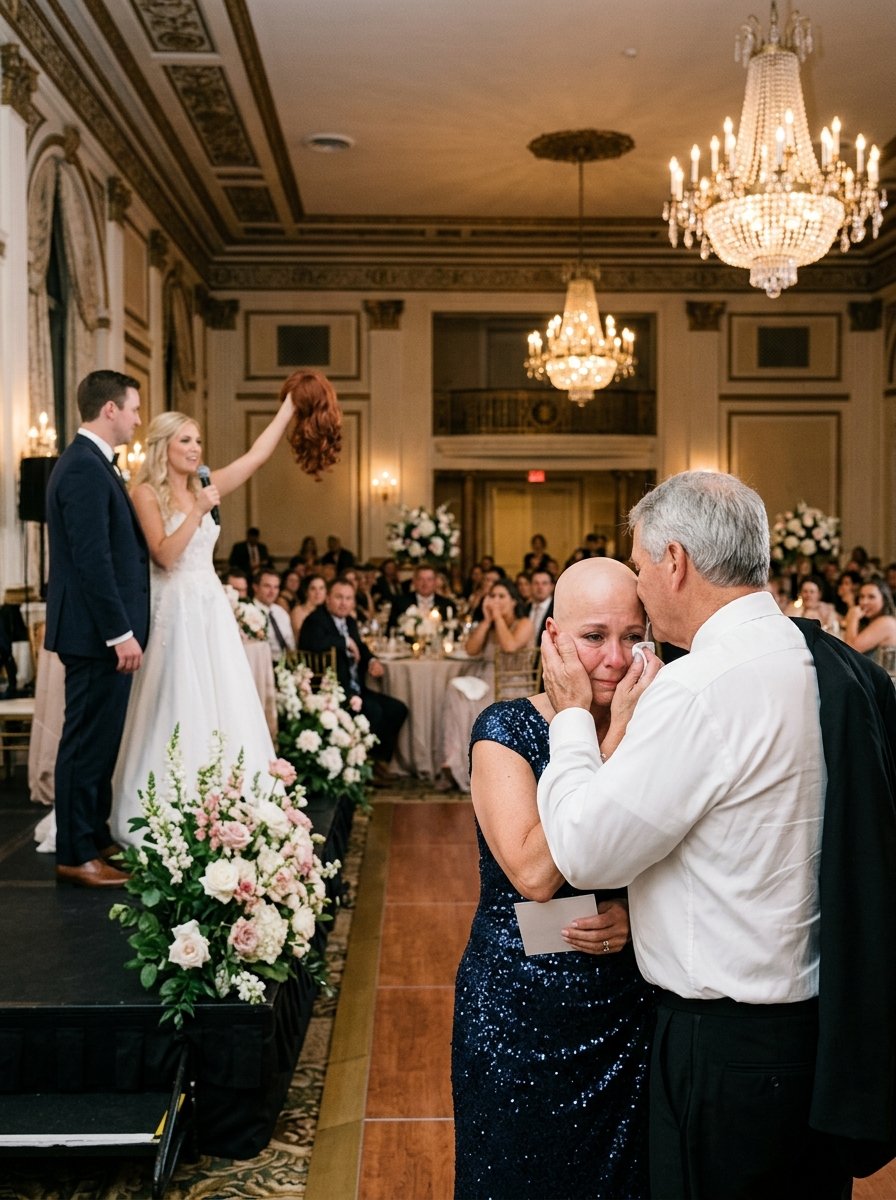
Margaret stood beside me with my jacket wrapped around her shoulders. Her hands were still trembling, but she had stopped trying to hide her head. She looked tired, frightened, and somehow more dignified than anyone else in the ballroom.
I glanced at her before looking down at the document.
She gave me the smallest nod.
Not permission.
Trust.
I turned toward the microphone.
“For months,” I said, “my wife and I have kept something private. Not because we were ashamed, but because we believed certain matters belonged within the family.”
Vanessa’s face had lost its color.
Daniel finally lifted his eyes.
I saw confusion there, but not yet understanding.
That hurt more than his silence had.
The ballroom remained still. Even the musicians had stopped moving. At the edge of the dance floor, a waiter lowered a tray and stared at the envelope in my hand.
I continued.
“Margaret has been battling cancer. Some of you know that. Some of you may not. She did not hide it to deceive anyone. She simply wanted one evening where she was not treated as a diagnosis.”
A murmur moved through the guests.
Margaret lowered her gaze.
Vanessa opened her mouth, then closed it.
I turned toward her.
“You called her wig a joke. You told everyone she was pretending to be glamorous. But the only thing she was pretending was that your behavior did not hurt her.”
“Richard,” Vanessa said sharply, though her voice was no longer steady, “this is not the time—”
“No,” I interrupted quietly. “It is exactly the time. Because you made it public.”
I held up the document.
“This envelope contains the result of an investigation my attorney completed three weeks ago. It concerns the money used to pay for this wedding, the ownership of this hotel, and a decision that will affect what happens after tonight.”
Vanessa’s mother, Patricia Whitmore, rose from her table.
“What investigation?” she demanded. “This is absurd.”
Patricia had spent the entire evening speaking about the wedding as if she had designed a state ceremony. She had corrected the placement of flowers, criticized the champagne, and complained that the ballroom lighting made her look pale.
Now, for the first time, she looked genuinely afraid.
I faced the guests again.
“The Grand Ashton Hotel is not owned by the corporation most people assume owns it. The corporation is only the public operating company. The controlling trust belongs to Bennett Hospitality Group.”
A few people looked toward the enormous crystal chandelier, as if the ceiling itself might confirm what I was saying.
I folded the first page and reached for the second.
“I founded Bennett Hospitality thirty-eight years ago with a borrowed office, two employees, and a belief that hotels should make people feel cared for. Over time, we grew. Today, the group owns or manages twenty-seven properties across the country.”
Daniel stared at me.
Vanessa whispered, “No.”
It was not disbelief alone.
It was recognition.
She had heard the name before.
Perhaps at one of her family’s business dinners. Perhaps in one of the financial magazines her parents kept on their coffee table. Bennett Hospitality had never been a household name, but within the hotel industry, it carried weight.
I had never discussed it with Daniel because he had never asked.
That realization came back to me with unexpected force.
For years, I had told myself I was protecting him from pressure. I wanted him to choose his own career, marry for love, and build a life without feeling that every achievement belonged to his father.
But perhaps I had also been avoiding a harder truth.
I had wanted to believe he saw me as his father, not as the man behind a company.
Tonight, I was learning that he had not known which one mattered more to him.
Vanessa stepped closer to the microphone.
“You planned this,” she said.
I looked at her.
“No. You did.”
Her eyes flashed.
“You waited until my wedding to announce this?”
“I waited until I knew whether you were merely careless or whether you were willing to hurt Margaret to impress a room full of people.”
That silenced her.
The document in my hand contained more than ownership records. It contained the findings of a private financial review conducted by my attorney, Helen Park.
For months, certain numbers connected to the wedding had troubled me.
The original contract had listed the reception, accommodations, catering, flowers, music, and security at just under $180,000. I had agreed to cover the amount because Daniel was my son and because Margaret wanted the wedding to be beautiful.
But two weeks before the ceremony, Helen had called me.
“There are inconsistencies,” she had said.
“What kind?”
“Payments made to vendors that do not match their contracts. Deposits transferred through accounts connected to people in Vanessa’s family. And a consulting fee that appears to have been added after you signed.”
I had assumed there was an explanation.
Wedding planning was complicated. Vendors changed. Families misunderstood one another. I did not want to become the suspicious father who treated his son’s marriage like a business acquisition.
So Helen had continued quietly.
Then she discovered something else.
The wedding account had been used to pay $46,000 toward a property renovation in Evanston, a house Patricia and her husband had recently purchased.
The transaction was disguised as a catering deposit.
I looked down at the report.
I did not need to tell every guest the details. This was not a trial, and Margaret deserved better than another spectacle.
But Daniel deserved the truth.
“Daniel,” I said.
He flinched at the sound of his name.
“The money I gave you for this wedding was meant for you and Vanessa to begin your life together. It was not meant to finance your in-laws’ renovation or any private debt.”
His face tightened.
“What are you talking about?”
Vanessa turned toward him.
“Daniel, don’t listen to him. He’s angry.”
“I’m not angry,” I said. “I’m disappointed. There is a difference.”
Helen had warned me that the records were strong but not complete. She had found evidence that Patricia had directed the payments, but she had not been able to prove Vanessa knew about all of them.
That distinction mattered.
I had spent much of my life learning that facts and assumptions were not the same thing.
Vanessa had humiliated Margaret. That was a fact.
Whether she had knowingly participated in the financial deception was still a question.
And questions deserved answers before judgments.
I handed the microphone to the hotel’s general manager, Thomas Reed, who had been standing near the service doors. Thomas had worked with me for eighteen years. He knew when to speak and when to let silence do the work.
“Please have the staff pause the reception,” I told him. “No one is to be asked to leave. Offer refreshments in the west salon. And make sure Margaret has access to the bridal suite.”
Thomas nodded.
“Of course.”
Then he turned to the guests.
“Ladies and gentlemen, we’ll be moving refreshments to the west salon while the ballroom is prepared. Please take your time.”
His calm voice eased the tension by a fraction.
People began to move, slowly at first. Some approached Margaret with sympathetic expressions. Others avoided looking at her altogether.
A woman I recognized as one of Vanessa’s cousins touched Margaret’s arm.
“I’m sorry,” she whispered.
Margaret gave her a tired smile.
“Thank you.”
That was all.
Vanessa remained beside the stage.
Daniel looked as though he had forgotten where he was.
I walked toward him.
“We need to talk somewhere private.”
His gaze shifted to Margaret.
“Mom…”
She looked at him for a long moment.
He had not helped her when she asked.
Now he seemed to want forgiveness simply because he was finally uncomfortable.
Margaret did not punish him with silence. She had never been that kind of person.
“Go with your father,” she said. “Listen before you defend anyone.”
Daniel swallowed.
Vanessa stepped between us.
“I’m coming too.”
“No,” I said.
Her expression hardened.
“This concerns me.”
“It does. But it concerns Daniel as my son first. You’ll have an opportunity to respond after he understands what happened.”
“I’m his wife.”
“You became his wife today. I have been his father for thirty-two years.”
The words came out more sharply than I intended.
Daniel looked at me, and something wounded passed between us.
Not anger.
Recognition.
He had just realized that tonight was not only about Vanessa’s cruelty. It was also about the distance between us.
We left the ballroom through a side corridor. The hotel’s walls were lined with framed photographs from its early years: black-and-white images of grand openings, famous guests, and staff standing proudly beneath the original brass sign.
Daniel had walked through that corridor as a child.
He used to call it the picture hall.
At seven, he believed every man in a suit was a detective. At thirteen, he complained that the hotel smelled like old carpet. At twenty-one, he said he never wanted to work in hospitality because everyone expected him to inherit it.
I had accepted that.
Perhaps too easily.
We entered a small conference room overlooking Michigan Avenue. The city lights shimmered below us. From this height, traffic looked orderly, almost peaceful.
Daniel remained standing.
“What does this mean?” he asked.
“It means the wedding expenses are being reviewed.”
“You think Vanessa stole from you?”
“I think money was moved without my approval.”
“Did she know?”
“I don’t know.”
His jaw tightened.
“But you’re assuming she did.”
“I’m assuming nothing. That is why I’m asking you to look at the records.”
He stared at the envelope.
“Why didn’t you tell me about the hotel?”
It was the question I had expected and dreaded.
“Because I wanted you to make your own choices.”
“That doesn’t answer me.”
“It’s the truth.”
“You let me believe you were retired.”
“I am retired from daily operations.”
“You let me believe we had to be careful about the wedding budget.”
“We did have to be careful. The money was mine, but that doesn’t mean it was unlimited.”
“You own a hotel worth—”
“I own part of a company, Daniel. The company owns properties. That does not mean I keep millions in cash beneath the mattress.”
He looked away.
“When did you plan to tell me?”
“I thought you would ask.”
A bitter laugh escaped him.
“I was your son. I shouldn’t have had to ask.”
I sat down.
“You’re right.”
That answer stopped him.
He had come prepared for denial, perhaps even anger. He had not expected agreement.
I rubbed my hands together.
“When you were younger, I made a decision. I wanted your life to be yours. I did not want every friend, teacher, or girlfriend wondering what they could get from you. So I kept business separate from family.”
“Vanessa knew before I did?”
“I don’t know what she knew.”
“She knew something. Her mother kept asking questions about the hotel.”
I looked up.
“What questions?”
Daniel hesitated.
“Mostly about the ballroom. Whether the rates were discounted. Whether the hotel had private ownership. I thought she was trying to negotiate.”
“Did Vanessa ask you?”
“She asked if your company was connected to the hotel. I told her I didn’t know.”
“You never asked me?”
“No.”
His voice cracked slightly.
“Because you never told me anything.”
The accusation landed quietly.
I could have defended myself. I could have listed every school event I attended, every hospital visit, every night I drove across town because he had a flat tire.
But love was not a receipt, and fatherhood was not a ledger.
Instead, I said, “I’m sorry.”
Daniel’s eyes filled, but he looked down before the tears could fall.
“I thought you were disappointed in me.”
“What?”
“Because I didn’t join the company. Because I wanted to teach history. Because I wasn’t ambitious in the way you were.”
I leaned back.
“Daniel, I was never disappointed that you chose teaching. I was proud.”
“You never said that.”
“I thought I did.”
“You said, ‘You should keep your options open.’”
“I meant that you should not feel trapped.”
“I heard that you were waiting for me to become someone else.”
The room seemed to grow smaller.
All these years, we had been speaking the same language with different meanings.
“I’m sorry,” I said again.
He finally looked at me.
“So why tonight? Why expose everything in front of everyone?”
“I did not expose it. Vanessa exposed Margaret.”
His expression changed.
“I should have stopped her.”
“Yes.”
The honesty hurt him.
I saw it, but I did not soften the word.
“You should have,” I continued. “You saw your mother standing there without her wig. She asked you for help. You looked at the floor.”
“I froze.”
“I know.”
“I didn’t know what to do.”
“You could have walked to her.”
His eyes closed.
“I know.”
For a moment, neither of us spoke.
Then he said, “I thought if I challenged Vanessa in front of everyone, the whole wedding would collapse.”
“Your mother’s dignity was already collapsing.”
“I was afraid.”
“Of her?”
“Of losing everything.”
He sank into the chair opposite me.
“Vanessa told me her family would never forgive me if I embarrassed them. She said the wedding had to be perfect. She said your mother’s illness was making everyone uncomfortable and that we needed to keep the mood light.”
I felt a coldness in my chest.
“She planned the wig?”
Daniel stared at the floor.
“She called it a surprise. I thought she might ask Mom to wear something funny or give a speech. I didn’t know.”
“But when she did it, you knew.”
He nodded.
“I knew it was wrong. I just… I couldn’t move.”
“Why?”
He looked toward the window.
“Because she had been telling me for months that I was weak. That I let my family control me. That if I wanted to be her husband, I had to prove I would choose her over everyone else.”
There it was.
Not an excuse.
An explanation.
Vanessa had not created his weakness. She had found it and pressed on it until he mistook surrender for loyalty.
I thought of Margaret’s face beneath the chandeliers.
“Loyalty is not silence when someone is being hurt,” I said.
“I know that now.”
“Knowing it now is the beginning. Not the end.”
He nodded.
Then he noticed the second folder beneath the financial report.
“What else is in the envelope?”
I looked at it.
“This is a copy of the trust agreement.”
“Why would that matter?”
“Because the hotel is not the only thing involved.”
Before I could explain, there was a knock.
Thomas entered.
“Mr. Bennett, Margaret is in the bridal suite. Dr. Lewis is with her. She’s asked that no one worry.”
“Thank you. How is she?”
“Shaken, but composed.”
Daniel stood.
“I want to see her.”
Thomas glanced at me.
I nodded.
“Go.”
Daniel reached the door, then stopped.
“What about Vanessa?”
“She is in the ballroom with her parents.”
“What will you do?”
I looked at the folder.
“That depends on what she knew.”
Daniel’s hand tightened around the doorknob.
“She’ll say she didn’t know about the money.”
“Then she should tell the truth.”
“And if she did?”
“Then your marriage begins with a decision you cannot avoid.”
He nodded slowly and left.
I remained alone in the conference room.
Outside, the city continued as if nothing had happened. Taxis moved through the streets. Pedestrians crossed beneath the glow of storefronts. Somewhere far below, a siren rose and faded.
I opened the second folder.
Helen had attached a note.
Richard,
The name settled over the room like a weight.
Elaine.
My younger sister had been part of the company long before it became large enough to attract attention. She had handled records, coordinated with trustees, and kept track of the details I was too busy to notice. When she retired, she promised she wanted a quieter life near Lake Geneva.
She had also been one of the few people who knew the original structure of Margaret’s trust.
Daniel stared at me.
“You have a sister who worked with the trust?”
“She was an administrative liaison,” I said. “She did not make decisions. She handled documents and communication.”
“But she had access.”
“Yes.”
Helen pulled the access report closer.
“The notation says access confirmed by beneficiary request. That suggests Elaine’s credentials were used to validate a request connected to Daniel.”
“I don’t understand,” Daniel said. “Why would she do that?”
Neither did I.
The last time I had spoken to Elaine, she had called to ask whether Margaret was improving. She had not mentioned the wedding, the trust, or any financial concerns.
But there had been something in her voice.
A hesitation.
At the time, I had assumed she was simply worried.
Now I wondered whether she had been waiting for me to ask the right question.
I took out my phone and called her.
She answered after several rings.
“Richard?”
Her voice was soft, almost cautious.
“Elaine, where are you?”
“At home.”
“Did you create a wedding planning account using your former company credentials?”
Silence.
Not long.
Long enough.
Helen watched me carefully.
Elaine exhaled.
“Yes.”
Daniel pushed his chair back.
“Why?”
I put the phone on speaker.
“Elaine,” I said, “we need to understand what happened.”
“I know.”
Her voice trembled.
“I have been waiting for you to call.”
“Did you access the trust records?”
“I accessed an earlier draft and a summary. I did not change anything. I did not file a petition. I did not give Malcolm authority to represent Daniel.”
“Then why use his name?”
“I didn’t.”
Helen leaned toward the phone.
“The access log shows D.B.”
“I know what it shows,” Elaine replied. “But I never submitted anything under Daniel’s identity. I used my own credentials to open the file because I was trying to determine whether the request had already been made.”
I frowned.
“Already been made by whom?”
“By Patricia Whitmore.”
The room went still.
Elaine continued before I could speak.
“Six weeks ago, I received an inquiry through the trustee’s office. Patricia claimed she was acting as Daniel’s future mother-in-law and needed confirmation of his inheritance for a prenuptial agreement. I rejected the request. She sent another message, this time attaching a document with Daniel’s signature.”
“Did you notify me?”
“I tried.”
“When?”
“Three times.”
I searched my memory.
There had been no calls from Elaine, only one email I never answered because it had arrived during Margaret’s hospital treatment. I had seen the subject line—Family matter—and assumed it concerned an upcoming visit.
“I thought it was personal,” I said.
“It was personal.”
Her voice cracked.
“But I also knew you were overwhelmed. Margaret was ill, and you were trying to keep the wedding peaceful. I thought I could resolve it quietly.”
“You should have told me.”
“Yes,” she said. “I should have.”
The answer was immediate and unguarded.
“What did you do?”
“I contacted the trust administrator and asked for a review. I created a secure planning account so the communications would not pass through Patricia’s attorney. I used the account associated with the company because the trustee recognized those credentials.”
“Why did the record show Daniel’s initials?” Helen asked.
“Because Patricia’s original request was linked to his beneficiary file. When I opened the record, the system tagged the access to the beneficiary identified in the request. It was an administrative error, not an authorization.”
Helen exchanged a glance with me.
“That explains the initials,” she said. “But not the petition.”
“No,” Elaine replied. “The petition came from Malcolm after he obtained information from Patricia.”
“Did you give him anything?” I asked.
“Absolutely not.”
“Then how did he know about the trust amendment?”
“I believe Patricia gave him the earlier summary. She had received a limited response before I blocked further access.”
Daniel stood near the window, his back to us.
“Why didn’t you tell me?” he asked.
Elaine’s voice softened.
“Because I didn’t know what to tell you. Your father had kept the company private for good reasons. Your mother was facing treatment. You were planning a wedding. I feared that if I brought you financial concerns, you would think I was trying to interfere.”
Daniel turned.
“Everyone was afraid of interfering.”
No one answered.
He looked at me.
“Dad, you kept the company secret to protect me. Mom kept her illness private to protect me. Elaine tried to protect me by investigating my future in-laws. And I kept quiet while Vanessa hurt Mom because I thought silence would protect the wedding.”
His face crumpled with exhaustion.
“None of us protected anything.”
Margaret reached for him.
This time, he went to her.
She held him gently, and he rested his forehead against her shoulder like a tired child, though he was a grown man standing in a lawyer’s office after the worst night of his life.
“I’m sorry,” he whispered.
“I know,” Margaret said. “But you cannot spend the rest of your life apologizing. You have to learn what to do with the knowledge.”
He nodded against her.
I felt something inside me loosen.
Not forgiveness—not yet, not for all of us.
But the possibility of it.
Helen turned to Elaine.
“Where are the original communications?”
“I kept copies. They’re in a secure folder at my house.”
“Can you send them tonight?”
“I can bring them.”
“No,” Helen said. “Do not move anything until we preserve the chain of custody. I’ll send an investigator.”
Elaine agreed.
Before ending the call, I said, “Elaine, I’m sorry I didn’t answer your email.”
“I’m sorry I acted without telling you.”
“You were trying to help.”
“I was trying to control a situation I didn’t understand.”
“That sounds familiar.”
A small, sad laugh came through the phone.
“It runs in the family.”
After the call ended, the room seemed less tense, but not lighter. We had an explanation for the access records. We still had a petition filed in Daniel’s name by an attorney he had never hired.
Helen began making calls.
Within an hour, she had confirmed that Malcolm Voss had submitted the petition using the false declaration and copied signature. The court had not yet granted an emergency hearing. That gave us time to challenge the filing, preserve the evidence, and notify the judge that Daniel had not authorized the action.
Vanessa arrived at Helen’s office shortly after midnight.
She had changed out of her wedding dress and wore a plain gray coat over a black sweater. Without the elaborate makeup and carefully styled hair, she looked younger than I had realized.
Not innocent.
Only tired.
Patricia’s attorney had been instructed to remain silent until a hearing, but Vanessa brought her own phone, printed messages, and a key to the desk in her parents’ study.
She placed everything before Helen.
“I don’t expect this to erase what I did,” she said.
“It won’t,” Daniel replied.
Vanessa looked at him.
“I know.”
They sat across from each other while Helen reviewed the documents.
Vanessa explained that her parents had been pressuring her for months. Patricia had framed the marriage as a rescue: marry into security, gain influence over Daniel, and eventually obtain a position within Bennett Hospitality.
Vanessa said she had resisted at first. But when Daniel proposed, her parents began asking questions about his family’s finances. They told her that if she did not cooperate, they would reveal the private loan agreement tied to her education and accuse her of financial misconduct.
“They made me believe I had no way out,” she said. “But I did have choices. I could have told Daniel. I could have canceled the wedding. I could have walked away before I hurt your mother.”
Her eyes moved toward Margaret.
“I didn’t.”
Margaret sat beside me. She had remained quiet throughout the explanation, listening without rescuing Vanessa from the consequences of her actions.
“You did not,” she said.
Vanessa nodded.
“I’m sorry.”
Margaret studied her.
“I believe you are sorry. That is not the same as trusting you.”
“I understand.”
“Do you?”
“Yes.”
“Then do not ask me to forgive you tonight.”
Vanessa’s lips parted, but she nodded.
“I won’t.”
Daniel looked down at the documents.
“Are we married?”
Helen answered carefully.
“Legally, at this moment, yes. Whether the marriage can be annulled or dissolved depends on the facts and the jurisdiction. But those are legal questions. The personal question is whether either of you wants to continue.”
Vanessa turned to Daniel.
“I don’t expect you to.”
“I don’t know what I want.”
“That’s fair.”
“You lied to me.”
“Yes.”
“You let me believe your family was simply difficult.”
“They are difficult,” she said with a faint, humorless smile. “But I made them worse by allowing their fear to become my decision.”
Daniel looked at the wedding ring on his hand.
“I loved you.”
“I know.”
“Did you love me?”
Vanessa’s expression broke.
“Yes. But I also wanted their approval. I wanted to prove I was not dependent on them. I wanted the wedding to look perfect because I thought perfection would finally make me safe.”
“And did it?”
“No.”
Her answer was barely audible.
“It made me someone I don’t recognize.”
Daniel sat back.
For a moment, I thought he might reach for her. Instead, he removed his ring and placed it on the table between them.
“I need time,” he said.
Vanessa looked at the ring.
“Take it.”
That night, the marriage did not end with shouting or dramatic declarations. It ended with two people admitting they had entered it carrying fears they had never learned to name.
Helen arranged for Vanessa to stay with a friend rather than return to her parents’ home. She gave a formal statement and agreed to cooperate with the investigation into the false petition.
By morning, the court had suspended consideration of the filing. Malcolm Voss withdrew as counsel after being confronted with Daniel’s sworn denial. Patricia and her husband were required to preserve their records and later faced civil claims for misrepresentation and misuse of private financial information.
The wedding itself was canceled.
The vendors were paid what they were owed. The remaining funds were returned to the company account. The $46,000 renovation payment was recovered after Helen documented that it had been disguised as a catering expense.
No one went to prison.
No one gave a speech announcing victory.
There was no satisfying public punishment that could restore Margaret’s dignity or erase the image of the wig lying on the marble floor.
What helped instead were smaller things.
Thomas arranged for the hotel staff to donate the unused wedding food to shelters and community centers. The flowers were delivered to oncology wards and nursing homes. Margaret chose the organizations herself.
The ballroom was empty by noon.
Sunlight entered through the tall windows, catching on the scattered remnants of the previous evening: a ribbon beneath a table, a single place card, a folded program with Daniel and Vanessa’s names printed in elegant silver.
I found Margaret in the bridal suite, sitting near the window with her cream scarf wrapped around her head.
She was looking at the city.
“Do you want to go home?” I asked.
“In a little while.”
I sat beside her.
For several minutes, we watched traffic move below.
Then she said, “I keep thinking about how carefully I chose that wig.”
I turned toward her.
“The auburn one?”
“Yes. I spent an hour deciding whether it looked natural.”
“It did.”
“I know. That was the problem.”
I took her hand.
“You don’t need to hide from me.”
“I know that too.”
She rested her head against my shoulder.
“I don’t want last night to become the story of my illness.”
“It won’t.”
“It already is for some people.”
“Then we’ll give them another story.”
She looked at me.
“What kind?”
“One about a woman who faced treatment, fear, and a room full of strangers—and still chose to stand.”
Margaret smiled.
“That sounds less like a story and more like an argument.”
“Then we’ll make it both.”
She leaned closer.
“I want to start the foundation sooner.”
The idea had been part of our trust, but we had expected to wait.
“For cancer patients?” I asked.
“For families too. The illness affects everyone. Transportation, meals, childcare, time away from work. People need more than medication.”
I kissed her hand.
“We’ll do it.”
“And I want to speak honestly about the wig.”
“Are you sure?”
“Yes. Not about Vanessa. About the shame people carry when their bodies change. I don’t want anyone sitting in a hospital room believing they have to make everyone else comfortable.”
Her voice was steady.
“That is something worth doing.”
We spent the next months rebuilding the parts of our family that could be rebuilt.
Daniel moved into a small apartment near the school where he taught. He took a leave of absence for several weeks and began counseling. He did not ask for money, and I did not use money to solve the discomfort between us.
Instead, we had dinner every Sunday.
At first, the conversations were awkward. We discussed Margaret’s treatments, Daniel’s students, Elaine’s garden, and the weather. Gradually, we began speaking about the things that had always been waiting beneath the ordinary subjects.
He told me he had felt invisible beside the company.
I told him I had mistaken privacy for protection.
He admitted that he had often looked at my quiet life and assumed it meant I had no difficult choices.
I told him that wealth had never made decisions easier, only more consequential.
Elaine joined us one evening in the spring.
She apologized to Daniel for accessing the records without telling him. He apologized for assuming that anyone asking questions about his future was trying to control him.
They did not become close immediately.
But they stopped treating one another as strangers.
Vanessa’s legal case was resolved through civil agreements. She testified about the false petition and the misuse of Daniel’s signature. She returned the ring and moved to another state to live with a cousin.
Months later, she sent Margaret a letter.
Not an appeal.
Not an explanation.
Only an apology that acknowledged exactly what she had done and promised not to ask for forgiveness.
Margaret read it once and placed it in a drawer.
“Will you answer her?” I asked.
“Not now.”
“Maybe someday?”
“Maybe.”
That was enough.
Cancer treatment continued to be difficult, but Margaret responded better than the doctors had expected. Her strength returned gradually. She still wore scarves on some days and went without them on others.
The first time she attended a foundation meeting without a wig or scarf, I asked whether she wanted me to stay near her.
She gave me a look.
“Richard, I have been married to you for thirty-eight years. If I need you, I will tell you.”
“Yes, dear.”
“And if you hover, I will assign you paperwork.”
“Yes, dear.”
She smiled.
By the end of the year, the Margaret Bennett Family Care Foundation had helped more than two hundred patients with transportation, temporary housing, meal support, and counseling referrals.
At the opening of its first center, Margaret stood before a modest audience of patients, nurses, volunteers, and families.
She wore a blue dress.
No wig.
Her hair had begun to grow back in soft silver curls.
I stood in the second row beside Daniel and Elaine.
Margaret looked at the people gathered before her.
“An illness can change your body,” she said. “It can change your schedule, your finances, your sense of the future. But it should never be allowed to convince you that you are less worthy of tenderness.”
Daniel’s eyes filled.
She continued.
“And families sometimes make mistakes while trying to protect one another. We hide information. We stay quiet. We confuse peace with silence. But love is not proven by keeping difficult truths away from someone. Love is proven by trusting them enough to face the truth together.”
Her gaze found mine.
Then Daniel’s.
“And when we fail, we begin again by telling the truth.”
The applause that followed was gentle at first, then warm and sustained.
Afterward, Daniel came to me.
“She was always the brave one,” he said.
“She still is.”
“I’m trying to become honest before I become brave.”
“That may be the better order.”
He smiled.
“Are you still going to leave the company to the foundation?”
“Yes.”
He nodded.
“I’m glad.”
I looked at him.
“You are?”
“I don’t want my life to be measured by what I inherit.”
“You can build something of your own.”
“I am.”
He glanced toward the families speaking with Margaret.
“I want to help the foundation with the education programs.”
“That would make your mother happy.”
“It would make me happy too.”
A year after the wedding, Daniel and Vanessa’s marriage was formally dissolved. There had been no public announcement, no gossip in the newspapers, and no effort to turn their private failure into a lesson for strangers.
Some endings are better when they remain quiet.
Daniel continued teaching.
Elaine returned to her garden.
Margaret’s scans showed no evidence of active disease.
And I learned that owning a hotel was less important than knowing when to open its doors.
The ballroom where everything had nearly broken apart was later renovated. We replaced the chandeliers, changed the carpets, and turned one side of the space into a community event room for foundation gatherings.
We kept one small thing from the original reception.
A single silver place card bearing Daniel and Vanessa’s names.
Not as a monument to betrayal.
As a reminder.
A reminder that appearances could be carefully arranged and still conceal the truth. That silence could look like loyalty and still cause harm. That forgiveness was not the same as forgetting, and trust was not owed simply because people shared blood.
One evening, Margaret and I stood alone in the renovated ballroom.
Music drifted from a charity dinner in the adjoining hall. The room glowed beneath new lights, brighter and warmer than before.
Margaret touched my arm.
“Do you remember what you said that night?”
“Which part?”
‘Nobody here will ever forget tonight.’”
I nodded.
“I was angry.”
“You were.”
“But you were right.”
She looked around the room.
“Everyone remembered the wrong thing.”
“What do you mean?”
“They remembered the wig. The shouting. The money. The hotel.”
“And what should they remember?”
Margaret turned toward me.
“That a person can be humiliated and still stand. That a family can break trust and still choose honesty. That wealth cannot buy dignity, but it can be used to help protect it.”
I put my arm around her.
“Do you think we learned enough?”
“No,” she said. “But we learned how to keep learning.”
That was the truth I carried with me.
Not that Vanessa had been exposed.
Not that I owned the hotel.
Not that an envelope had changed the course of a wedding.
The truth was simpler, and harder.
People reveal themselves in moments of pressure, but they also have the chance to become someone different afterward.
Daniel had chosen that chance.
Elaine had chosen it.
Margaret had chosen it every morning she woke and faced another day.
And I had finally understood that protecting the people I loved did not mean keeping the world away from them.
Sometimes it meant standing beside them while the truth came into the light.
- END OF PART 4 - LET SAY YES AND LIKE, SHARE THIS POST IN FACEBOOK SO THAT WE HAVE THE MOTIVATION TO SHARE MORE STORIES
The financial irregularities are serious, but they are not the most important discovery. Please read the final section before speaking with Daniel or Vanessa.
My stomach tightened.
I turned the page.
The final section was not about wedding payments.
It concerned a trust Margaret and I had created years earlier.
After Margaret’s diagnosis, we had amended the trust so that, if she did not recover, her medical care would remain fully funded and the majority of our personal assets would be directed to a charitable foundation supporting cancer patients and their families.
Daniel would still receive a modest inheritance, but he would not inherit the company.
That decision had been made together.
Not because we did not love him.
Because we wanted our money to serve people who needed it, rather than become a source of control within the family.
But the amendment included a clause I had not understood at first.
If Daniel married while under financial or legal pressure created by another party, the trustees could delay any inheritance until an independent review was completed.
Helen had added a handwritten note beneath the clause.
The provision was triggered six weeks ago.
I read the line twice.
Then I saw the attached evidence.
A series of emails between Patricia Whitmore and an attorney named Malcolm Voss.
The first message was dated two months before the wedding.
Patricia had written:
We need confirmation that the Bennett assets will eventually pass to Daniel. Vanessa cannot enter this marriage without clarity. If Richard refuses to disclose, we should obtain leverage through the wedding arrangements.
The reply from Voss was brief.
The son appears unaware of the family structure. Proceed carefully. If the father owns the hotel, the event itself may provide access to financial information.
My hands went cold.
The next message was from Patricia.
Vanessa believes Daniel will cooperate once the ceremony is complete. The mother’s illness may make him more emotionally dependent and easier to influence.
I stopped reading.
For a long moment, I could not breathe properly.
They had not merely wanted an extravagant wedding.
They had been trying to position themselves inside my family.
But there was one more email.
It came from Vanessa.
I read it once.
Then again.
Richard,
I understand what you are asking. I cannot support this. Daniel does not know, and I will not let my parents turn the marriage into a financial arrangement. I will speak to them after the wedding.
The message had been sent three weeks ago.
The same day Helen gave me the envelope.
My thoughts shifted.
Vanessa knew about the financial pressure.
She knew her parents were pursuing information about my assets.
But she had written that she opposed it.
Why, then, had she humiliated Margaret?
Why had she stood before three hundred guests and called it a joke?
I turned the page.
There was an attachment to Vanessa’s email.
A copy of a message Patricia had sent her that morning.
If you do not make Margaret look weak tonight, Daniel will never understand that his family is a liability. You promised to prove that you were in control. Do not disappoint us.
Below it, Vanessa had replied:
I will handle it.
I read the sentence until the words blurred.
A second attachment showed a message sent only minutes before the reception.
Vanessa had written to Patricia:
I’m sorry. I can’t do this.
Patricia’s response was immediate.
Then we will tell Daniel what you did before the ceremony. You know what that will cost you.
I sat back.
The truth was not simple.
Vanessa had planned to participate. Then she had tried to withdraw. Her parents had threatened her. At the last moment, she had gone through with it anyway.
She had still made a choice.
A terrible one.
But perhaps not the choice I first believed.
The door opened quietly.
Margaret stood there with Dr. Lewis beside her. Her head was covered with a soft cream scarf Thomas must have found in the bridal suite.
She looked pale but composed.
“Richard,” she said.
I immediately rose.
“Are you all right?”
“I will be.”
Dr. Lewis gave me a reassuring nod.
“She needs rest, but there is no medical emergency.”
After he left, Margaret closed the door.
“Did you speak to Daniel?”
“Yes.”
“Did he understand?”
“He is beginning to.”
She came to the table and saw the papers spread before me.
“What did you find?”
I handed her the email.
She read it silently.
When she reached the final line, her expression changed.
“She knew,” Margaret whispered.
“She knew some of it.”
“And still did this.”
“Yes.”
Margaret lowered the paper.
“Why?”
“I don’t know.”
She looked toward the window.
“All evening, I kept thinking there must be something I had missed. A reason she looked at me with such contempt. A reason Daniel would not meet my eyes.”
“None of that was your fault.”
“I know.”
She folded the page carefully.
“But I wonder if I made things worse.”
“How?”
“When I was diagnosed, I asked you not to tell Daniel everything. I didn’t want him to postpone his life for me. I told him I was fine when I was frightened. I smiled when I wanted to cry.”
“You were trying to protect him.”
“Yes. But perhaps he learned that love means pretending nothing is wrong.”
I took her hand.
“Then tonight he learned something different.”
She looked at me.
“Did he?”
“He will.”
Margaret sat down.
“What will happen to Vanessa?”
“I don’t know.”
“Do you hate her?”
I considered the question.
“I hate what she did. I don’t know if I hate her.”
“That matters.”
“It does.”
She reached for my hand.
“Richard, do not make this about punishment. Make it about truth.”
I looked at the papers.
“That may be harder.”
“Truth usually is.”
A soft knock sounded.
This time it was Daniel.
He entered alone.
His face was pale, and his eyes were red.
He crossed the room and stopped in front of Margaret.
“Mom,” he said.
She waited.
“I’m sorry.”
Margaret studied him.
“For what?”
“For not helping you. For believing that keeping quiet was the same as keeping peace. For allowing Vanessa to think I would stand by while you were hurt.”
Margaret’s eyes softened, but she did not rush to embrace him.
“Do you love her?”
Daniel looked down.
“I thought I did.”
“That is not an answer.”
“I love the person I believed she was. I don’t know who she is tonight.”
Margaret nodded.
“Then don’t decide tonight.”
He looked toward me.
“Dad, I saw the documents.”
“Which documents?”
“The ones Helen sent you. The messages from Vanessa’s mother.”
I frowned.
“How?”
“Vanessa showed me.”
He reached into his pocket and removed his phone.
“She came to the conference room after you left. She said she wanted me to know the truth before anyone else told me.”
My chest tightened.
“What did she say?”
“That she had been pressured. That she knew her parents were trying to use the wedding to gain access to your finances. She said she intended to stop them, but when they threatened to expose something about her, she panicked.”
“What did they threaten to expose?”
Daniel shook his head.
“She wouldn’t tell me.”
“Where is she now?”
“She left the ballroom.”
“Did she leave the hotel?”
“I don’t know.”
He looked at the phone.
“She sent me one message.”
“What did it say?”
Daniel hesitated before turning the screen toward us.
The message was short.
I’m sorry for what I did to Margaret. I know an apology cannot undo it. But there is something you both need to know about the trust. My parents were not the ones who discovered it.
Beneath the words was an address.
And a name.
Malcolm Voss.
Margaret read the message twice.
“Who is he?” she asked.
I felt the blood drain from my face.
“Her parents’ attorney.”
Daniel looked at me.
“Why would Vanessa send us to him?”
I opened the envelope again and searched through the remaining documents.
There was one page I had not examined.
At the bottom, beneath Helen’s signature, was a handwritten note:
Richard, the person who first accessed the trust amendment was not Patricia Whitmore. It was someone with authorized family credentials.
I stared at the line.
Then I looked at Daniel.
“
-END OF PART 2, –PRESS NEX PART IN BOTTOM OF PAGE TO READ NEXT PART
PART 3: The Envelope Contained a Truth Daniel Had Never Been Told 031
The authorized family credentials.
The phrase seemed to hang in the room between us.
Daniel took one step closer.
“What does that mean?”
I looked at Margaret. Her face had gone still, but her hand remained wrapped around mine.
“It means someone connected to our family accessed the trust records before Helen began her review.”
“Could it have been you?” Daniel asked.
“No. I authorized Helen to review the documents, but she accessed them through her firm’s credentials. The note says the first access happened before that.”
“Then who?”
I studied the page again.
The record listed only an initial and a reference code.
D.B.
My breath caught.
Daniel noticed.
“What is it?”
I turned the paper toward him.
He stared at the initials.
“That’s me.”
Margaret’s fingers tightened around mine.
“You accessed the trust?” she asked gently.
Daniel shook his head immediately.
“I didn’t even know there was a trust.”
“Could someone have used your credentials?” I asked.
“I don’t know. What credentials?”
“Your legal name, date of birth, perhaps a digital signature. The trust administrator may have accepted verification from a secure portal.”
Daniel took out his phone and began scrolling.
“I’ve never logged into anything connected to Dad’s company. I don’t even have an account.”
“Perhaps your name was used to request information rather than access the full document,” I said. “Helen’s note may be referring to a preliminary inquiry.”
“Why would anyone use my identity?”
No one answered.
The silence that followed felt different from the silence in the ballroom. That had been public and humiliating. This was private, intimate, and far more unsettling.
Someone had stepped into our family’s locked rooms without permission.
Margaret rose slowly.
“We should call Helen.”
I nodded.
It was nearly ten o’clock, but Helen had told me to contact her at any hour if the envelope required clarification. I dialed her number. She answered after the second ring.
“Richard?”
“Helen, we found your note about the authorized family credentials.”
There was a pause.
“Where are you?”
“In the conference room with Margaret and Daniel.”
“Then listen carefully. I did not include that note to alarm you. I included it because I believe the access may explain how the Whitmores learned about the trust.”
“You wrote D.B. beside it.”
“Yes.”
Daniel leaned toward the phone.
“I didn’t access anything.”
“I believe you,” Helen said. “The log does not prove that you personally made the request. It only shows that the request was submitted under your identity.”
“Who submitted it?” I asked.
“That is what I was trying to determine when I sent the envelope. The server recorded the request, but the originating device was masked through a private network.”
“Can you trace it?”
“Not directly. But I found a second record.”
“What kind?”
“A message sent to the trust administrator from an email address associated with Daniel’s wedding planning account.”
Daniel frowned.
“My wedding account?”
“The shared planning portal,” Helen explained. “The one Vanessa and her parents used for vendor contracts and payments.”
I looked at my son.
“Who had access to that account?”
“Vanessa, me, her mother, the wedding coordinator, and maybe the venue team.”
“Not the hotel,” I said. “Our staff used a separate system.”
Helen continued, “The message requested a copy of the trust’s beneficiary schedule. The sender claimed to be Daniel and said he needed the information to finalize a prenuptial agreement.”
Daniel went pale.
“I never sent that.”
“I know,” Helen said. “The wording was unusual. It referred to your father as ‘the principal beneficiary controller,’ which is not language you would likely use.”
Patricia, I thought.
Or Malcolm Voss.
“Did the message include a signature?” I asked.
“It included a scanned copy of what appears to be Daniel’s signature.”
Daniel stared at the floor.
“I signed dozens of things during the planning. Venue forms, insurance forms, hotel agreements. Someone could have copied it.”
“Legally, a copied signature is not enough to establish authorization,” Helen said. “But it was sufficient to make the administrator respond.”
“What did they send?” Margaret asked.
“Only a summary. Not the full trust. It listed Daniel as a contingent beneficiary, stated that the company was excluded from his inheritance, and noted that distributions could be delayed under certain circumstances.”
Daniel’s expression changed.
“Under certain circumstances?”
Helen hesitated.
“That is the part that concerns me. The request was followed by a second message from the same account. It asked whether a marriage entered under financial pressure could trigger a review.”
Margaret closed her eyes.
Daniel turned away.
“Someone was trying to find out whether marrying Vanessa would give them access to my inheritance.”
“No,” I said quietly. “They were trying to determine whether your marriage could be used to challenge the trust.”
Helen’s voice softened.
“The timing matters. The first request was sent six weeks ago. The second came three weeks later. I believe the Whitmores were gathering information before they decided how much pressure to place on you.”
Daniel’s face tightened.
“Vanessa said her parents threatened to expose something about her.”
“What could they have?” I asked.
“I don’t know.”
“Did she tell you anything else?”
“She said they had kept something from me. Something involving a former relationship or a legal issue. She was frightened that if they revealed it, I would assume she had deceived me from the beginning.”
Margaret spoke quietly.
“Did she?”
Daniel looked at his mother.
“I don’t know.”
The answer carried more pain than certainty.
Helen said, “Richard, there is another reason I need you to come to my office tonight.”
“Tonight?”
“I received a notice less than an hour ago. Malcolm Voss has filed an emergency petition regarding the trust.”
I sat down.
“On whose behalf?”
“That is the problem. The petition claims to represent Daniel.”
Daniel’s head snapped up.
“What?”
Helen continued, “It alleges that you were misled about the extent of your inheritance and that your father concealed material assets from you before you entered the marriage. It asks the court to suspend the trust amendment until you receive independent counsel.”
“That’s not true,” Daniel said.
“I know. But the petition contains enough accurate information to appear credible.”
“Who signed it?” I asked.
“Malcolm Voss.”
“On Daniel’s behalf?”
“According to the filing.”
Daniel stepped toward the table.
“I never hired him.”
“I know that too.”
“Then how can he claim to represent me?”
“He can’t, unless he has some form of authorization. That is why we need to act quickly.”
A heavy quiet settled over the room.
The night had begun with a wedding, an act of cruelty, and a sealed envelope. Now it had become something colder: a legal struggle built around a son’s name and a family’s private decisions.
Margaret looked at me.
“Could this affect the company?”
“Not immediately,” Helen said. “But if the court believes Daniel’s identity was used to challenge the trust, it could create complications. More importantly, someone is trying to make him appear to be contesting the arrangement.”
“I’m not contesting anything,” Daniel said.
“I believe you,” Helen replied. “But belief is not enough. We need evidence.”
I stood.
“Where are you?”
“At my office downtown. I can meet you there.”
“We’ll come.”
Margaret straightened.
“I’m coming too.”
“You should rest.”
“I have rested enough for one evening.”
Her voice remained calm, but I recognized the resolve beneath it.
She had spent too long being protected from information that belonged to her.
“I’m coming,” she repeated.
Daniel looked at her.
“Mom, you don’t have to involve yourself.”
“This involves my family. And my name is on the trust.”
He lowered his gaze.
“Yes.”
Helen said, “Bring every document from the envelope. Do not discuss the petition with anyone outside this room until we review it.”
“Understood.”
After the call ended, Daniel remained motionless.
“What did Vanessa mean by sending us to Malcolm?” he asked.
“Perhaps she knew about the petition.”
“Then why send us to him?”
“Maybe she wanted us to see what her parents were doing.”
“Or maybe she wanted to make us think she was helping.”
Margaret rose and moved toward him.
“Daniel, suspicion may protect you for a moment, but it cannot guide every decision.”
He looked at her.
“How do I know what to believe?”
“You may not know tonight. But you can begin with what you do know.”
“What do I know?”
“You know your wife humiliated me. You know she apologized. You know her parents were looking into your father’s finances. You know someone used your name to contact the trust administrator.”
Daniel swallowed.
“And you know that whatever Vanessa was afraid of, fear did not excuse what she did.”
He nodded.
Margaret touched his arm.
“Truth is not always a single clean story. Sometimes it is a collection of difficult facts. Your task is not to make them comfortable. It is to face them.”
The three of us left the hotel through the private entrance. Thomas had arranged a car, but I insisted on driving. The city air was cool, carrying the smell of rain from the lake.
For several minutes, none of us spoke.
Daniel sat in the back beside Margaret. Through the rearview mirror, I could see them sitting close without touching.
At last he said, “I should have told you about the questions Vanessa’s mother asked.”
“Yes.”
“I thought she was just being ambitious.”
“People often call suspicion ambition when they want to avoid seeing it clearly.”
“I didn’t want to believe anything bad about her family.”
“Neither did I.”
“That’s not the same.”
“No,” I said. “But it is related.”
We stopped at a red light.
Daniel looked out the window.
“Did you really plan to leave most of the company out of my inheritance?”
Margaret answered before I could.
“We planned to leave the company to people who could continue operating it. The trust was never meant to be a reward or punishment.”
“I understand.”
“Do you?”
He turned toward her.
“I think I do. But part of me still wonders why you didn’t trust me with the truth.”
Margaret’s expression softened.
“Because we were afraid.”
“Of me?”
“Of what money might do to all of us. Your father and I built the company over decades. We watched relatives fight over smaller things. We wanted to give you a life where every decision did not carry a price tag.”
Daniel’s eyes lowered.
“And instead, you made me feel like I wasn’t part of your life.”
She accepted the words.
“Yes. That is what happened.”
I glanced at him in the mirror.
“We thought secrecy would protect you. We were wrong about the cost.”
He looked at me.
“Why didn’t you tell me tonight before the wedding?”
“Because I still believed the person you chose to marry deserved the benefit of the doubt.”
“And now?”
“Now I believe you deserve the truth, whether it comforts you or not.”
The car moved forward.
Margaret rested her hand against the window.
“Your father and I have always believed that wealth should give people choices, not take them away. But we forgot that hiding the wealth could also take choices away.”
Daniel’s voice was quiet.
“I don’t want the hotel.”
“You may never want it,” I said. “That is not the point.”
“Then what is?”
“That you should never have to wonder whether someone loves you for yourself or for what they believe you will inherit.”
He gave a strained smile.
“Tonight I’m wondering.”
“I know.”
We arrived at Helen’s office twenty minutes later. The building lobby was nearly empty, lit by soft recessed lights and the muted glow of a security desk. Helen met us in the elevator lobby wearing a charcoal suit and carrying a thick file.
She hugged Margaret first.
“I’m sorry you had to deal with this tonight.”
Margaret gave her a tired smile.
“I’ve had worse evenings.”
Helen’s expression tightened with concern, but she did not ask questions.
Inside the conference room, three large screens displayed copies of the petition, the trust summary, and the email records.
Helen sat at the head of the table.
“The emergency petition was filed electronically at 8:42 p.m.,” she said. “The wedding was still underway.”
Daniel looked at the time.
“That was before Vanessa pulled off Mom’s wig.”
“Yes.”
“Then the petition was already filed before the incident.”
“Correct,” Helen said.
A new understanding moved through the room.
The humiliation had not caused the legal maneuver.
It had been part of a plan already in motion.
Daniel’s hands curled into fists, though his voice remained controlled.
“Was Vanessa involved?”
“We don’t know,” Helen said. “But the petition cites private details that were never shared outside the family and my office.”
“What details?” I asked.
She pointed to the screen.
“It references the clause regarding marriage under financial pressure. It also states that Margaret’s medical condition may have influenced the timing of the trust amendment.”
Margaret looked at the screen.
“That information was not in any public filing.”
“No,” Helen said. “Only three people had access to the final amendment: Richard, Margaret, and me.”
Daniel looked between us.
“Then how did they know?”
Helen brought up another document.
“Because someone requested an earlier draft from the trust administrator.”
I leaned forward.
“An earlier draft?”
“Yes. Before the amendment was finalized, there was a version that included a different distribution structure. In that draft, Daniel would have received a larger share of the company.”
Daniel stared at the page.
“Why was it changed?”
Margaret answered.
“Because your father and I reconsidered what would be healthiest for everyone.”
Helen nodded.
“The petition argues that Daniel was deprived of an expected inheritance without proper notice.”
“I was never promised anything,” Daniel said.
“That is important,” Helen replied. “But the petition presents the earlier draft as evidence that your parents changed the trust to punish you for marrying Vanessa.”
Daniel let out a disbelieving breath.
“They’re saying Dad changed it because of her?”
“They imply that,” Helen said. “They also suggest he concealed the company’s value to pressure you into signing the wedding agreements.”
“What wedding agreements?” I asked.
Helen glanced at Daniel.
“Did you sign a prenuptial agreement?”
“Yes,” he said. “Vanessa’s attorney prepared it. We signed two days ago.”
“Did you receive independent legal advice?”
“I reviewed it with a lawyer Vanessa recommended.”
Helen’s face became very still.
“Who?”
Daniel told her.
Helen closed her eyes briefly.
“That attorney is an associate at Malcolm Voss’s firm.”
Daniel stood abruptly.
“I didn’t know that.”
“Did you understand the agreement?” Helen asked.
“I thought I did.”
“What did it say regarding inherited assets?”
“That anything I received from my family would remain mine. Vanessa would have no claim to it.”
Helen looked at the petition.
“That provision may be one reason they needed to establish that you entered the marriage without understanding the true value of those assets.”
Margaret’s voice was low.
“They wanted him to sign something while keeping him uninformed.”
“Possibly,” Helen said. “But we need to be precise. The agreement may still be valid. We cannot assume misconduct without reviewing the entire file.”
Daniel sat again.
“Can I annul the marriage?”
Margaret looked at him sharply.
“Do not make a permanent decision tonight because you are exhausted and hurt.”
“I don’t know what else to do.”
“Begin by refusing to let anyone else decide for you.”
Helen slid a packet across the table.
“There is another issue. The petition includes a declaration supposedly signed by Daniel.”
He stared at the signature.
“That isn’t mine.”
“It resembles yours,” Helen said.
“It’s not.”
“Then we can challenge it.”
Daniel leaned closer.
He traced the signature with his eyes.
“I’ve seen this.”
“Where?” I asked.
“In the wedding planning folder. Vanessa had a scanned copy of my signature for vendor documents.”
“Who maintained the folder?”
“Vanessa.”
Helen looked at me.
“That gives us a direct connection, but not proof of intent.”
Daniel’s phone began to vibrate.
He looked at the screen.
Vanessa.
For several seconds, he did not answer.
Then Margaret said, “You should hear what she has to say.”
Daniel accepted the call but kept it on speaker.
“Where are you?” he asked.
Vanessa’s voice sounded small and strained.
“Outside your father’s office.”
Helen exchanged a glance with me.
“You followed us?” Daniel asked.
“No. I saw the car leave the hotel and guessed where you were going.”
“You filed a petition under my name.”
“I didn’t.”
“Your parents did.”
“I know.”
Her voice broke slightly.
“I found out this afternoon.”
“Then why did you go through with everything tonight?”
A long pause.
“I was trying to stop them.”
“By humiliating my mother?”
“No.”
“You did it.”
“I know.”
The words were quiet, stripped of defense.
“I know what I did,” she continued. “I thought if I refused, they would send the documents to you during the ceremony. They had prepared a packet accusing me of hiding money from you before we met. Some of it was true, some of it was twisted. I was afraid you would hear it from them and never let me explain.”
Daniel’s breathing changed.
“What did you hide?”
“I had a student loan in default when we met. My parents paid it off, but they made me sign an agreement saying I owed them the money. Later, they used that agreement to control me. They told me if I disobeyed them, they would call it a fraud and ruin my career.”
“That doesn’t explain the wig.”
“No,” Vanessa whispered. “It doesn’t.”
For the first time, her voice carried no attempt to escape responsibility.
“They told me to make Margaret look insignificant. They said if I showed you that your mother was weak and your father was hiding things, you would turn toward me instead of them. I thought I could make it look like a harmless joke, then use the confusion to take the planning files and destroy the copies of your signature.”
I felt a chill move through me.
“Did you destroy them?” I asked.
“No.”
“Why not?”
“Because I couldn’t do it.”
Daniel’s voice hardened.
“But you still hurt my mother.”
“Yes.”
“And you still let everyone watch.”
“Yes.”
“Why?”
“Because I was afraid,” she said. “And because, for one terrible moment, I wanted to prove to my parents that I could do what they asked.”
The admission sat heavily in the room.
Margaret closed her eyes.
Daniel asked, “Where are the files now?”
“In my parents’ house. The originals are in a locked desk in Patricia’s study. The petition was prepared weeks ago. Malcolm told them they needed evidence that you were financially dependent on your father and unaware of the trust.”
Helen leaned toward the speaker.
“Vanessa, did you authorize Malcolm Voss to represent Daniel?”
“No.”
“Did you sign anything on Daniel’s behalf?”
“No.”
“Did you provide his signature?”
Vanessa hesitated.
“I gave my mother access to the wedding planning folder. I didn’t know she would use it for that.”
“Why did you give her access?”
“I was trying to find the documents they had about me. I thought if I let her into the folder, she would show me the packet.”
Helen’s tone remained calm.
“You need to understand that sharing access may have legal consequences.”
“I know.”
“Where are you now?”
“Outside the building.”
“Do not leave,” Helen said. “We need to document your statement properly.”
Vanessa breathed unevenly.
“Will Daniel come down?”
Daniel looked at Margaret.
She gave him no instruction, only a steady gaze.
He stood.
“I’ll talk to her.”
Helen began to object, but I raised a hand.
“Let him.”
Daniel left the room.
Through the glass wall, I watched him cross the lobby. Vanessa stood near the revolving doors, still wearing her wedding dress. Without the lights of the ballroom, the gown looked less like a celebration and more like a costume she had forgotten how to remove.
They spoke for several minutes.
No one embraced.
No one raised a voice.
At one point, Vanessa covered her face. Daniel listened, but he did not touch her.
Finally, he stepped away and returned to the conference room.
“She has the files,” he said. “She’ll give them to Helen.”
“Did she explain the name Malcolm gave her?” I asked.
Daniel shook his head.
“She said Malcolm found her through my father’s company records.”
I felt a sudden unease.
“That is impossible. The company records are protected.”
Helen looked at the documents on the screen.
“Unless he had another source.”
The thought arrived slowly.
Someone with authorized family credentials.
Not Daniel.
Not me.
Not Margaret.
I looked again at the initials on the access log.
D.B.
Then at the wedding planning account.
A new possibility formed, one I did not want to believe.
“Daniel,” I said, “when did you first create the wedding account?”
“Vanessa set it up.”
“Under whose email?”
He took out his phone and opened the old invitation message.
His face changed.
“It’s not my email.”
“Whose?”
He turned the screen toward us.
The account had been created under an address belonging to the Bennett Hospitality Group’s internal communications office.
Helen stood.
“Richard, who in your company would have access to that office?”
I stared at the address.
Only three people had permission to create external accounts through that system.
I knew two of them personally.
The third had left the company six months earlier.
But according to the timestamp on the original account, someone had used her credentials two months after her departure.
Margaret looked at me.
“Who is it?”
I could barely speak.
“My sister.”
Daniel frowned.
“You have a sister?”
I met his eyes.
“Her name is Elaine.”
Helen’s expression sharpened.
“Why would your sister have access to the company system?”
“She was the trustee’s administrative liaison before she retired.”
“And why would she create a wedding account under her credentials?”
I looked down at the trust records.
A second line had appeared beneath D.B.
E.B.
The same reference code.
My sister’s initials.
And beside them, a notation I had not seen before:
Access confirmed by beneficiary request.
-END OF PART 3–PRESS NEX PART IN BOTTOM OF PAGE TO READ NEXT PART
PART 4 (THE END): The Envelope Contained a Truth Daniel Had Never Been Told 031