My Mother Brought Five Lawyers to Make Me Surrender Dad’s Estate She Had No Idea I Was Colonel Alyssa Prescott
The name on the wire transfer stopped my heart cold.
Dr. Harold Reeves.
I stared at the screen at six-thirty in the morning, my coffee going cold beside my laptop. Margaret Chen had emailed me the file at 6:12. The subject line just said: You need to see this.
Two hundred and fifty thousand dollars. Wired from a shell company to an account registered to Dr. Harold Reeves.
My father’s cardiologist.
The man whose name was printed at the bottom of my father’s death certificate.
The man who was supposed to have died in a boating accident off Cape Cod six months before my father ever had his heart attack.
I read the file three times. I was sure I’d misunderstood something. I hadn’t.
Somebody had been using a dead man’s name to kill my father.
My phone rang at 6:47. Margaret’s voice was tight.
“You saw it?”
“I saw it. How is this possible?”
“That’s what I’m trying to figure out. Reeves supposedly drowned last spring. They never found a body. But his medical license stayed active. Somebody kept writing prescriptions under his name. Including the heart medication your father was taking. And somebody signed his name on the death certificate.”
“Somebody who wanted my father dead.”
“Somebody who knew exactly how to make it look natural.” She paused. “Alyssa, there’s more. I traced the shell company that paid for the prescriptions. It goes back to a holding corporation in Delaware. And that corporation is owned by a trust.”
“Whose trust?”
“The Gregory Prescott Family Trust. Your father set it up. But the trustee isn’t your father.”
I gripped the edge of the desk. “Who?”
“Your mother.”
My name is Alyssa Prescott. I’m thirty-four years old. I spent twelve years in the United States Army. Two deployments to Afghanistan. Military police. I came home a captain.
I thought I’d seen the worst people could do to each other.
I hadn’t met my own family yet. Not really.
I need to go back seven months. To the day my father died.
His name was Gregory Prescott. He built Prescott Regional Builders from a two-truck construction outfit into one of the biggest commercial builders in Rhode Island. Office parks. Hospitals. Later, a restaurant group on the side. He worked six days a week until he was sixty-seven.
He collapsed in his study on a Tuesday night in March. Massive heart attack, they said. He’d had heart trouble for two years. Nobody was surprised.
Except me.
I was stationed at Fort Bragg when I got the call. I flew home the next morning in uniform because I didn’t think to change.
My parents had divorced when I was nineteen. My mother, Florence, remarried a man named Christopher Vale. Smooth. Expensive suits. A smile that never got as far as his eyes. Christopher had a son from his first marriage, Lucas, who was twenty-six and worked in the company’s restaurant division.
At the reading of the will, I found out my father had left me the old Prescott house in Providence. The house I grew up in. And a controlling share of the company.
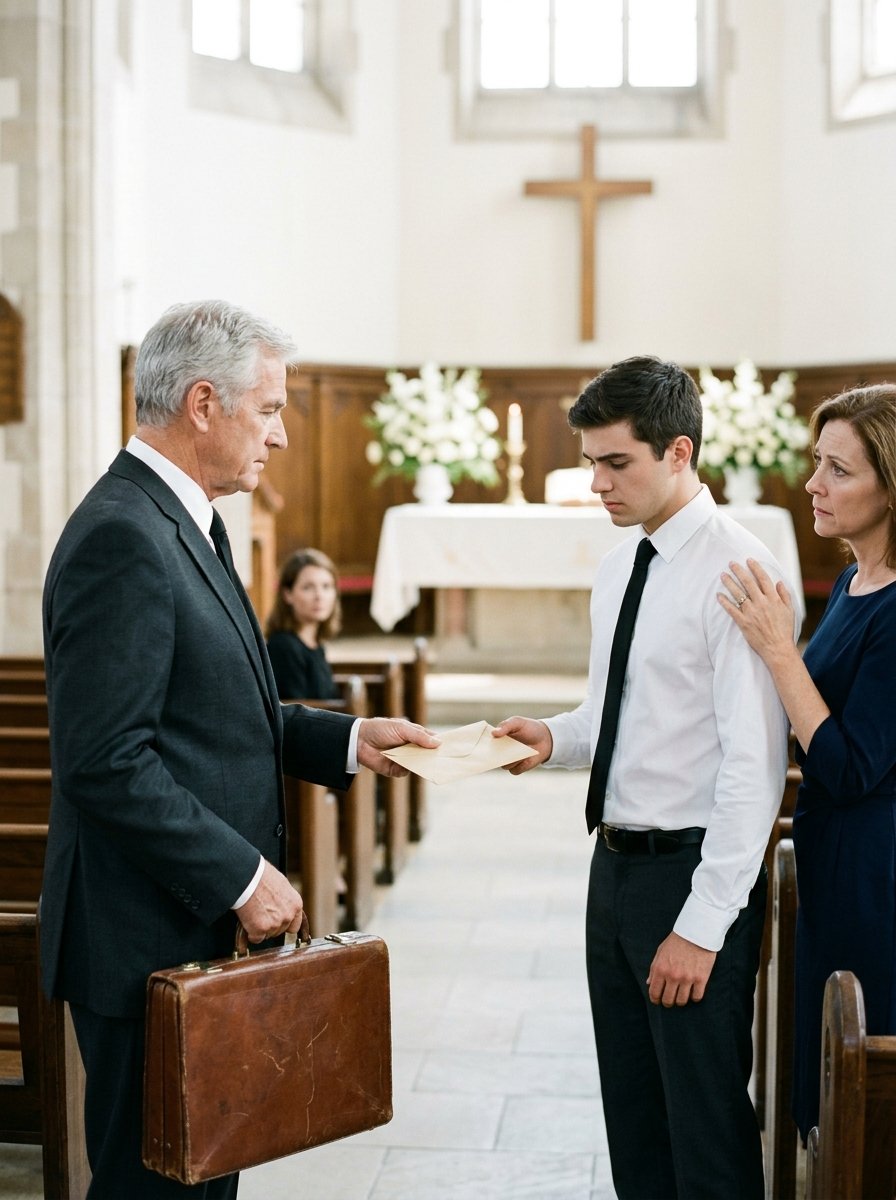
My mother stood up in the lawyer’s office and said, very calmly, “That’s not possible. Gregory promised that to me.”
Three weeks later, she filed to contest the will. She said my father hadn’t been of sound mind. She said I’d manipulated him from overseas.
I almost let her have it all. I was tired. I was grieving. I didn’t want the company. I didn’t want a war.
Then Arthur Delgado called me.
Arthur was my father’s attorney. Seventy-three years old, semiretired, the only person my father ever trusted completely. He asked me to come to his office alone.
He set a blue leather ledger on the desk in front of me.
“Your father gave me this six months before he died,” Arthur said. “He told me if anything happened to him, you were to have it. Nobody else.”
It was my father’s handwriting. Eight years of it.
Every page documented money disappearing from the company. Fake vendors. Padded contracts. Shell companies. Millions of dollars.
And every shell company led back to my mother and Christopher.
My father had known. For years. He’d been quietly building a case. He’d hired a forensic accountant, a former federal investigator named Margaret Chen. He was weeks away from going to the authorities.
Then his heart stopped.
I took the ledger to Margaret. Margaret took it to the FBI.
Four months later, my mother and Christopher were arrested for fraud and embezzlement. Twenty-three million dollars over eight years.
My mother was sitting in the Rhode Island Women’s Correctional Facility, waiting for trial.
I thought it was over.
Then Margaret sent me that file.
“Why would she kill him?” I asked Margaret on the phone. “She was already stealing from the company. It was working. Killing him would only draw attention.”
“Unless he found out,” Margaret said quietly. “Unless he threatened to expose her.”
I thought about the blue ledger. My father’s careful handwriting. Eight years of it. He’d known. He’d been preparing to act. Maybe he’d confronted her.
Maybe that conversation had killed him.
“I need to see her,” I said. “I need to look her in the eye and ask her.”
The women’s prison in Cranston is a gray concrete building that seems to soak up all the light around it. I sat in a small visitation room with a metal table bolted to the floor and waited.
When they brought my mother in, I barely recognized her.
The elegant, calculating woman who’d tried to take my inheritance was gone. Florence Prescott had always been the best-dressed woman in any room. Pearl earrings. Perfect hair.
The woman who sat down across from me was wearing prison scrubs. Her hair was gray at the roots. She looked twenty years older than she had four months ago.
“Hello, Alyssa.” Her voice was flat.
“Hello, Mother.”
We stared at each other across the table. The silence stretched out between us.
“I need to ask you something,” I said finally. “And I need you to tell me the truth.”
She laughed. It was a bitter little sound. “The truth. That’s a luxury I haven’t had in a long time.”
“Did you kill Dad?”
The question hung in the air.
My mother’s face went through a series of emotions. Shock. Then anger. And then something I didn’t expect at all.
Genuine confusion.
“What? No. No. I stole from him. I lied to him. I manipulated him. But I didn’t kill him.”
“You expect me to believe that?”
“I expect you to believe whatever you want.” She leaned forward. Her eyes went suddenly sharp. “But I loved your father. In my own twisted way, I loved him. I would never have killed him.”
“Then why was money from your trust paying for his prescriptions? Under a dead doctor’s name?”
My mother went very pale.
“What trust?”
“The family trust. You’re listed as trustee.”
“I’ve never been trustee of anything. Gregory never would have allowed that.” She stared at me. “Somebody put my name on it.”
“Who?”
She was silent for a long time. Her hands were shaking on the table.
Then she said something that changed everything.
“Ask your Uncle Robert.”
I didn’t have an Uncle Robert.
I spent the whole drive back to Providence trying to remember. Had my father ever mentioned a brother? There were no photographs. No family stories. No uncle at Thanksgiving. Gregory Prescott was an only child. That’s what I’d always been told.
I called Margaret from the car.
“Robert Prescott,” she said after a few minutes. “Born 1961. Five years younger than your father. Died in a car accident in New Hampshire in 1994. Car went into a river. Body was never found.”
“Body was never found,” I repeated. “Just like Dr. Reeves.”
There was a long silence on the line.
“Then we’re dealing with something much bigger than a family fight over money,” Margaret said.
“I need to talk to Arthur.”
The next morning, I drove to Arthur Delgado’s office downtown.
His receptionist was a young woman named Kayla. She looked nervous the second I walked in.
“Mr. Delgado hasn’t been in for three days,” she said. “He said he was driving up to his cabin in Vermont. But his daughter called yesterday. He never got there.”
My blood went cold.
“Did he say anything before he left? Anything unusual?”
She hesitated. Then she opened a desk drawer.
“He said if anybody came looking for him, I should give them this. He said especially if it was you.”
She handed me a sealed envelope. My name on the front, in Arthur’s neat handwriting.
I opened it in my car. My hands were shaking.
Alyssa,
If you are reading this, something has happened to me. Robert found out I had the ledger. He knows everything now.
Your father did not die of a heart attack. He was poisoned. Slowly, over months. The medication was switched by someone he trusted. Someone who had access to his food, his drinks, his daily routine.
It was not your mother. She is a thief. She is not a killer.
The man who murdered your father has been hiding in plain sight for thirty years. He changed his name. He changed his face. And he waited.
Look at the photographs in your father’s house. Your grandmother’s eightieth birthday party. There is a man in the background, near the garden. Tall. Gray hair. That is him.
That is Robert.
He wants the company. He wants everything. And he will kill anyone who stands in his way.
I am sorry I could not protect you better. Your father made me promise.
Be careful, Alyssa. Please. Run if you have to.
Arthur.
I didn’t run.
I drove straight to the house on Benefit Street.
The old Prescott house. Three stories of brick and white trim, built in 1890. The house where I learned to ride a bike on the sidewalk out front. Where my father taught me to play chess in his study. The study where they’d found him on the floor.
I hadn’t spent a single night in it since the funeral.
The family photo albums were in the attic. My grandmother kept everything. Thirty boxes of photographs, all labeled in her careful handwriting.
It took me two hours to find the right one.
Grandma Prescott’s eightieth birthday. June 2009. The backyard. A white tent, round tables, paper lanterns strung through the old maple tree. My father in a blue blazer with his arm around Grandma. Me at nineteen, home from my first year at West Point, in a sundress I’d hated.
I went through every photo slowly.
On the sixth page, I found him.
He was standing at the very edge of the frame. Near the rose garden. Apart from the crowd. Holding a glass of wine. Not smiling.
Watching my father.
Tall. Gray-haired. Expensive suit.
I held the photo up to the attic light and stared at his face. Looking for something familiar. Something that would explain how a stranger could be my father’s brother.
And then I saw it.
The same sharp jawline. The same deep-set eyes. The same slight crook at one corner of the mouth when he wasn’t trying to smile.
My father’s face. Thirty years of somebody else’s life laid over it.
I took a picture of the photograph with my phone and sent it to Margaret.
She called back in eleven minutes.
“We ran facial recognition,” she said. Her voice was strange. “It matches a current identity. Richard Harmon. Founder and CEO of Harmon Industries. Respected businessman. Philanthropist. Sits on four corporate boards in New England.”
“Which ones?”
A pause.
“Alyssa. He sits on the board of Prescott Regional Builders. He’s been on it for eleven years.”
The floor dropped out from under me.
Richard Harmon. I’d met him. He came to my father’s funeral. He shook my hand at the reception and said, “Your father was a remarkable man. You must be very proud.”
He’d held my hand a second too long. I remembered thinking his grip was cold.
“Eleven years,” I said. “He’s been sitting at the same table as my father for eleven years.”
“Waiting,” Margaret said.
It started to make sense then. All of it.
Robert had come back with a new name and a new face. He’d built his own company, quietly, for twenty years. Then he’d worked his way onto my father’s board. Close enough to watch. Close enough to learn everything.
Close enough to find a weak spot.
“He found my mother,” I said. “And Christopher.”
“That’s my guess,” Margaret said. “Greedy, unhappy people with access. He probably introduced the whole fraud scheme to them. Let them steal. Let them take the risk. Kept his own hands clean.”
“And when my father found out about the fraud—”
“Robert couldn’t let him go to the FBI. Because the investigation would lead past your mother. All the way back to him.”
“So he killed my father. And set it up so if anybody ever looked, it would point to my mother’s name on the trust.”
“It’s perfect,” Margaret said quietly. “If no one asks questions, Gregory died of a bad heart. If someone does ask questions, the woman already going to prison for fraud takes the blame for murder too. Either way, Robert walks away.”
“What about Dr. Reeves?”
“I’m working on that. I don’t think he’s dead either. I think Robert scared him into disappearing and took over his identity for the prescriptions.”
“Where’s Harmon now?”
Margaret was quiet a second.
“Alyssa. I flagged his car this morning with a contact at the state police. His phone too, through a warrant on the Reeves case. He’s in Providence.”
“Where in Providence?”
Another pause.
“Benefit Street. He’s been at your father’s house for the last hour.”
I looked at the window of the attic. I hadn’t heard a car. I’d been up here for three hours with the photos.
“Margaret,” I said quietly. “I’m at my father’s house.”
“Get out. Right now. I’m calling the police. Get out of that house.”
I hung up.
And I went down the stairs.
I know what you’re thinking. I’ve thought it a thousand times since.
Why didn’t I go out the back? Why didn’t I lock myself in the attic and wait for the sirens?
The honest answer is twelve years of Army training and three months of grief. Somebody was in my father’s house. The house where he died. And I wanted to see his face.
The second floor was dark. The main floor was dark.
Except for one light.
The study.
The door was half open. I could see the green glass lamp on my father’s desk.
I walked down the hallway without making a sound. I’d cleared a hundred buildings in Kandahar. I knew how to move through a house.
He was standing at my father’s desk with his back to me.
He was holding the blue ledger.
Arthur’s copy. The original was with the FBI. But Arthur had made a second one for himself, in case anything happened.
And now Robert had it.
“Hello, Alyssa,” he said without turning around. “I wondered when you’d figure it out.”
He turned. He looked exactly like the photograph. Older. Thinner. But unmistakably the same man.
My father’s face. Wearing a stranger’s life.
“Where’s Arthur?” I said.
“Somewhere quiet.” He set the ledger down on the desk carefully. “He’s alive, if that’s what you’re asking. For now. I needed to know who else he’d talked to.”
“You killed my father.”
“I did what was necessary.”
“He was your brother.”
“He was never my brother!”
His voice cracked across the room like a whip. For a second, the polished businessman was gone, and something raw and ugly looked out of his eyes.
“He was my competitor. My rival. From the day I was born, Gregory was the golden child. The smart one. The one Father took to the job sites. The one who got the company. The inheritance. Everything.”
He breathed hard.
“I got told to be more like Gregory. For thirty years. Be more like your brother.”
“So you faked your death.”
“I drove my car into the Pemigewasset River in 1994 and walked away. I built a new man from nothing. And I waited.”
“Thirty years,” I said.
“Thirty years.” He smiled. It was a cold, thin thing. “And it was perfect, wasn’t it? Your mother and her idiot husband took the fall for the fraud. You were overseas playing soldier. Lucas was too young and too scared to see anything. And your father—”
He picked up a framed photo from the desk. Me and my dad at my West Point graduation. He looked at it.
“Your father died thinking his whole family had betrayed him. His wife. Her husband. His company. That was the part I enjoyed the most.”
I didn’t move. I didn’t let my face move.
“How did you do it?”
“Gregory had a weak heart. Everyone knew. He took four pills a day. I simply arranged for one of them to be something else. A little at a time. For five months.” He shrugged. “Doctor Reeves’s prescription pad was very useful. So was his signature.”
“Where is Reeves?”
“Somewhere he’s very afraid of me.”
“And the trust in my mother’s name?”
“Insurance. In case someone like you started asking questions.”
He set the photograph down. Then he reached slowly into the inside pocket of his jacket.
He took out a syringe. The needle caught the green light from the lamp.
“You’re going to kill me too,” I said. “Just like Dad.”
“I’m afraid so. Same medication, actually. Much larger dose. The coroner will call it a heart attack. Congenital. Runs in the family. The grieving daughter, buried right beside her beloved father.”
He took one step toward me.
“It’s almost touching.”
“Except I’m not going to let that happen,” I said.
I moved first.
He was expecting a woman frozen with fear. He wasn’t expecting someone who’d spent twelve years training for exactly this moment.
I stepped inside his reach. I caught his wrist with both hands and twisted hard. He cried out. The syringe hit the floor and rolled under the desk.
Robert was stronger than he looked. He drove his shoulder into me and slammed me back against the bookshelves. Books came crashing down around us. My father’s books. The leather-bound Dickens. The construction manuals. The chess strategy books he’d read to me when I was eight.
I rolled away. I came up swinging and caught him square in the jaw with a right hook.
His head snapped back. Blood ran from his lip.
“You think you can beat me?” he snarled. “I’ve been planning this for thirty years!”
“And I’ve been fighting for my life since I was nineteen,” I said.
He came at me again. I grabbed the brass fireplace poker from the stand beside the hearth and swung it. It connected with his shoulder. He howled.
But he didn’t stop.
He lunged at me with everything he had. We crashed through the French doors behind my father’s desk. Glass exploded around us. We spilled out onto the stone patio in the cold March night.
We rolled across the wet stones. He got a hand around my throat. I drove my knee up into his ribs. He let go. I got on top of him and pinned his arm behind his back the way they teach you at the academy.
He was gasping. So was I. My arm was bleeding from the glass. I didn’t feel it.
Then I heard the sirens.
Faint at first. Then louder. Then everywhere at once. Blue and red lights sweeping across the bare maple tree in the backyard. The same tree where the paper lanterns had hung at my grandmother’s party.
Margaret Chen had tracked my phone. She’d known exactly where I was. And she’d brought half the Providence Police Department with her.
Robert heard them too.
He stopped struggling. He turned his head on the wet stones. For the first time, I saw fear in his face.
“It’s over,” I said. “You’re done.”
He looked up at me. Really looked at me.
Something shifted in his expression. Not remorse. Not regret.
Recognition.
“You’re just like him,” he whispered. “Just like Gregory. You never give up.”
“No,” I said. “I’m better than him. He trusted you. I didn’t.”
Police officers came around the side of the house with their guns drawn. I raised my hands and stepped back.
They put Robert Prescott face down on my father’s patio and cuffed him.
Margaret came running through the gate behind them. She was sixty-two years old, in a raincoat, and she was out of breath.
“You absolute idiot,” she said. Then she hugged me so hard my ribs hurt.
They found Arthur Delgado two days later.
He was alive. Robert had kept him locked in the basement of an empty rental property in Woonsocket. No food for two days. Dehydrated. Confused. But alive.
I visited him in the hospital. He was sitting up in bed with an IV in his arm and a cup of hospital Jell-O on the tray.
“I told you to run,” he said.
“You did.”
“You didn’t listen.”
“No, sir.”
He looked at me for a long moment. Then his eyes filled.
“Your father wouldn’t have listened either,” he said. “Damn you both.”
I held his hand. “Thank you for the ledger, Arthur. For keeping it safe. For everything.”
“He made me promise,” Arthur said. “Six months before he died, he sat in my office and said, Arthur, if anything happens to me, you make sure Alyssa knows the truth. Not Florence. Not the board. Alyssa.”
He squeezed my hand.
“He knew something was wrong, you know. Near the end. He said his heart felt different. He said he couldn’t explain it. He thought it was stress.”
I couldn’t speak.
“He was going to tell you everything,” Arthur said. “When you came home on leave in April. He had it all planned. He was going to take you to lunch at that place on Federal Hill and tell you everything.”
My father died on March 14.
I was supposed to come home on April 3.
Three weeks later, Dr. Harold Reeves walked into the FBI’s field office in Boston.
He’d been living in a trailer outside Bangor, Maine, under a fake name, for a year. Robert had shown up at his office one night with photographs of Reeves’s daughter and granddaughter, walking to school. He told Reeves to disappear. To fake a drowning. Or else.
Reeves had done it. He’d lived in terror for a year, reading the news every day, watching Robert use his name and his license.
When he saw on the news that Richard Harmon had been arrested, he got in his car and drove six hours straight to Boston.
“I’m the one who should be on trial,” he told the agents, crying. “I let him do it. I knew someone would die, and I ran away.”
The trial of Robert Prescott, also known as Richard Harmon, was the biggest case Rhode Island had seen in decades.
Reporters filled the courthouse steps every morning. It was on the national news. Dead Man Comes Back to Kill Brother. The tabloids loved it.
I sat in the second row every single day. In uniform. I’d been granted extended leave.
The evidence was overwhelming. The blue ledger. The financial records Margaret had spent seven months tracing. The forged trust documents. The pharmacy records under Dr. Reeves’s name.
Dr. Reeves testified for two days. His hands shook the entire time.
Arthur testified about the basement in Woonsocket. About how Robert had sat on a folding chair across from him and asked, over and over, who else knew.
And then my mother took the stand.
She’d agreed to testify in exchange for a reduced sentence on the fraud charges. I didn’t know what she would say. I hadn’t spoken to her since the prison visit.
She sat in the witness chair in a plain gray dress. No pearls. She looked at the jury. Then she looked at me.
“He came to me fifteen years ago,” she said. Her voice was steady for the first time in months. “At a charity gala. He said his name was Richard Harmon. He said he’d been watching our company. He said Gregory was weak. That he didn’t appreciate what he had. That I deserved more.”
She swallowed.
“He told me how to do it. The vendors. The shell companies. Who to talk to. He introduced Christopher to me. He made it seem so easy.”
The prosecutor asked her if she’d known Richard Harmon was really her husband’s brother.
“No,” my mother said. “I never knew. I never knew Gregory even had a brother. Gregory never once spoke his name. I think he thought Robert was dead, and it hurt too much.”
The prosecutor asked her if she’d known Robert intended to kill her husband.
My mother looked straight at me.
“I didn’t know he was going to kill him,” she said. “I swear to God I didn’t know. I was a thief. I was a selfish, terrible wife. But I didn’t know.”
Then she started to cry.
“I’m sorry, Alyssa,” she said, right there on the witness stand. “I’m so sorry.”
I didn’t say anything. I couldn’t.
The jury deliberated for four hours.
Guilty of first-degree murder. Guilty of attempted murder. Guilty of kidnapping. Guilty of fraud and conspiracy.
The judge sentenced Robert Prescott to life in prison without the possibility of parole.
When they led him out of the courtroom, he looked back over his shoulder. Not at the judge. Not at his lawyers.
At me.
I looked right back at him. I didn’t blink.
He turned away first.
My mother got eight years for the fraud, reduced for her cooperation. Christopher got twelve. He never apologized to anybody.
Lucas was cleared of all charges. He’d never known anything about the money. He’d just been running restaurants and trying to make his stepfather proud.
He found me on the courthouse steps after the sentencing. He was twenty-six years old and he looked about fifteen.
“I’m sorry,” he said. “About everything. About your dad. He was always good to me. Better than my own father.”
“You didn’t do anything wrong, Lucas.”
“I didn’t do anything at all,” he said. “That’s sort of the problem.”
I looked at him for a long time.
“Do you want to keep working at the company?”
He blinked. “After all this? You’d let me?”
“My father thought you were good at your job. He wrote it in the ledger. Page forty-one. ‘Lucas is honest. Lucas works hard. Lucas doesn’t know.’”
Lucas put his hand over his mouth.
“I need people who are honest,” I said. “And who work hard. Think about it.”
He thought about it for about two seconds.
“Yes,” he said.
One year later, I stood on the front steps of the house on Benefit Street and watched the sun come up over Narragansett Bay.
The house had been restored. New paint. New windows. The French doors in the study had been replaced with ones exactly like the old ones. I’d had the carpenter match the trim by hand.
The company had a new name. Prescott Family Enterprises. New board. New accountants. An outside auditor that Margaret picked herself. A whistleblower hotline that went straight to Arthur, who’d come out of retirement just to run it.
“I’m too old for this,” he said every Monday morning. And then he came in every Monday morning anyway.
Lucas ran the restaurant division. He was better at it than anybody expected, including himself. He’d opened two new locations. He named one of them Gregory’s.
I left the Army. It was the hardest decision I ever made. But someone had to run my father’s company. And I’d learned something important that year.
Fighting for your country and fighting for your family aren’t as different as you’d think. You stand up. You don’t look away. You finish what you start.
My mother wrote to me from prison. Every two weeks.
Her letters were short. Careful. Full of apologies I wasn’t ready to accept yet. She asked about the house. About the roses in the backyard. About whether I was eating enough.
I read every one. I kept every one in a shoebox in my father’s study.
I haven’t written back yet. But I’m thinking about it. Someday, maybe.
And then there was Marcus.
Marcus Chen. Margaret’s son. A former Navy SEAL who now worked as a security consultant. He’d helped his mother with the investigation that winter, mostly by following me around Providence without my knowledge to make sure I didn’t get myself killed.
“You were very bad at following me,” I told him once.
“I was extremely good at following you. You just figured it out because you’re paranoid.”
“I prefer observant.”
“You’d pick a fight with a fire hydrant.”
We met properly during the trial. We bonded over bad coffee in the courthouse cafeteria and shared stories about deployments and the strange loneliness of coming home. Somewhere between the depositions and the verdict, we fell in love.
Margaret pretends she didn’t plan it. Nobody believes her.
Marcus came out onto the porch behind me that morning with two cups of coffee. He handed me one. He stood beside me and watched the sun come up.
“You okay?” he asked.
“Yeah. I think so.”
“You did it, you know. You won.”
“We won,” I said. “All of us. You. Your mother. Arthur. Dr. Reeves. Even Lucas.”
“Even your mother?”
I thought about that for a long time.
“Maybe,” I said. “In the end.”
We went inside. I walked down the hallway to my father’s study.
His chess set was still on the desk. Mid-game. The last game we ever played, over video call, from Fort Bragg. He’d been winning. He always won.
On the wall above the fireplace, I’d hung the photograph from Grandma’s eightieth birthday. All of it. Every face.
Including the tall gray-haired man standing alone by the roses.
Marcus looked at it.
“You kept him in the picture?”
“I kept everybody in the picture,” I said. “That’s what happened. That’s our family. All of it. If I cut him out, I forget. And if I forget, it can happen again.”
He nodded slowly.
Next to the photograph, I’d hung one more thing. A single page I’d had framed. The very last page of the blue ledger. In my father’s handwriting. Dated March 2. Twelve days before he died.
I know something is wrong. I don’t know who yet. But I know this. Alyssa will finish it if I can’t. She has never once in her life walked away from something that was right. I am more proud of her than I have ever told her. I should have told her more.
I read it every morning.
My father didn’t leave me a house, a company, and a fortune.
Well. He did. But that’s not what he really left me.
He left me the truth. And he trusted me to carry it.
Marcus put his hand on my back.
“What now?” he said.
I looked at my father’s handwriting one more time. Then I turned away from the wall and smiled at the man beside me.
“Now,” I said, “we live.”